
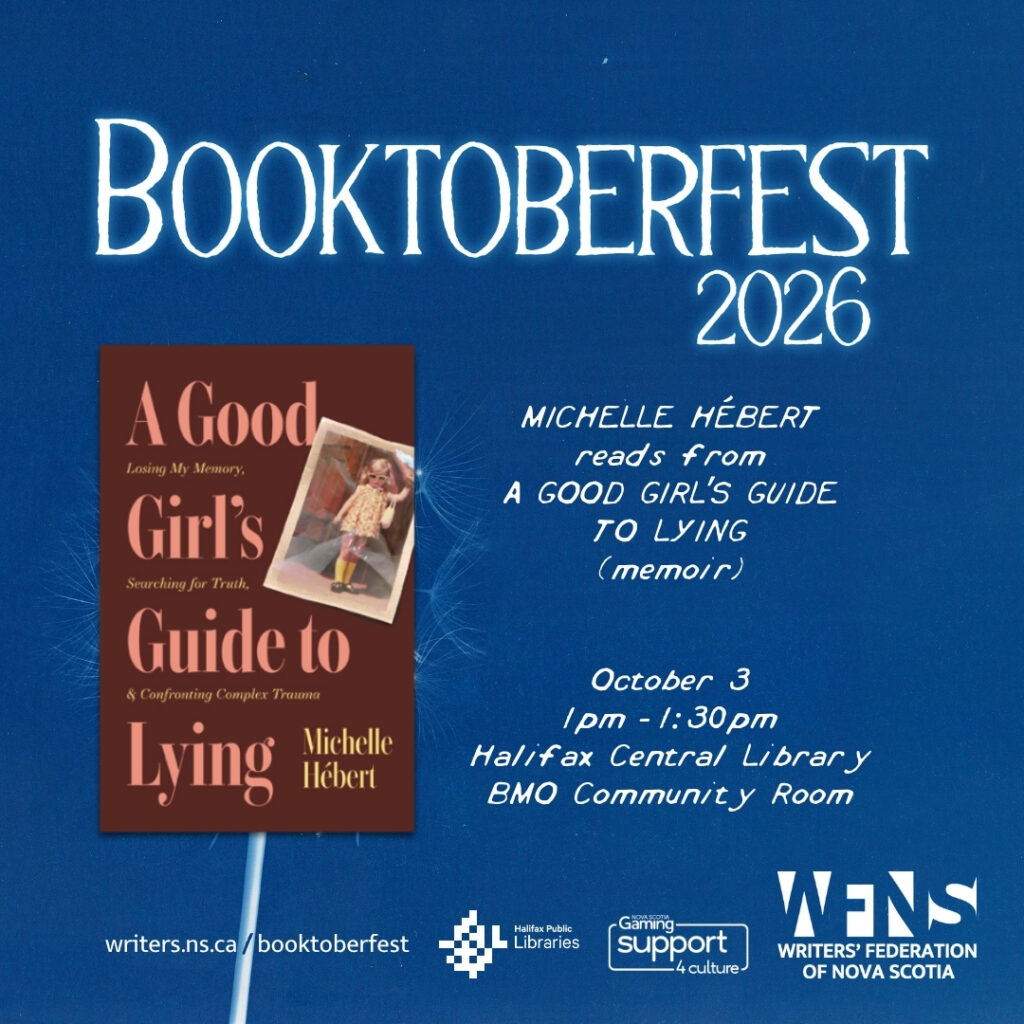
Michelle Hébert reads from A Good Girl’s Guide to Lying (Halifax)
Join us at Booktoberfest 2026 for a reading and Q&A with author Michelle Hébert, who will read from her memoir A Good Girl’s Guide to Lying: Losing My Memory, Searching for Truth, & Confronting Complex Trauma (Nimbus Publishing):
On paper, Michelle Hébert was a successful, high-functioning woman. A former social worker turned government executive, a mother of two, a wife, a published author. But there was a secret about her that nobody knew—one that her own brain was trying to keep from her. One that was destroying her from the inside out. Why couldn’t she recognize herself in mirrors? Why did her mind disconnect from her body for long periods, leaving her to deal with decisions she made while she was dissociated—like finding herself walking down the aisle at a wedding she didn’t remember planning? Why couldn’t she shake the gnawing fear that something was very wrong with her brain, or that she’d done something terrible?
A mystery disguised as a memoir, this deeply layered story of complex trauma takes readers on one woman’s search for decades of memories lost. Gaslighted by misogyny and a broken health-care system, and forced to reinvent herself over and over again, Michelle must piece together the fragments of her past to uncover what happened one August afternoon in the 1980s.
A sometimes heartbreaking, often darkly humorous, and ultimately redemptive memoir of identity, resilience, and resistance, and a compelling testament to the lengths our brains will go to protect us, A Good Girl’s Guide to Lying is a powerful reminder that it’s never too late to become who you really are.
Michelle will sell and sign copies before and after this reading as part of Booktoberfest’s book market.
Michelle Hébert writes about poignant topics with dark humour. Her debut novel, Every Little Thing She Does is Magic, was a Toronto Star 2024 ‘Must Read’ and a 49thShelf.com ‘Book of the Year’. Her new book, A Good Girl’s Guide to Lying, is a mystery disguised as a memoir. With a structure mimicking her fractured memories, it encourages readers to question whose truth society values.
Michelle has degrees in social work and creative writing and coaches writers using trauma-informed practices. She lives in Halifax with four cats and a dog who thinks she’s a cat.

Location: BMO Community Room (2nd floor), Halifax Central Library (5440 Spring Garden Rd, Halifax)
This is a wheelchair-accessible venue with all-gender and gendered washrooms.
Date: Saturday, Oct 3, 2026 (1:00pm to 1:30pm)
All are welcome!