

The Writers’ Federation of Nova Scotia (WFNS) will celebrate its 50th anniversary in September, 2026. As a part of this celebration, the Writers of Nova Scotia profile series aimed to explore and celebrate the diversity of writers across the province—including the variety of works they create and the range of backgrounds and experiences they draw from.
WFNS published 50 short-form profiles of Nova Scotian writers on the WFNS Instagram account between in spring and summer of 2026.
From February through June, any General Member who currently resided in Nova Scotia could submit a profile for possible inclusion. Profiles were selected by WFNS’s Membership & Engagement Committee.
All submitting writers were entered in draw to win a $200-value prize pack. The winning writer was Sarah Jane Conklin, whose profile was the 50th published.
Browse all Writers of Nova Scotia profiles below.
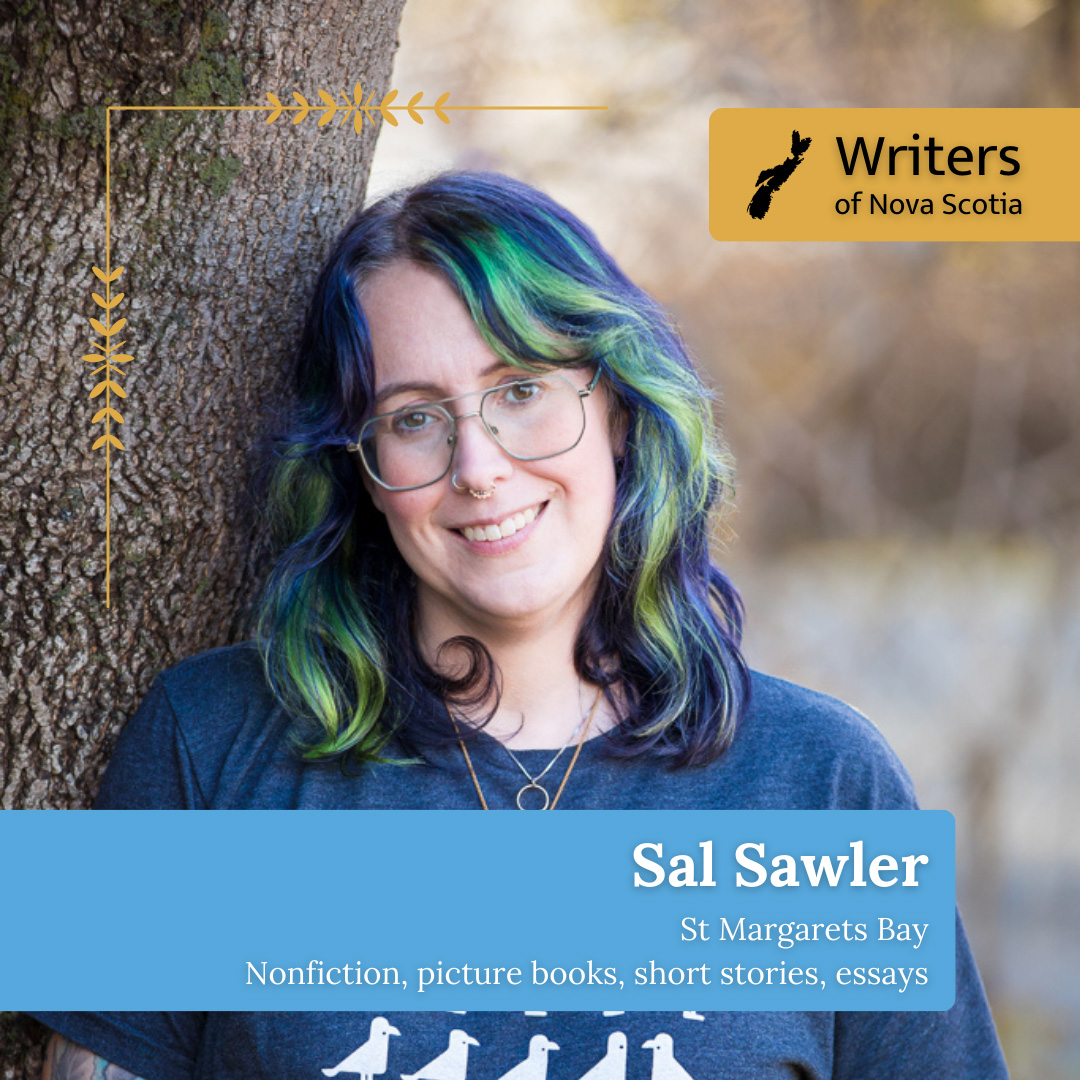
Sal Sawler is an author and educator living in Kjipuktuk / Halifax. Their books for young people have been shortlisted for the Forest of Reading, Hackmatack, and Canada Kids Reads and have earned a Moonbeam Children’s Book Award.
What’s your current work-in-progress?
I’m currently working on a new picture book, tentatively titled Sadie Needs Space, about an extroverted girl who doesn’t like having to be extroverted all the time.
What’s the best writing advice you’ve ever received?
Don’t worry about what other people think. There will always be someone who disagrees with what you have to say, and it’s better to be disliked for something you really believe than for something you think people want to hear.
When did you first feel confident calling yourself a writer?
I didn’t comfortable calling myself a writer until I was paid for my work, which is too bad because I’ve actually been a writer since I was young. Money doesn’t define the value of our work.
Any recommendations for NS writers & readers?
I’m going to go with Woozles Children’s Bookstore. The staff has supported me for a long time, as a writer and a friend, and we’re so lucky to have people who love children, children’s literature, and community in Halifax.
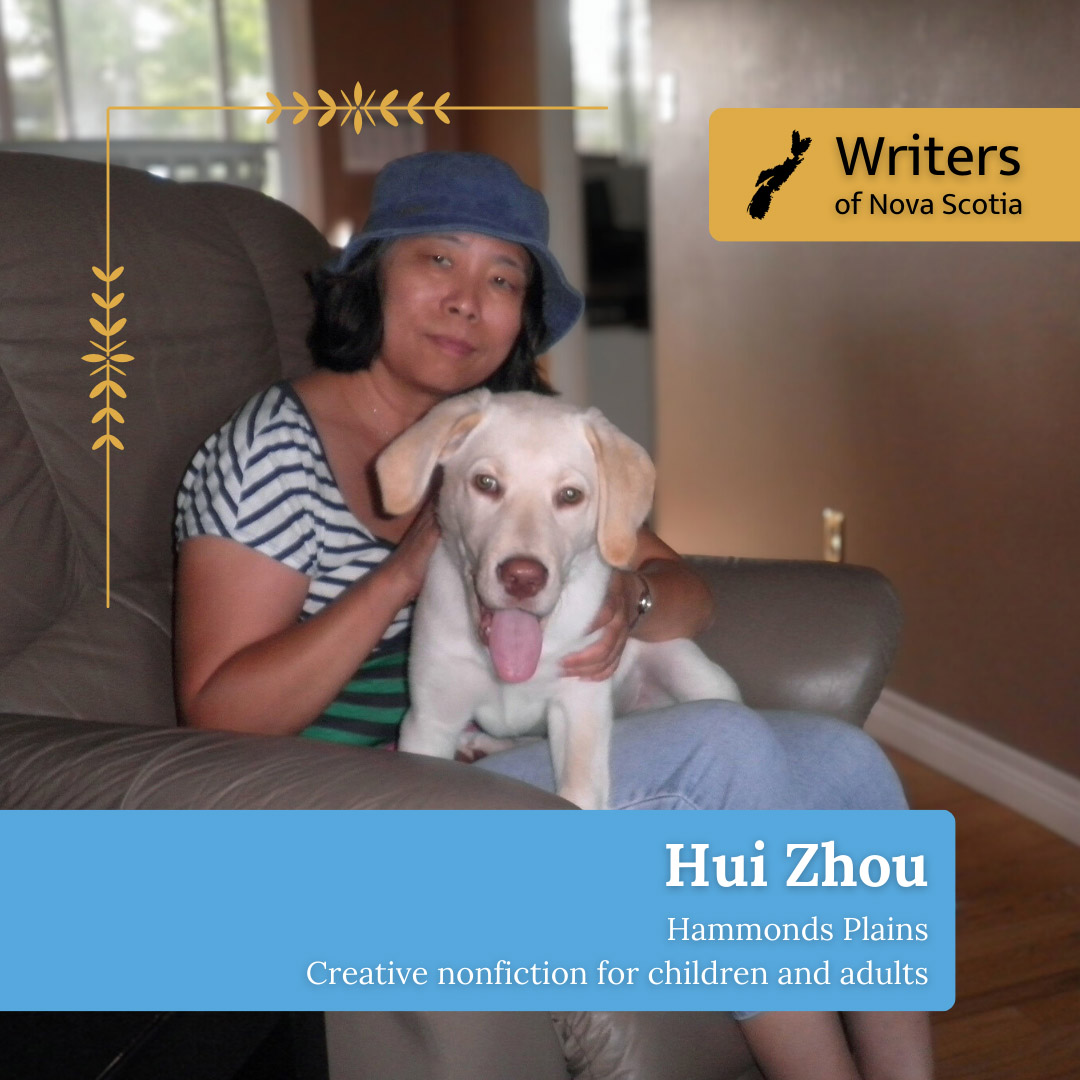
Hui Zhou is a retired entomologist and nonfiction writer who has been publishing since the 1990s. Her more recent works include “A Glance at an Old Newspaper” (2025) and two photographic nonfiction books for children: Running Wild with Bossy Boy (2018) and Puppy Oland (2023).
What’s your current work-in-progress?
I recently completed two nonfiction articles about two human-caused wildfires I personally experienced for nonfiction contests. I’m revising them while waiting for the contest results and thinking about my nonfiction collection, which will include published and unpublished stories.
What’s the best writing advice you’ve ever received?
A Surrey Muse Awards (2022) judge advised writing more personally in response to my longlisted story about my coincident connections to the Halifax Explosion. Accordingly titled “A Glance at an Old Newspaper” (and published 2025), it tells how history impacting my growth in NS.
When did you first feel confident calling yourself a writer?
Laid-off in 2016, I turned my long-term writing hobby to a career in English and in Chinese. Meanwhile, I became a WFNS Writers’ Council member and became involved in Writers In The Schools, focusing on nonfiction based on my science background, especially my expertise in entomology.
Any recommendations for NS writers & readers?
Tantallon Library: a cozy place to sit, read, write, and share. They provide various programs, warm drinks in winter…. Maybe some other libraries do the same thing, but for me, Tantallon is close, convenient, and friendly.
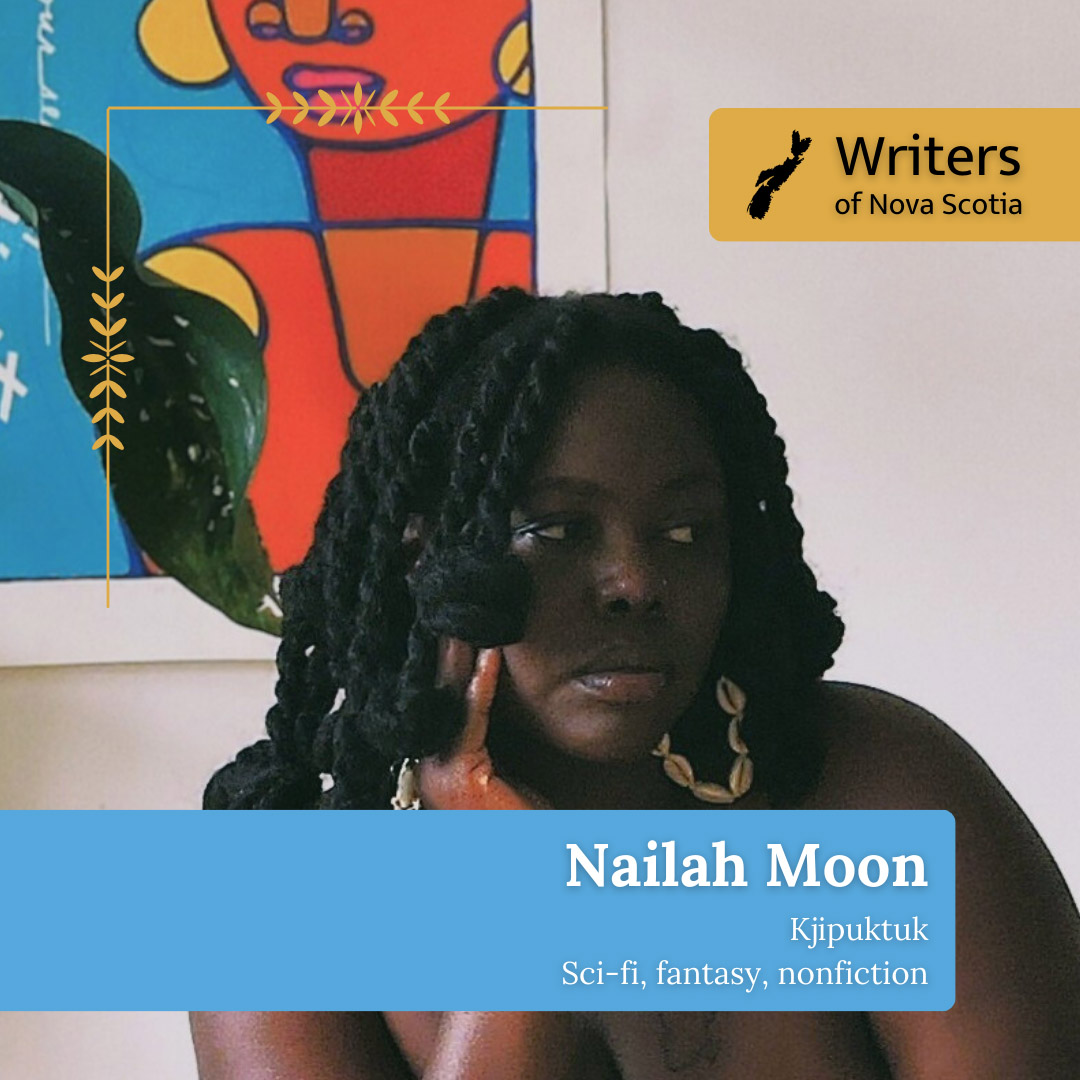
Nailah Moon is a Black queer writer, artist, and community worker based in Mi’kma’ki. They use speculative fiction as a tool to explore Black futures, Black liberation, and visionary abolition. From the Didigna Hills, South Sudan.
What’s your current work-in-progress?
I have finished my first draft of Under Space Over Time and am on to the next step of editing and completing my second draft of this work-in-progress.
What’s the best writing advice you’ve ever received?
The best advice I’ve received is this: “Accept that the first bit of writing you ever do is going to be garbage—so get that out of the way. You can make it better later.”
What’s a surprising source of inspiration for you?
I get the best creative ideas usually from mundane moments, like when I’m taking the bus. I wrote one of my first short stories while I was sitting on the #1 bus wondering about the perspective of a black hole!
Any recommendations for NS writers & readers?
I got the chance to interview Claudette Bouman last year, and what she said about writing as a Black author really inspired me. I always find gems of inspiration and knowledge from Black women in the writing world!
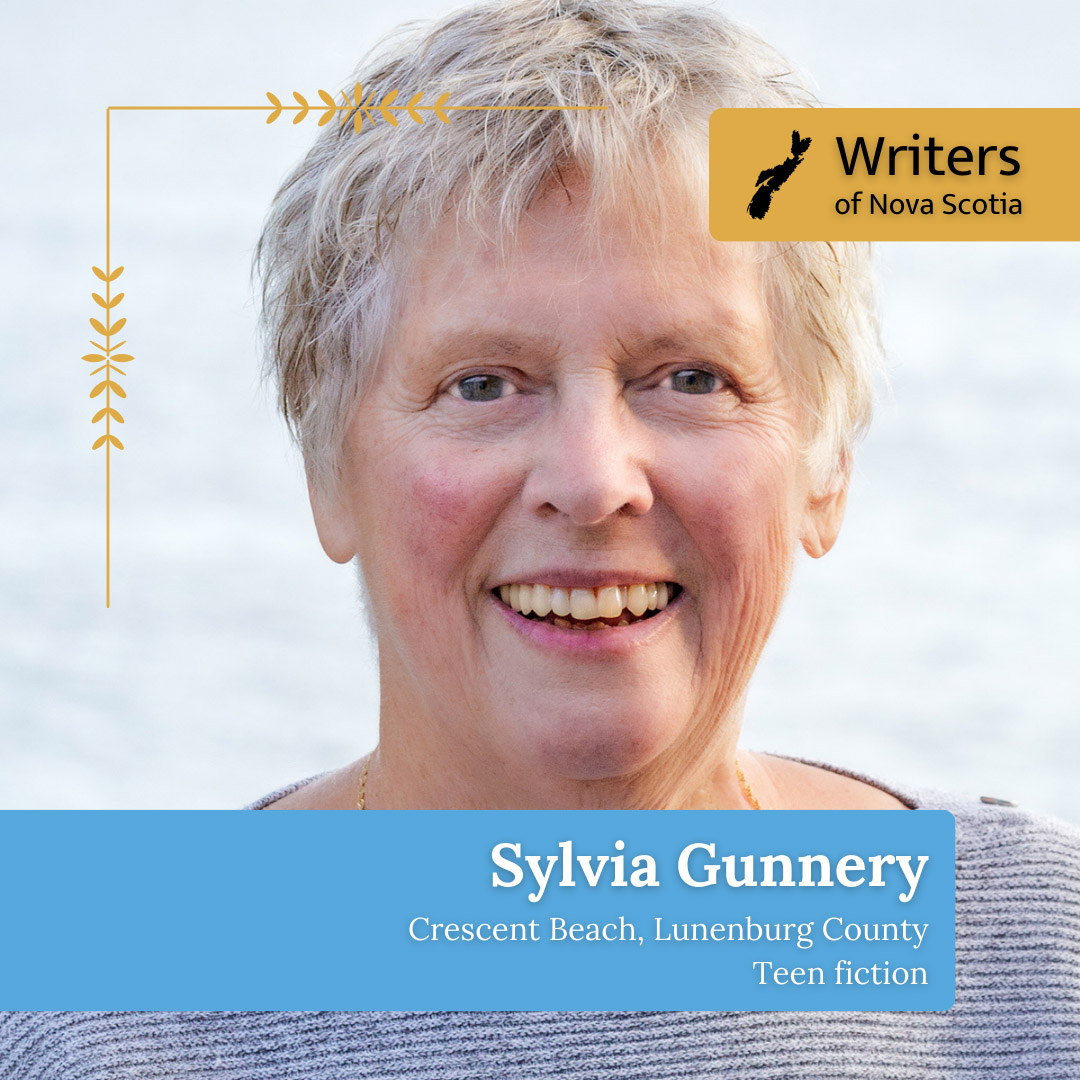
Sylvia Gunnery‘s writing career began 50 years ago, with WFNS support and inspiration ever since. She’s met thousands of readers through Writer In The Schools visits, encouraged new writers through workshops, mentorships, and manuscript reviews, and made many friends on boards, committees, and juries.
What’s your current work-in-progress?
What I know about next, my collection of YA linked stories, explores the individual and shared experiences of three diverse teens who become friends on the first day of high school.
What’s the best writing advice you’ve ever received?
When you’re not writing, read.
When did you first realize that stories matter?
Before I started school, my sister would read to me each night in the bedroom we shared on Hillside Avenue in Halifax. Black Beauty. Lassie Come Home. Beautiful Joe. Words in the air taking the shape of stories. Magical!
Any recommendations for NS writers & readers?
LaHave River Books turns 10 this summer, and I work there once a week. It’s a community space that reaches across our province and further. Regular readings by Nova Scotia writers are a popular excuse to gather there!
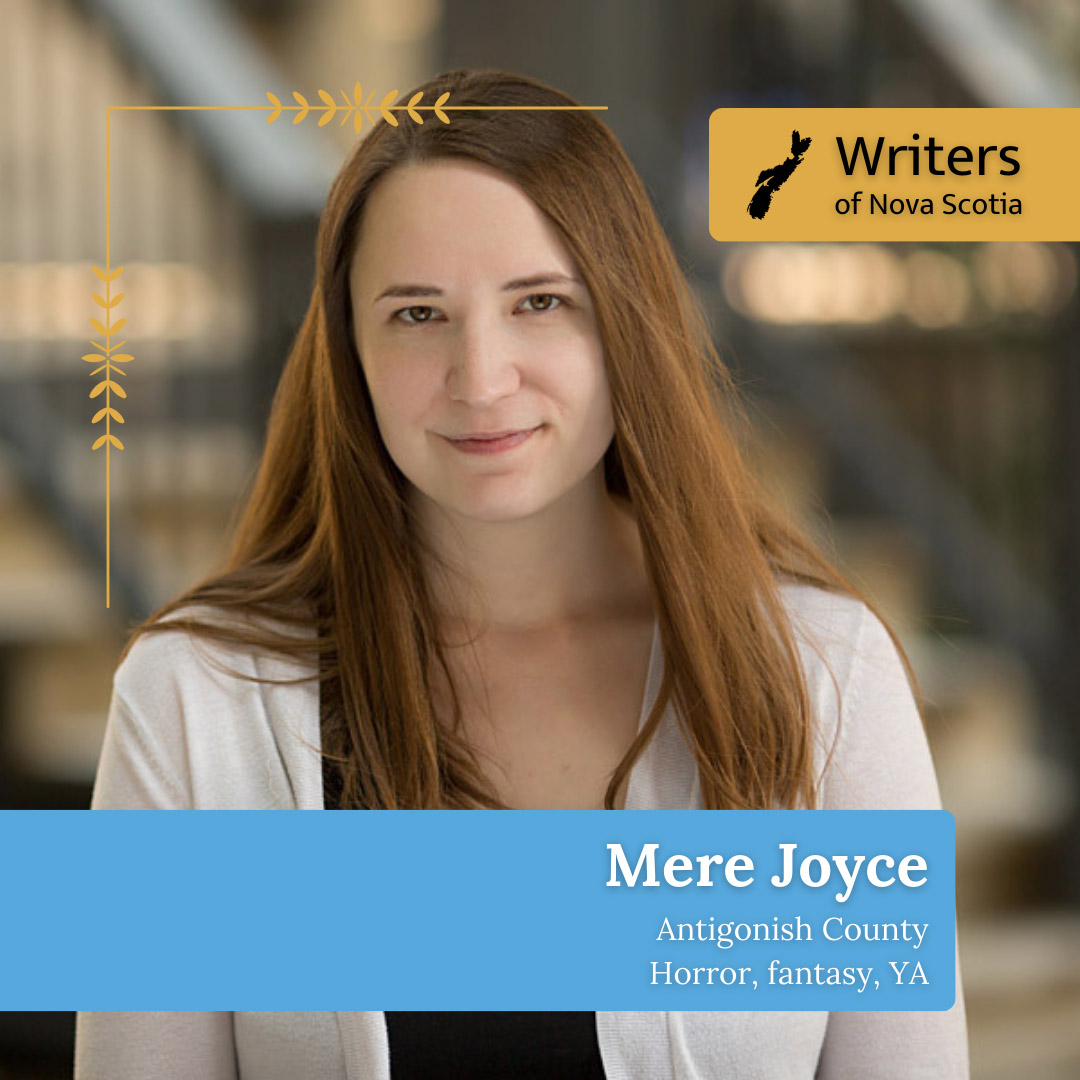
Mere Joyce is an author of short stories as well as longer works for middle grade, young adult, and adult audiences in genres including contemporary tales, mysteries, fantasies, and horror. When she’s not writing, Mere teaches library studies.
What’s your current work-in-progress?
My upcoming historical queer horror is titled As the Snow Gathers and will be released by Sourcebooks / Poisoned Pen Press in September.
What’s the best writing advice you’ve ever received?
My favorite writing advice has always been that writing without expecting to be rejected is like trying to box without ever being hit. Rejection is part of the process, and when it happens, you get back in the ring.
When did you first realize that stories matter?
Horror often deals with themes of “othering.” This realization helped me understand not only why I’ve always connected to these stories but also why they are so important to others who also feel “othered.”
Any recommendations for NS writers & readers?
My fellow NS horror writer Sarah L. Hawthorn, whose debut novel, A Fate Worse than Drowning, will be published this summer.
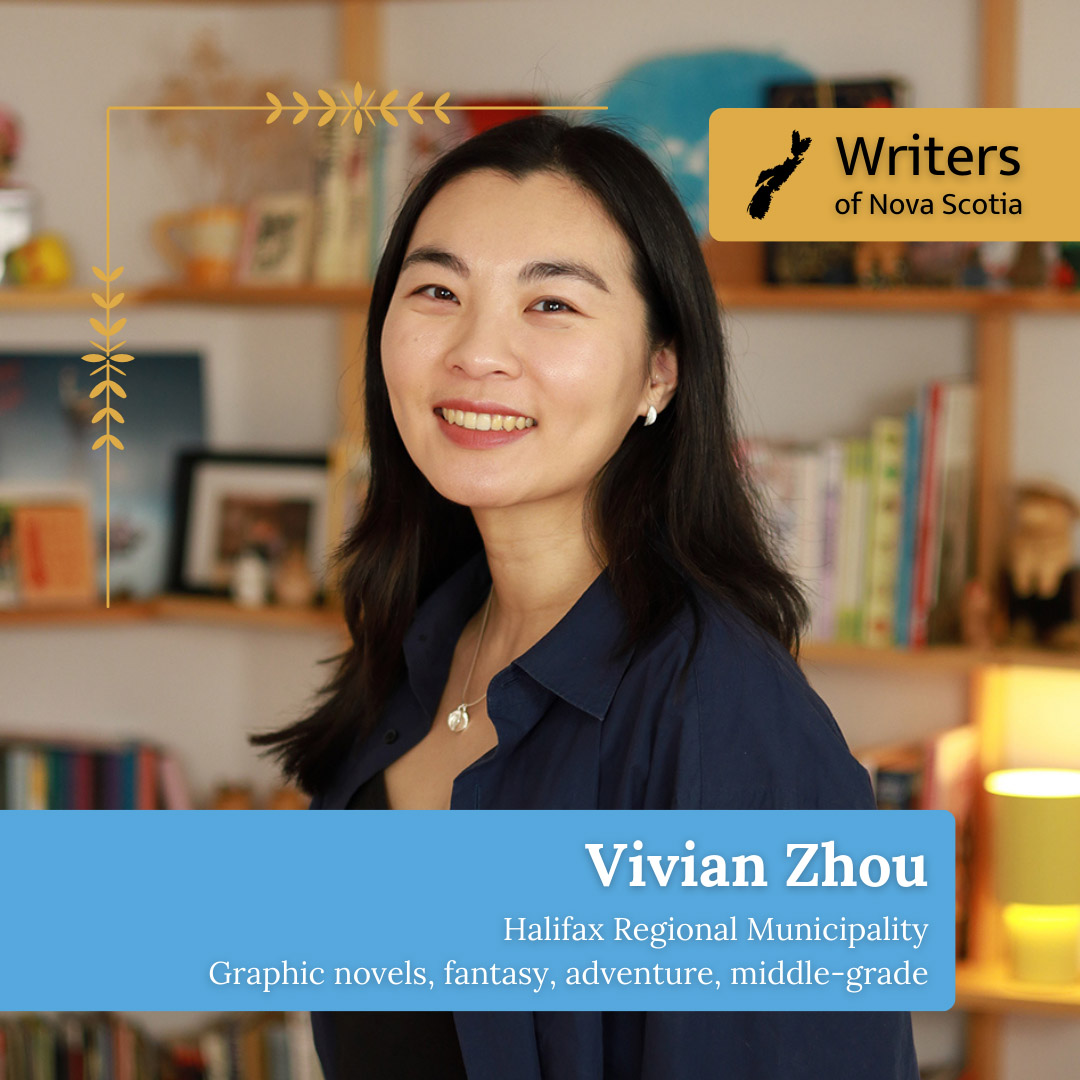
Vivian Zhou is a Chinese-Canadian graphic novel creator based in Halifax, Nova Scotia. She loves writing stories filled with magic, and her work often blends fantasy with personal narratives.
What’s your current work-in-progress?
I just wrapped up on my new graphic novel (which will be coming out in spring of 2027), so now I’m in the very fun stage of exploring new projects and comic ideas!
What’s the best writing advice you’ve ever received?
You don’t have to show your first draft to anyone, so just write it down, spelling mistakes and all. Fix it for the second draft. Just make it exist first.
When did you first realize that stories matter?
I’ve had my head in books since I was a little kid, so the importance of fiction has always been a given to me. But as I’ve grown, I’ve come to realize the importance of diversity in story, too.
Any recommendations for NS writers & readers?
Some of my favourite Halifax-area bookstores are Cape & Cowl Comics and Strange Adventures for all the comics you could want, Woozles for children’s books, and Egghead Books for general fiction!
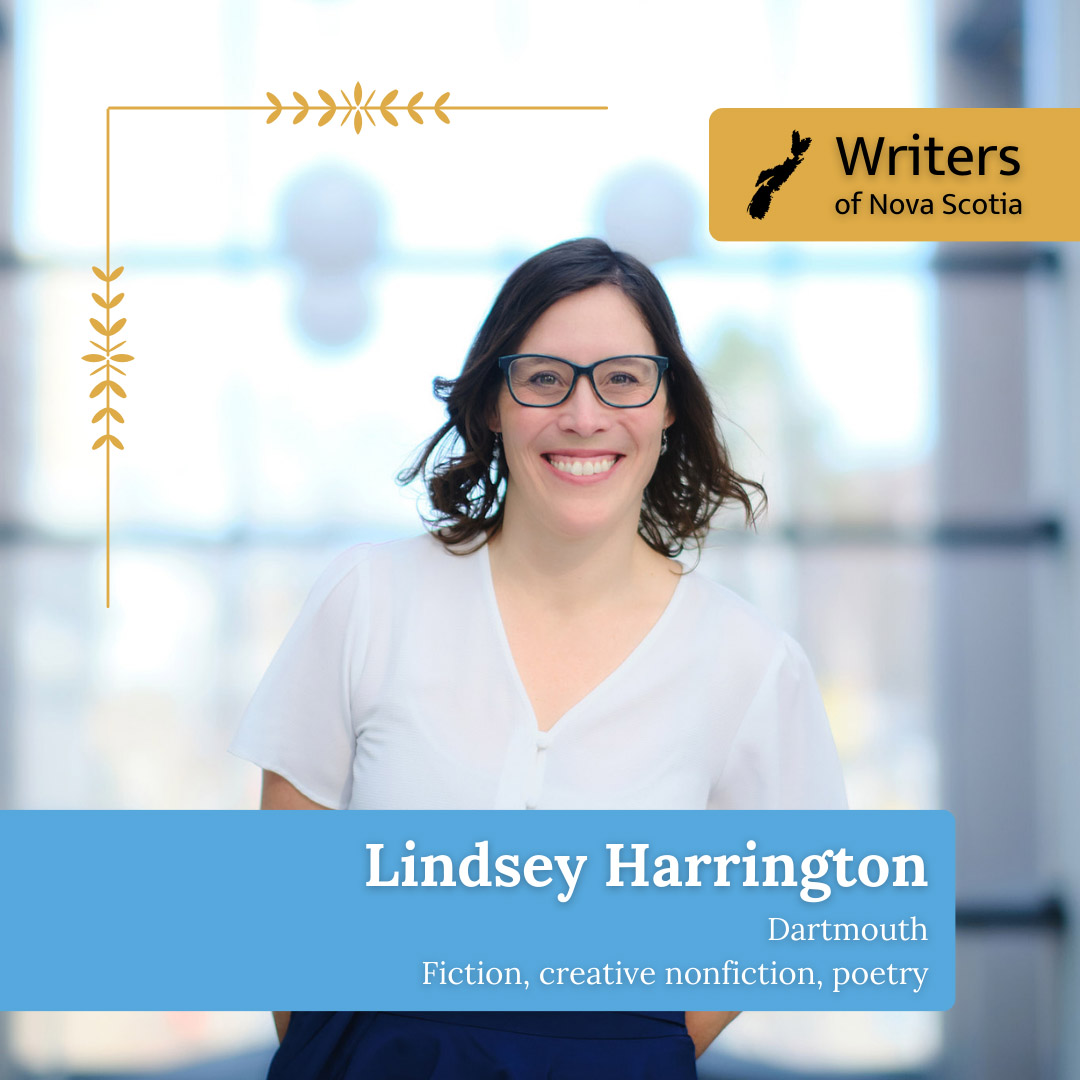
Lindsey Harrington is a Nova Scotian writer with Newfoundland roots who loves exploring societal issues through a personal lens in poetry, fiction, and nonfiction. Her debut, Nobody’s Mother: A Childfree Memoir, will be released in fall of 2026 with Nimbus Publishing.
What’s your current work-in-progress?
I just finished the final round of edits on my debut, Nobody’s Mother: A Childfree Memoir, and have started work on my next book, Salty: A Newfoundland Outmigration Memoir. I’m always working on short stories, essays, and poems too!
What’s the best writing advice you’ve ever received?
You don’t have to show your first draft to anyone, so just write it down, spelling mistakes and all. Fix it for the second draft. Just make it exist first.
When did you first realize that stories matter?
I’ve had my head in books since I was a little kid, so the importance of fiction has always been a given to me. But as I’ve grown, I’ve come to realize the importance of diversity in story, too.
Any recommendations for NS writers & readers?
Jaime Burnet’s milktooth (Nimbus, 2025) is everything a book should be and more. I don’t care if you’re lactose intolerant: read it immediately; repeat often.
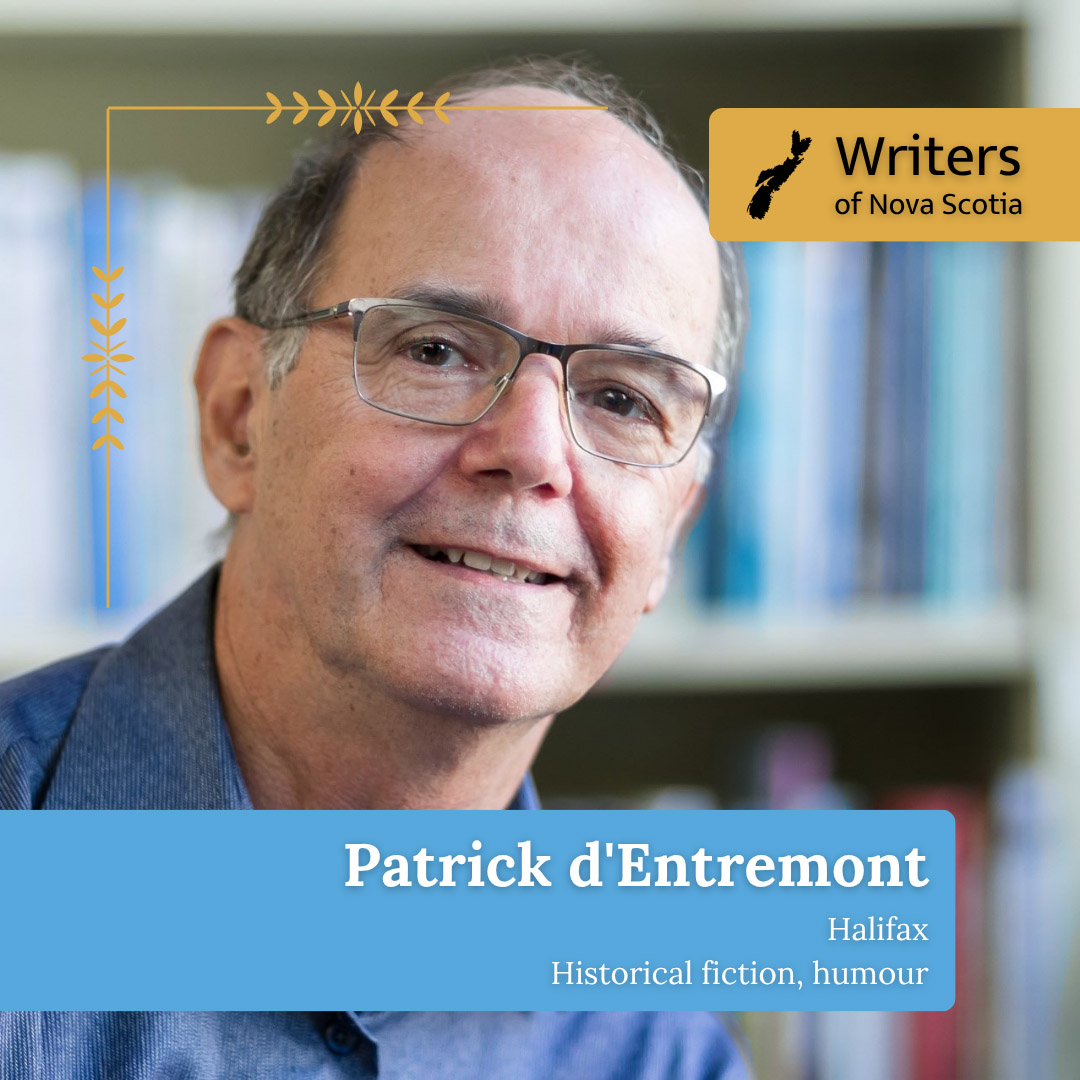
Patrick d’Entremont writes novels set in rural Nova Scotia, based on his Acadian heritage and 1960s upbringing. Readers say these stories evoke both laughter and tears, with their snappy dialogue, distinct characters, and unique and vivid settings.
What’s your current work-in-progress?
I’m working on a novel set in an Acadian village in the late 1960s, due to be published this summer. It’s a story that has the adult protagonist looking back at his unique, at times zany adolescence.
What’s the best writing advice you’ve ever received?
Learn to like revision—because that’s where you’ll be spending the majority of your time. Knowing this frees you up to take chances in your early drafts and let your imagination run wild.
What’s a surprising source of inspiration for you?
For me, writing about the late 1960s, I get inspired by playing music of the era. If there was a late ’60s music trivia contest, I’d ace it. That music puts me right in a groovy frame of mind.
Any recommendations for NS writers & readers?
Debra Amirault Camelin, author of Nathalie: An Acadian Tale of Tragedy and Triumph, is a fervent advocate of Acadian culture with infectious energy and enthusiasm. Debra writes intelligent and well-researched historical fiction, an inspiration to debut novelists like me.
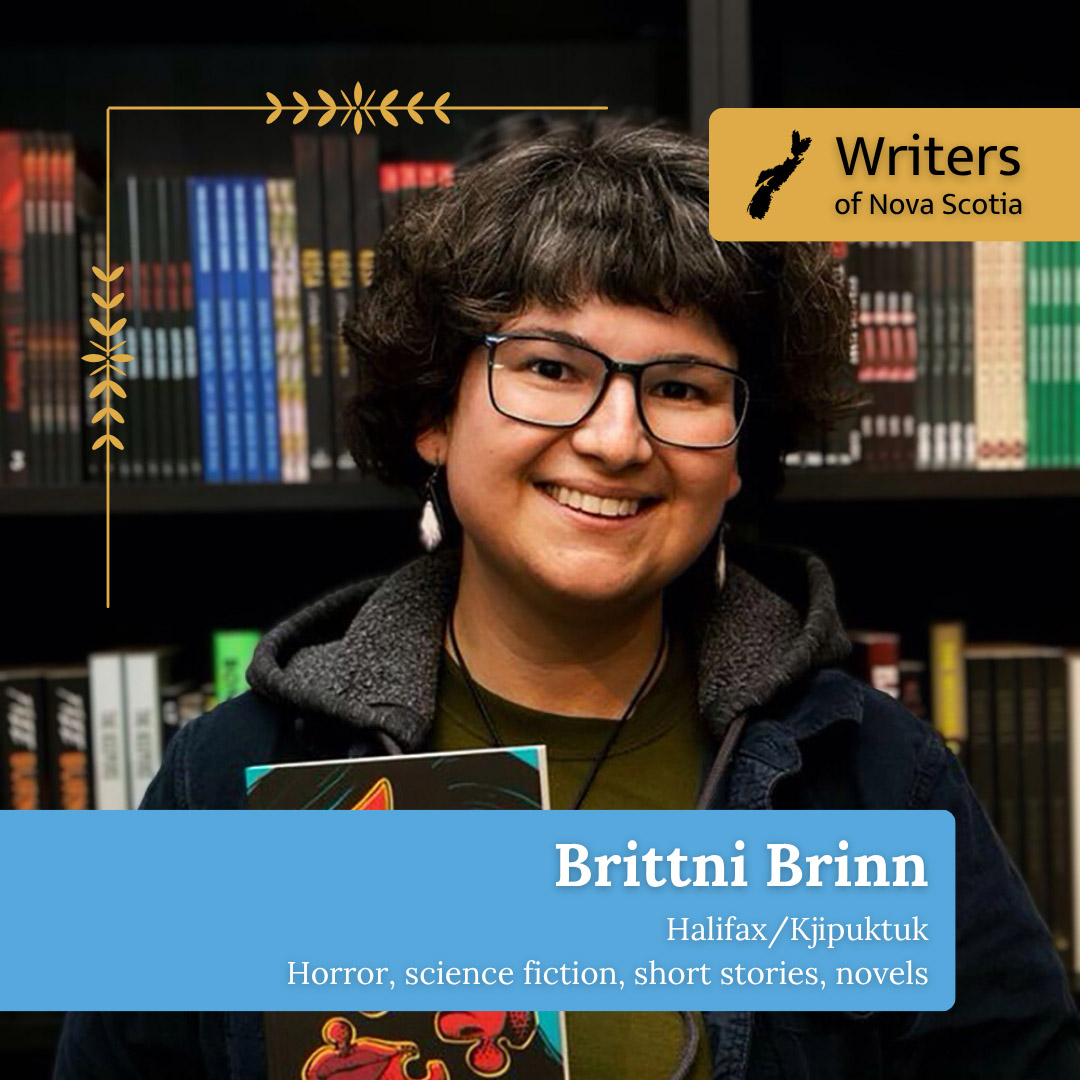
Brittni Brinn writes from a tower and sometimes a cottage in Mi’kma’ki/Nova Scotia. They hold an M.A. in Creative Writing and worked in theatre for many years. Her weird horror novella Misplaced is available from Little Ghosts Books.
What’s your current work-in-progress?
I’m adding the finishing touches to a cyberpunk novella about a journalist searching for her missing friend with the help of a mysterious stranger.
What’s the best writing advice you’ve ever received?
My grade five teacher told me that, if I wanted to be a writer, I should keep a journal. Journaling improved my craft, helped me process things in my life, and gave me a no-pressure place to explore creative ideas.
When did you first realize that stories matter?
When I was a kid, we moved cities and my parents got divorced. I didn’t understand a lot of what was happening. So I escaped through books; they helped me feel less alone.
Any recommendations for NS writers & readers?
Horror is thriving in Mi’kma’ki right now! Some of the best established and up-and-coming writers are Tiffany Morris, Elliott Gish, Peter Counter, and Sarah L. Hawthorn!
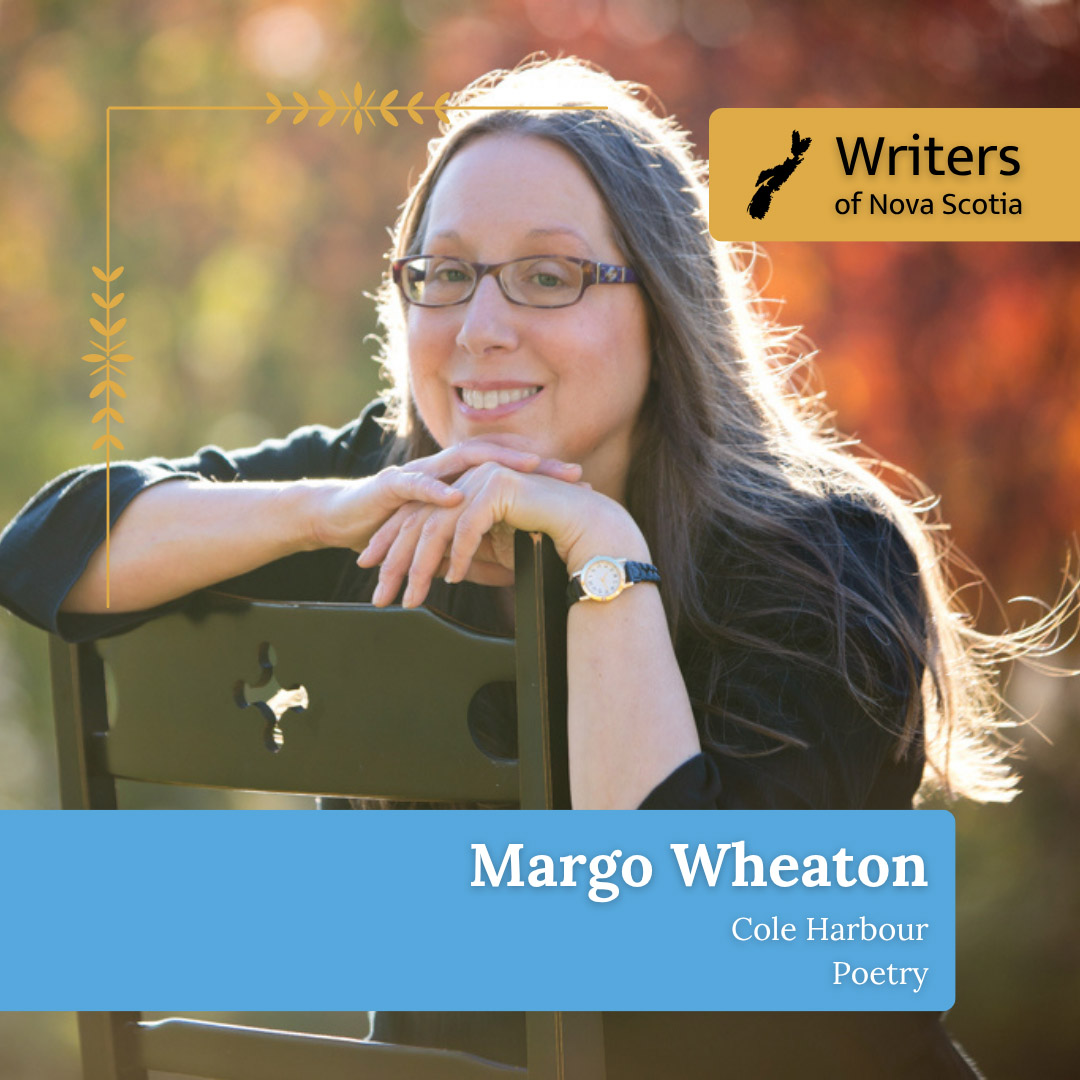
Margo Wheaton is the author of Rags of Night in Our Mouths and The Unlit Path Behind the House. Her debut collection received the Fred Kerner Book Award and was shortlisted for multiple regional and national awards.
What’s your current work-in-progress?
I’m currently working on a third full-length collection of poems.
What’s the best writing advice you’ve ever received?
The novelist David Adams Richards once advised me to “go with what’s right there.” That strange, mysterious line or image that keeps pulsing? Don’t judge it. Trust it. That’s what your imagination is after.
What’s a surprising source of inspiration for you?
For some reason, music videos from the ’70s, ’80s and ’90s are always really energizing and artistically generative for me. Maybe because they often follow a storyline, however loosely. And in their heyday, they were wildly creative, goofy and fun.
Any recommendations for NS writers & readers?
I adore the work of E. Alex Pierce and find that her poetry always rewards deep reading. Her books are pulse-quickening, rhapsodic, wise, environmentally focused, and verbally rich. I come away inspired and emboldened after reading her fierce work.
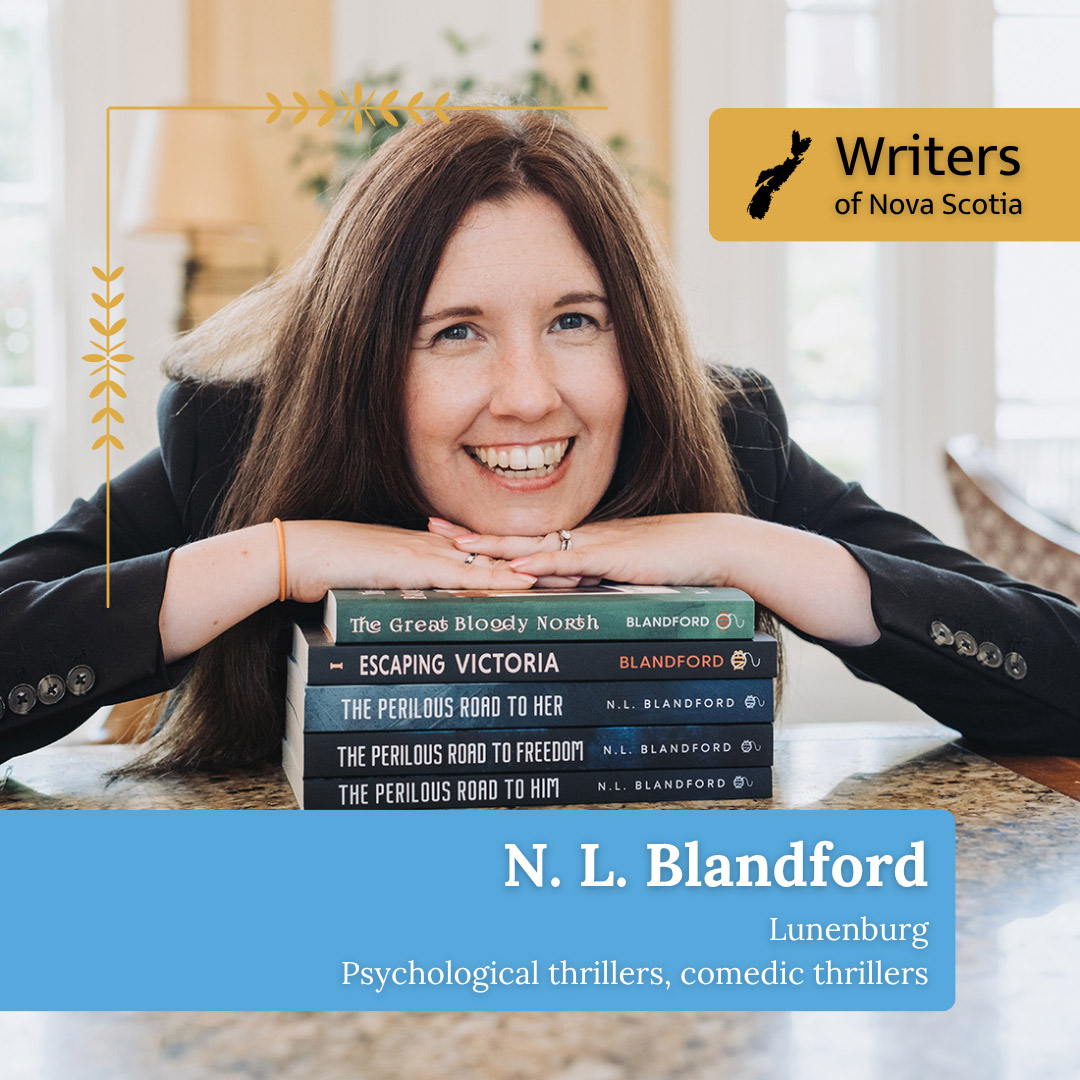
Crime fighter by day and crime writer by night, N. L. Blandford is an award-winning author of six psychological thrillers. Known for cliffhangers and social awareness, she also mentors writers through Novel Bound Consulting, coaching authors from initial idea to publication.
What’s your current work-in-progress?
The Good Ol’ Bloody Game is my second comedic thriller. One single mother, six hockey penalties, and a trail of bodies: a vigilante killer must be stopped before the final buzzer sounds on the town’s biggest hockey tournament.
What’s the best writing advice you’ve ever received?
“The shoes you dream of filling have already been worn ragged through their soles. You’ve gotta step into your own kicks and just do you,” writes Alicia Keys is More Myself: A Journey. There’s no right way to write. Do it your way.
What’s a surprising source of inspiration for you?
My full-time job is investigating fraud. It’s amazing what one can learn about human behaviour and psychology when interviewing subjects and witnesses….
Any recommendations for NS writers & readers?
For two years, I’ve facilitated writing workshops at Tantallon Library. Working with Emma and the staff is a dream; their organization and support for local authors are unmatched. Thanks to their promotion, every session is always at full capacity.
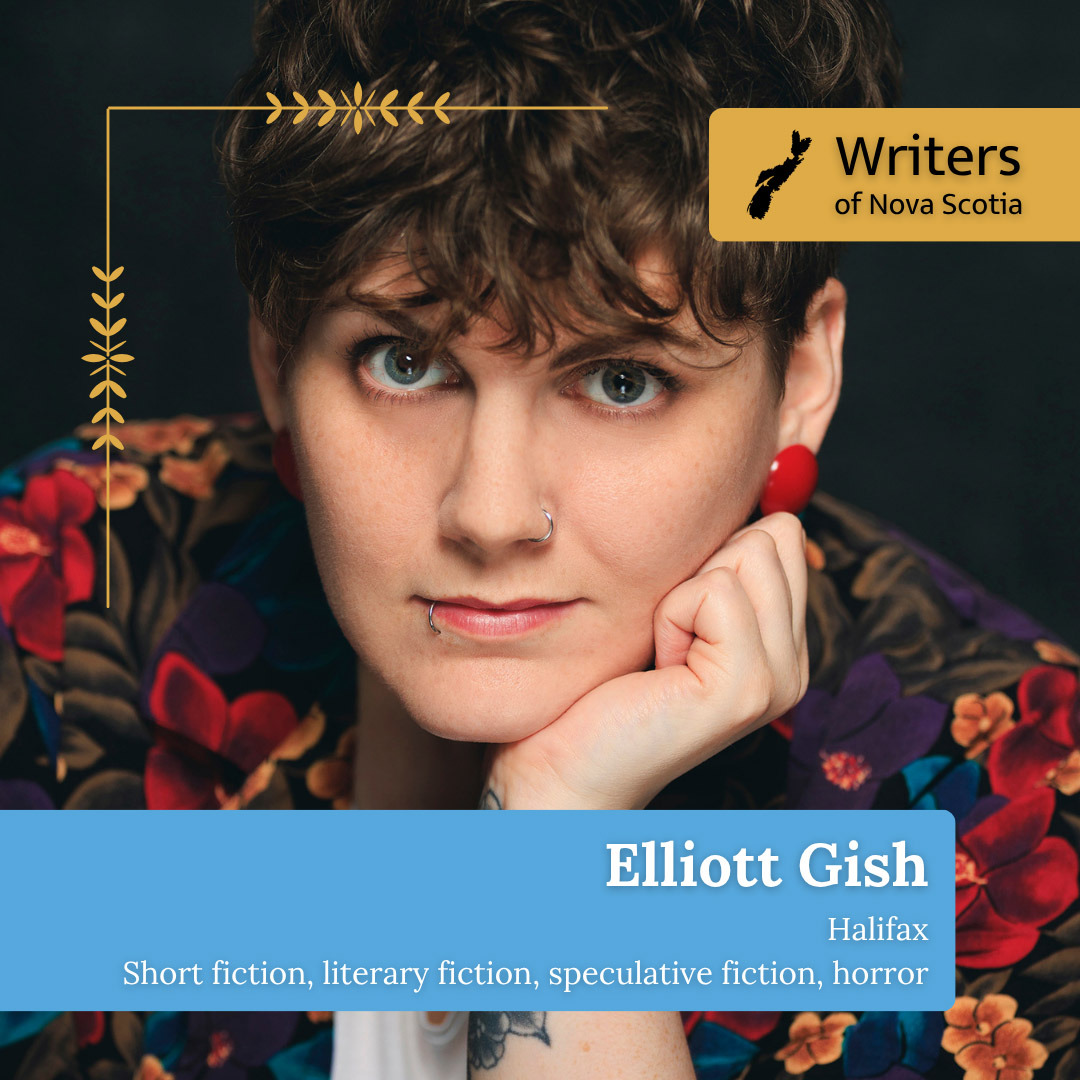
Elliott Gish‘s debut novel, Grey Dog (ECW Press, 2024), was shortlisted for the Edmund White Award for Debut Fiction and the Kobo Emerging Writer Prize for Literary Fiction. She lives in Halifax with her wife and a small black cat.
What’s your current work-in-progress?
I am currently writing a horror novel very loosely based on the life of Elizabeth Bishop.
What’s the best writing advice you’ve ever received?
Write the book you want to read.
What’s a surprising source of inspiration for you?
I always gain inspiration from being out in public and listening to what is going on around me. Eavesdropping is the original story prompt!
Any recommendations for NS writers & readers?
King’s Co-Op Bookstore in Halifax is a fabulous community resource. The manager, Paul, is a great friend to writers at all levels!
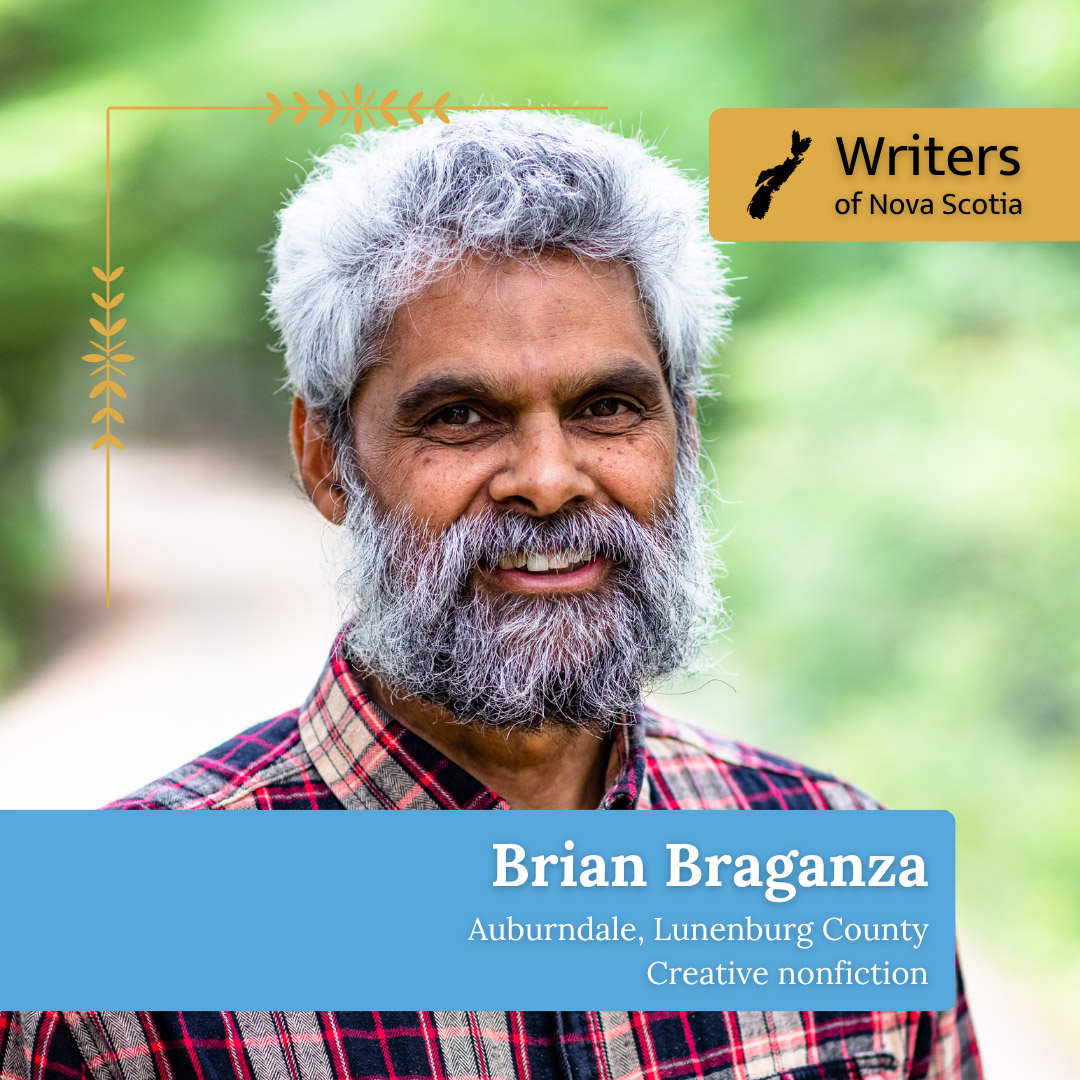
Brian Braganza has published creative nonfiction in The Fiddlehead, Rooted 2, Existere Journal, The Willow Herb Review, and Saltscapes Magazine. Brian is currently writing a collection of essays about identity, family, and outdoor-based practices for healing and reconnection.
What’s your current work-in-progress?
I’m writing a collection of creative nonfiction essays. As brown-bodied immigrants to Canada in the 1970s, my parents had the gumption to take their family camping. These early experiences influenced my life’s work in wilderness leadership & outdoor healing practices.
What’s the best writing advice you’ve ever received?
Don’t let the truth get in the way of a good story.
What’s a surprising source of inspiration for you?
I have a 150-year-old barn that I’m renovating. When I’m in my body working on the barn, I use different cognitive neurons and physical movements that open up space for the creative inspiration needed for the writing to flow.
Any recommendations for NS writers & readers?
Good Dog Books in Bridgewater. It’s so great to have access to an independent book seller in my town. They stock a great diversity of writers, especially local and Nova Scotian, and stock both new and used books.
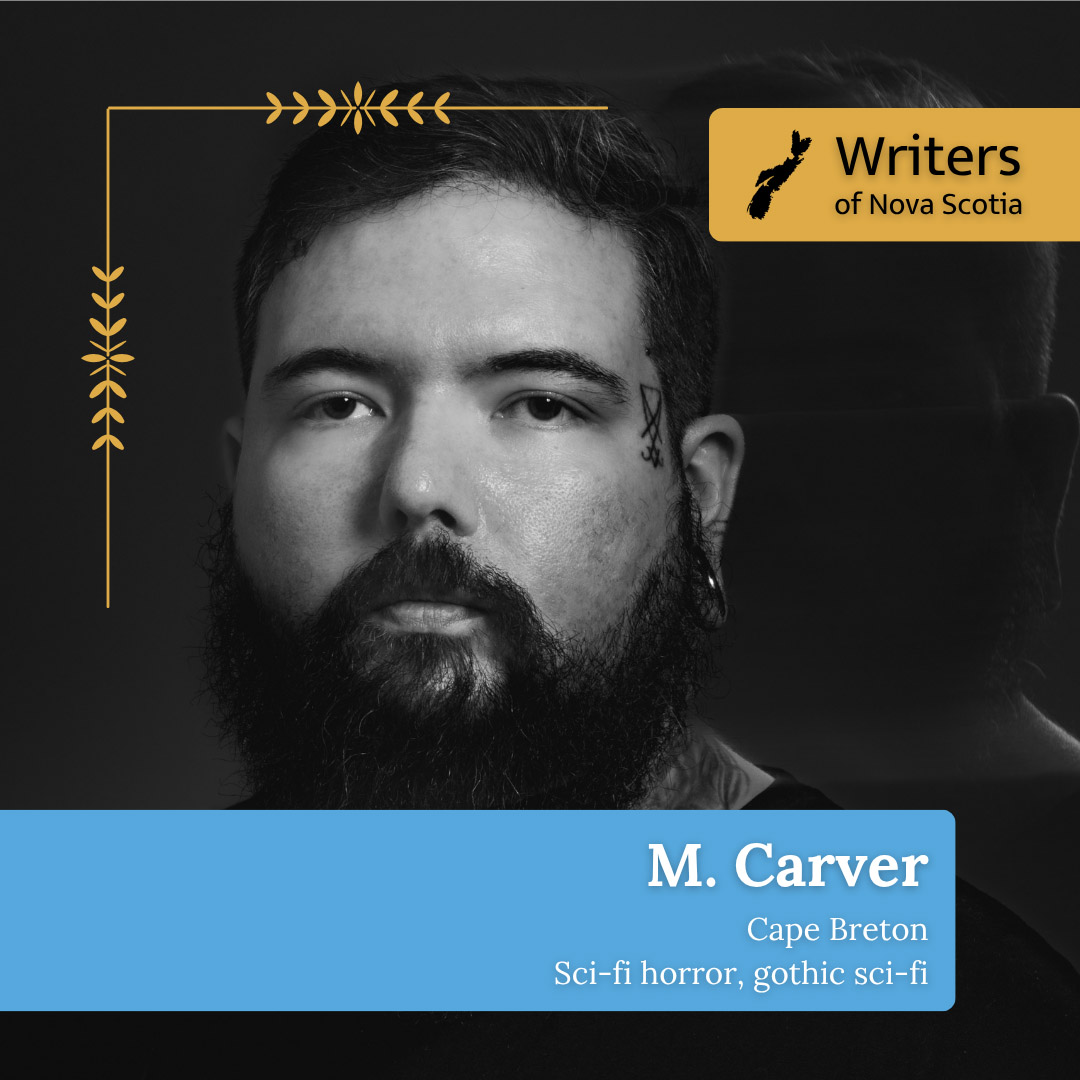
M. Carver‘s childhood dream was to become a novelist. Writing took a back seat, but now he’s taking that dream and making it tangible. Inspired by gothic horror and sci-fi, Carver takes the emotional psyche of his characters to the stars.
What’s your current work-in-progress?
My debut novel, Buried In Me, which is a sci-fi thriller exploring survivor’s guilt, isolation, mass paranoia, and personal redemption inspired by Gothic horror.
What’s the best writing advice you’ve ever received?
The biggest fear I think all writers face is failure or not being good enough. “Make it exist, then you can make it better” is easily the best piece of advice I’ve ever been given.
When did you first feel confident calling yourself a writer?
I was once driving my friends to a Dungeons and Dragons game, and they asked me to come up with a story so we could play on the drive. That really solidified my sense of myself as a storyteller.
Any recommendations for NS writers & readers?
On The Same Page Books in Sydney is absolutely incredible. It’s run by the most fantastic people. They are always uplifting their community in every way, big supporters of local, and deserve as much recognition as they give out.
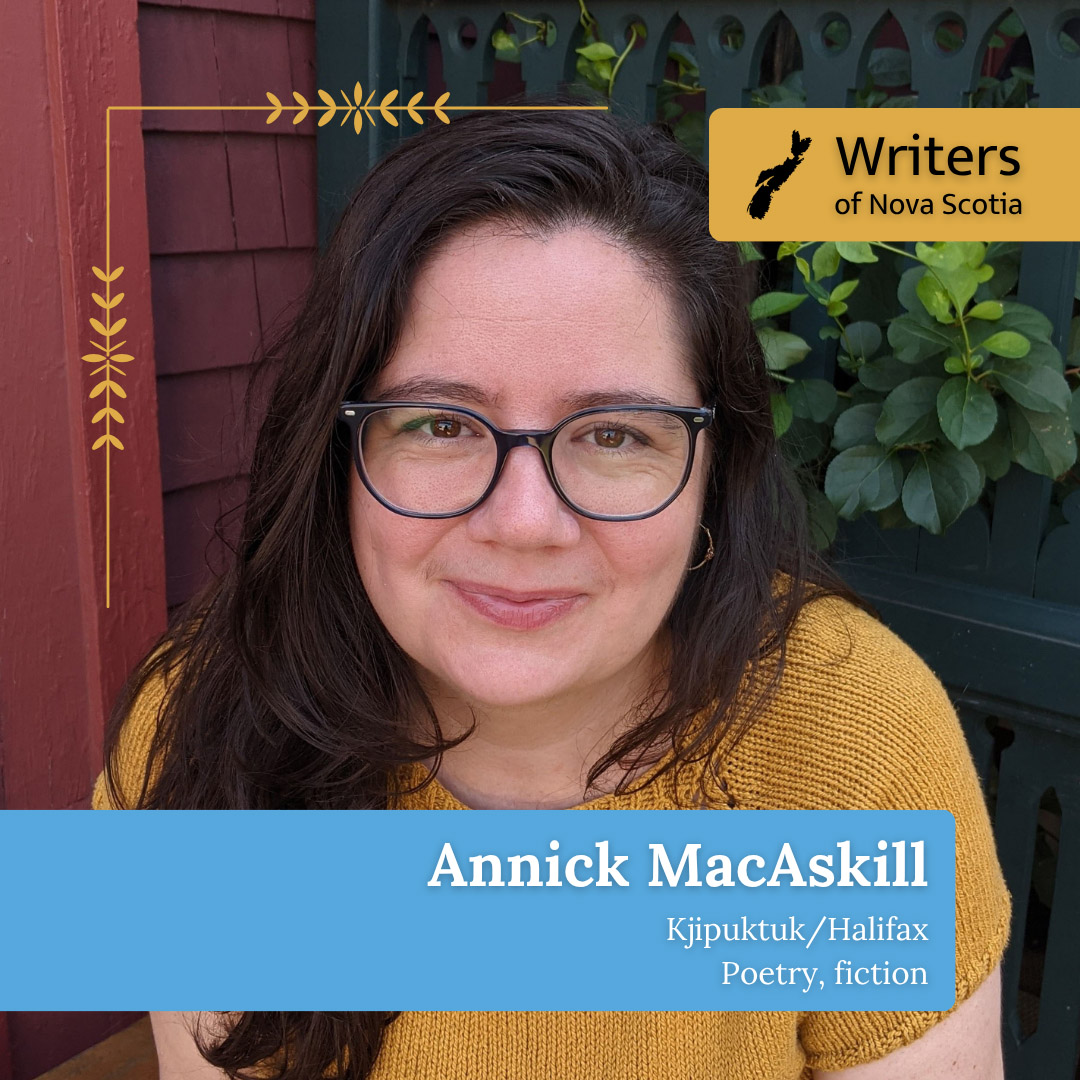
Annick MacAskill is a writer based in Kjipuktuk (Halifax). She is the author of four poetry collections, including Shadow Blight (winner of the Governor General’s Award) and Votive. Her fiction has appeared in journals such as Canthius, Plenitude, and EVENT.
What’s your current work-in-progress?
I am currently working on several projects, including a novel, a collection of short stories, and a book of poetry about a case of supposed demonic possessions said to have occurred in an Ursuline convent in early seventeenth-century France.
What’s the best writing advice you’ve ever received?
Read. Books are truly our best teachers. With this in mind, I’ve come to think of ‘writer’s block’ as just an excuse to spend more time reading.
What’s a surprising source of inspiration for you?
Perhaps not so surprising, but I am a big fan of walks and silence. More and more these days, I carry a lot of my ideas with me for weeks, months, or years before I get out the pen.
Any recommendations for NS writers & readers?
I am so very excited about Jaime Forsythe’s work in general, and in particular, her new book of poetry, Yield, a stunning exploration of the postpartum period set against the Maritime coastline, published by Wolsak & Wynn this year.
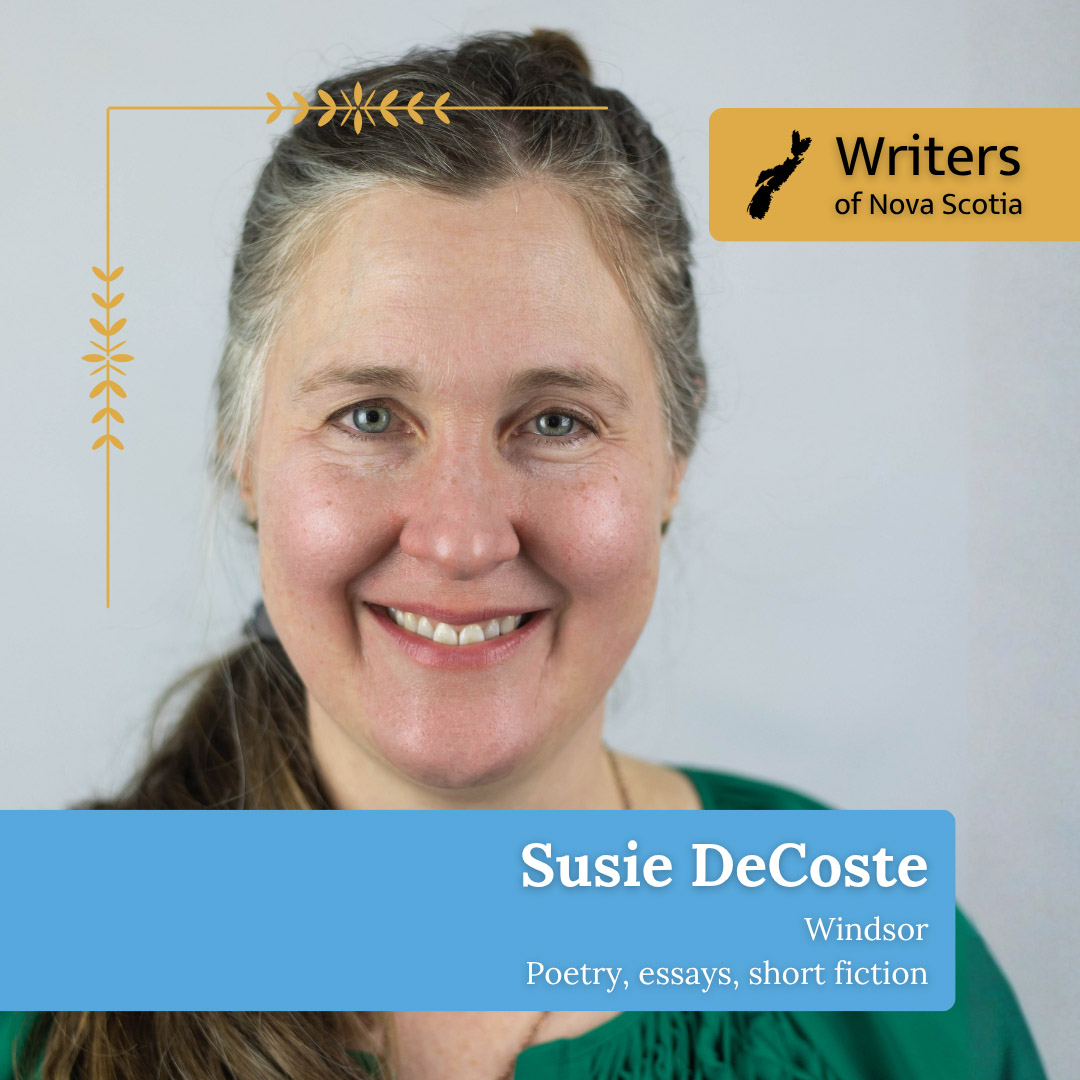
Susie DeCoste grew up in Antigonish and now lives in Windsor, where she works as a school librarian. She studied English literature and creative writing, earning a PhD at UWaterloo and a MA at UNB.
What’s your current work-in-progress?
My current work in progress is a collection of poetry tentatively titled Tidal Manual. A selection of this manuscript won the Rita Joe Poetry Prize in WFNS’s 2025 Nova Writes Competition.
What’s the best writing advice you’ve ever received?
I was told to “keep finding people to write for” by a teacher at Sage Hill. When I do this today, my poems are charged with so much more meaning and energy.
When did you first feel confident calling yourself a writer?
I only recently felt confident enough to say this. When I work with middle school and high school students on writing ideas, I refer to them as writers to encourage them. I realized I should call myself a writer as well.
Any recommendations for NS writers & readers?
King’s Co-op Bookstore in Halifax is a recent find for me. They carry many titles by small presses like Gaspereau Press, and their curation of poetry and literature is amazing!
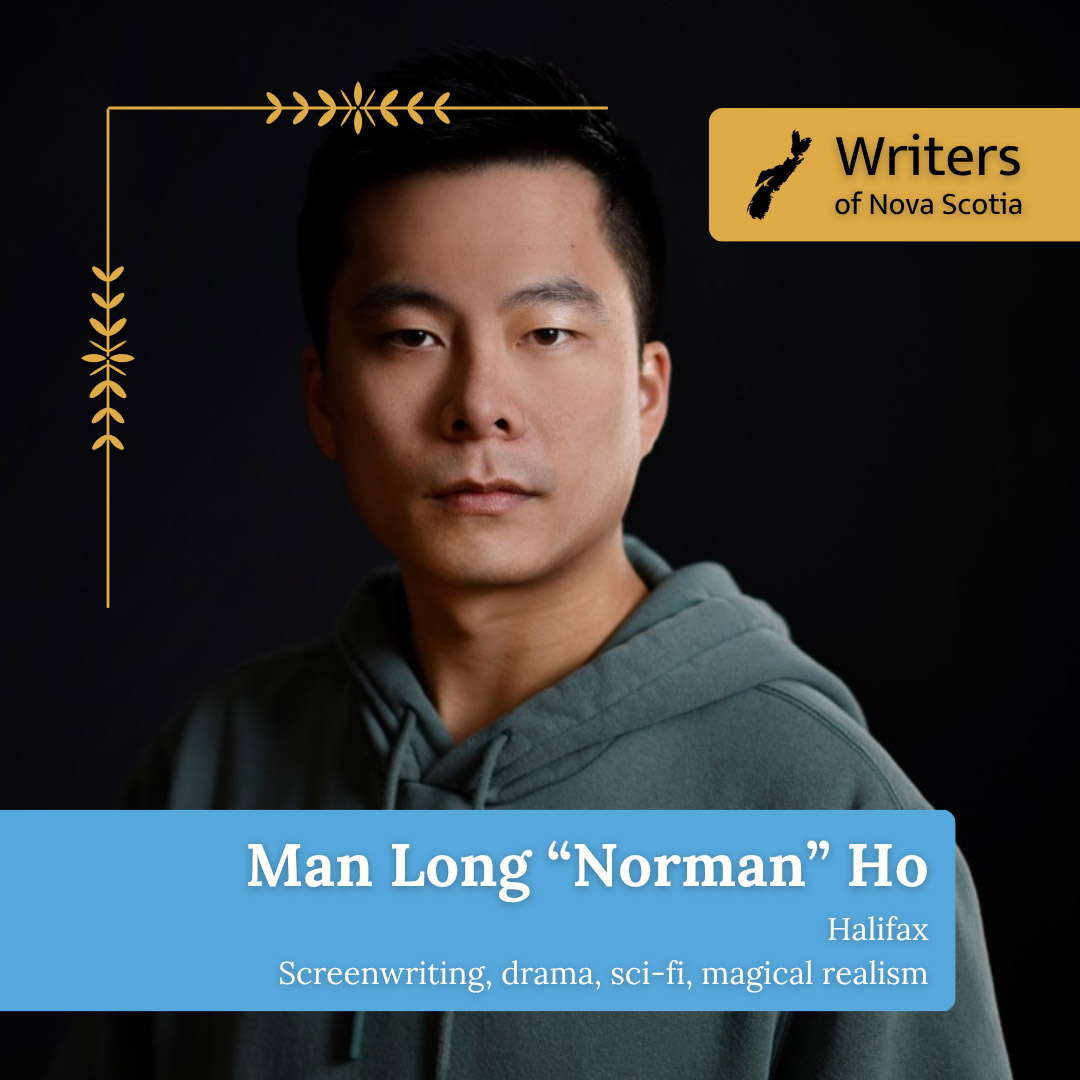
Norman Ho is a Hong Kong-born writer and director based in Nova Scotia. He is the 2026 Charles R. Saunders Prize recipient and a writer-in-residence at Eyelevel Artist Run Centre, with award-winning work from ScreenCraft and the Island Literary Awards.
What’s your current work-in-progress?
I’m developing The Neroli Rescue, a socio-political survival sci-fi novel about miners from diverse backgrounds trapped underground after a catastrophic collapse on a distant asteroid colony.
What’s the best writing advice you’ve ever received?
Have fun with it. When I enjoy the process, the work feels alive and things flow. When I don’t, I get stuck. Sometimes the only way forward is to have fun and explore.
When did you first feel confident calling yourself a writer?
A friend once told me, “When someone asks who you are, tell them who you want to be.” After moving to Canada, I started calling myself a writer. I said it before I fully believed it, and grew into it.
Any recommendations for NS writers & readers?
Eyelevel Gallery, an artist-run centre in Halifax. They encourage emerging artists to experiment, connect, and grow within a supportive creative community. It’s a space where taking creative risks feels safe.
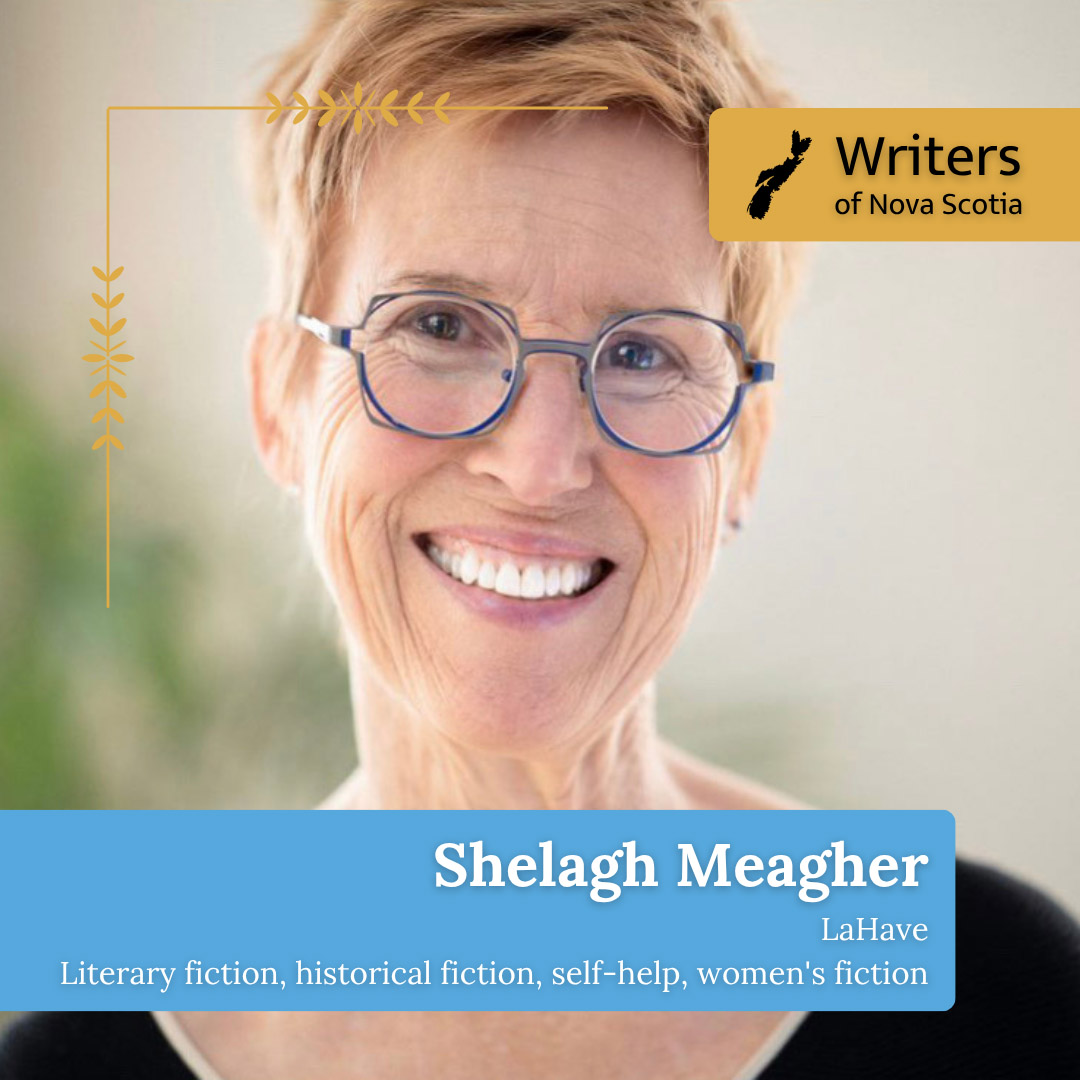
Shelagh Meagher is the author of three published novels and two works of nonfiction. She has lived in Italy, England, Switzerland, and the US, diverse cultures which have shaped her way of thinking and living.
What’s your current work-in-progress?
I’ve just begun a new novel focused on one woman’s experience of the emancipation movement in Nova Scotia (1890 – 1910) and her struggle for agency and autonomy in a highly restricted, male-dominated world.
What’s the best writing advice you’ve ever received?
When you’re writing an emotional scene, keep going until it makes you cry. This advice from mentor Karen Connelly has helped me understand how deep one has to dig to get the full emotional quotient from any situation.
When did you first feel confident calling yourself a writer?
When I moved to Nova Scotia, gave a reading at my local bookstore (LaHave River Books), and all kinds of people started recognizing me with, “Oh, you’re that writer!”
Any recommendations for NS writers & readers?
Not only is LaHave River Books the most delightful bookstore to hang out in—always an interesting conversation to be had—they are also incredibly generous and welcoming to authors of every ilk and form of publishing.
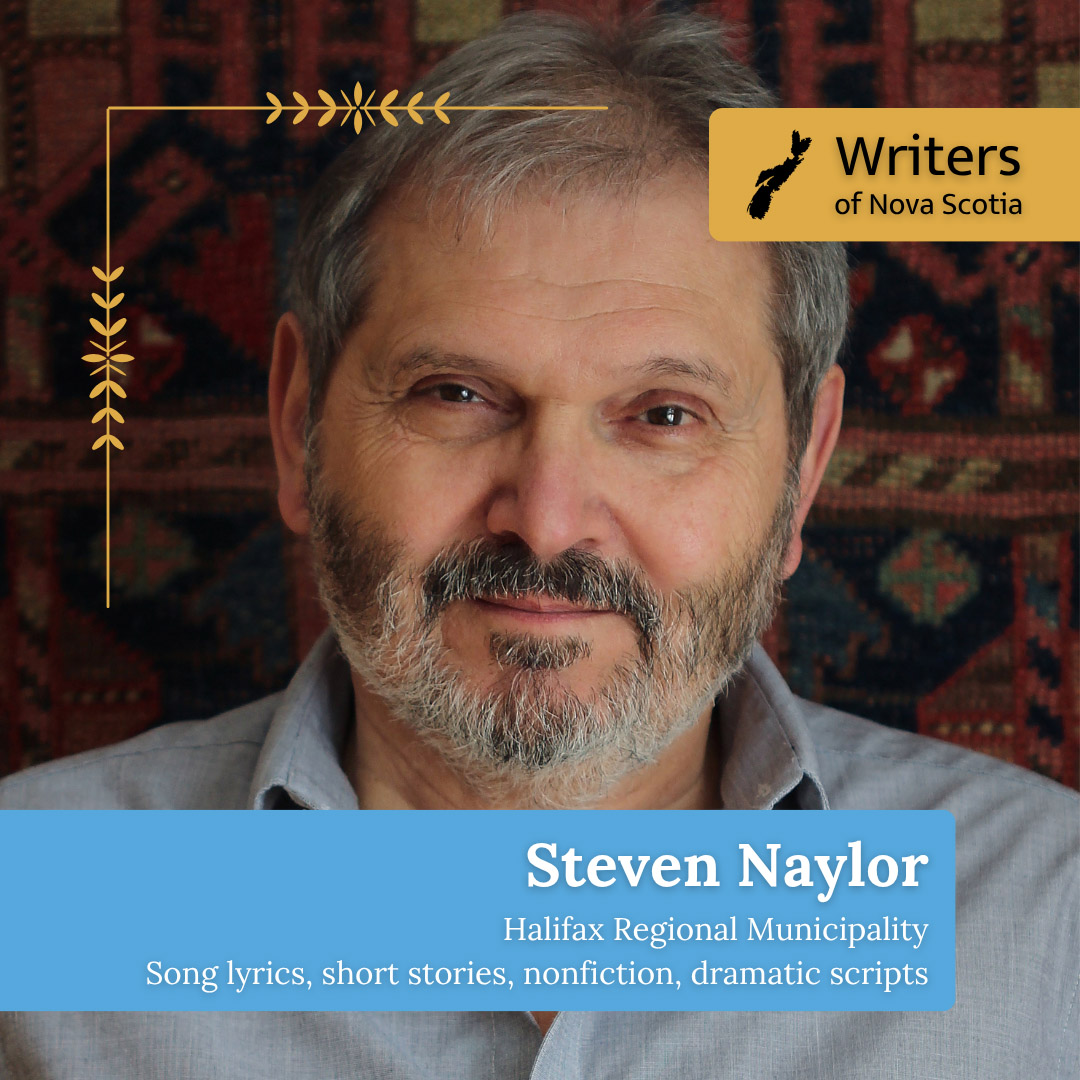
Steven Naylor is a composer, performer, producer, and writer. His education includes degrees in English (BA; WLU) and Musical Composition (PhD; Birmingham, UK). He has written short stories, professional theatre scripts, and song lyrics for theatre, film, and television.
What’s your current work-in-progress?
I am (still…) working on three projects: a long-incubating collection of short stories, and two fictional biographies of musicians from very different worlds.
What’s the best writing advice you’ve ever received?
Write first; edit later.
When did you first feel confident calling yourself a writer?
My writing confidence began to rise after creating lyrics (and music) for several Sesame Street segments and co-authoring scripts and lyrics for professional theatre productions. Winning the Short Story Prize in the 2013 Atlantic Writing Competition was a major boost.
Any recommendations for NS writers & readers?
I think what’s most important to acknowledge is the positive impact of having a vibrant literary community in our province—in the other words, the entire literary ecosystem of our authors, publishers, organizations, and events.
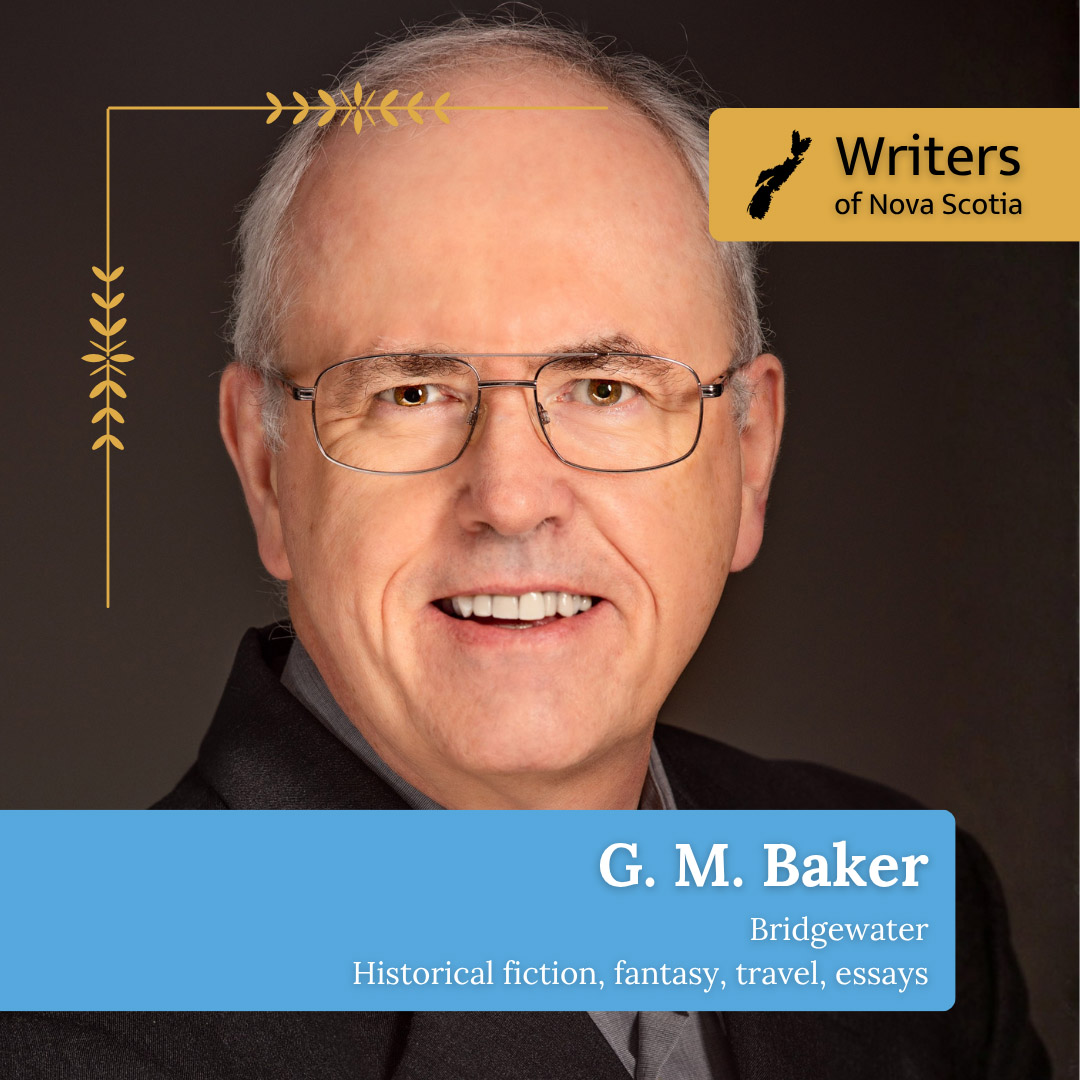
G. M. Baker writes about kind abbesses and melancholy kings, about elf maidens and ship wreckers and shy falconers, about great beauties and their plain sisters, about sinners and saints and ordinary eccentrics.
What’s your current work-in-progress?
My current work-in-progress is a YA fantasy called The Withered King, which begins and ends in Nova Scotia but visits fairyland in between.
What’s the best writing advice you’ve ever received?
The best writing advice I ever received was to know your audience. You don’t write to market, and you don’t write for yourself. You write to communicate what you have seen to another who should see it too.
When did you first feel confident calling yourself a writer?
I first felt confident calling myself a writer the first time a publication sent me a cheque with my name on it. It was from the old Atlantic Advocate when I was 19.
Any recommendations for NS writers & readers?
I love LaHave River Books. There may be bigger bookstores, but there are none prettier.
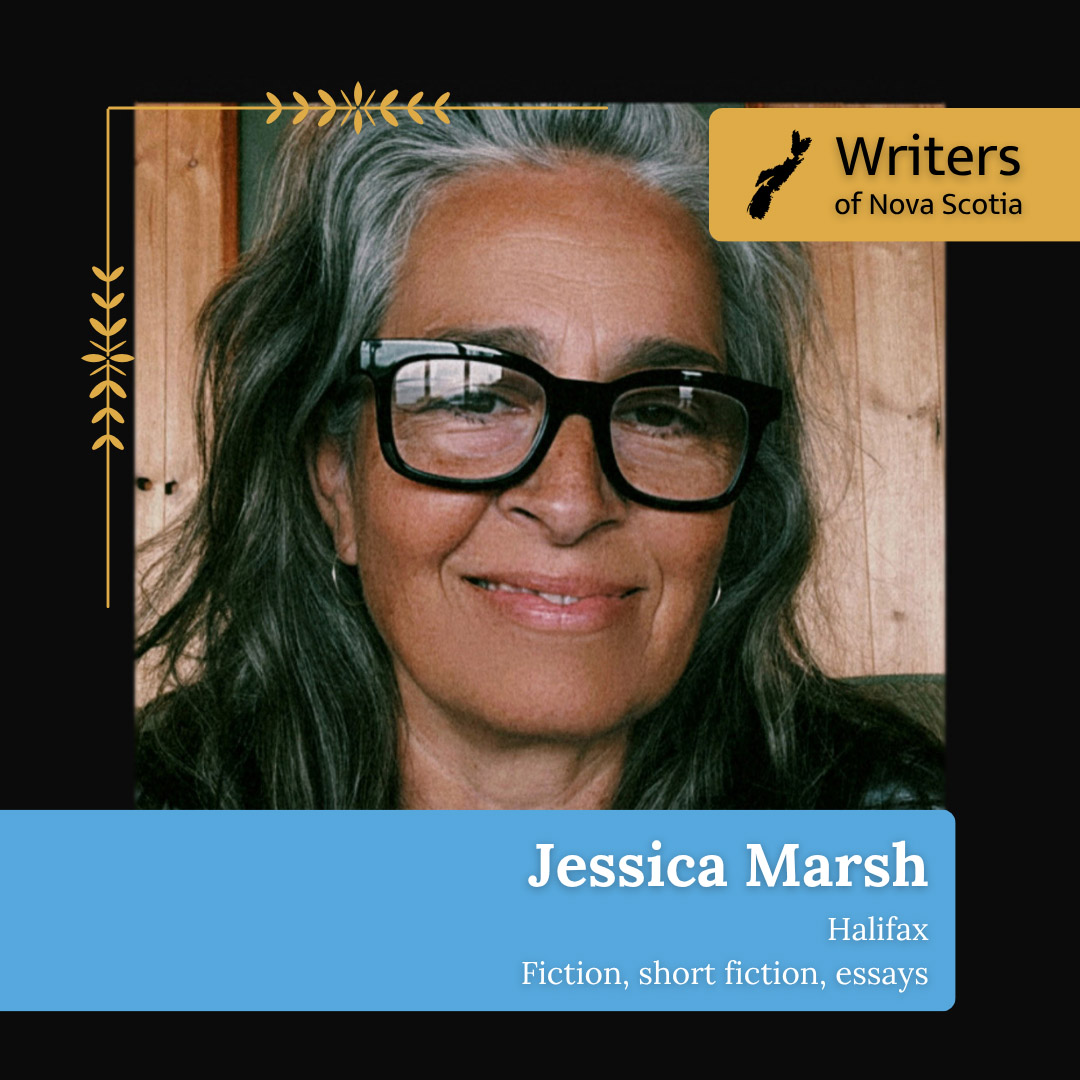
Jessica Marsh writes fiction and essays. Her short stories have appeared in The New Quarterly, The Fiddlehead, Grain, and The Sun. Her work has been nominated for the Journey Prize and the National Magazine Awards.
What’s your current work-in-progress?
With support from the Canada Council for the Arts, I am working on my first novel, a fictional coming-of-age story about a biracial girl, set during the back-to-the-land movement of the 1970s.
What’s the best writing advice you’ve ever received?
Stephanie Domet, my mentor in the 2026 WFNS Alistair MacLeod Mentorship Program, said that the first series of manuscript drafts is for the writer; the second series of drafts is for the reader. It was just the advice I needed.
What’s a surprising source of inspiration for you?
Impermanence lights a fire under my ass. In my final hours, I don’t want to look back with regret for wasted time. I want to feel satisfied I wrote stories that are expressions of my true self.
Any recommendations for NS writers & readers?
Open Book Coffee in Halifax is my home away from home, as it is for so many. Owner Joe Tinney is dedicated to cultivating community with so many literary events, including Latte Lit, his monthly open mic night.
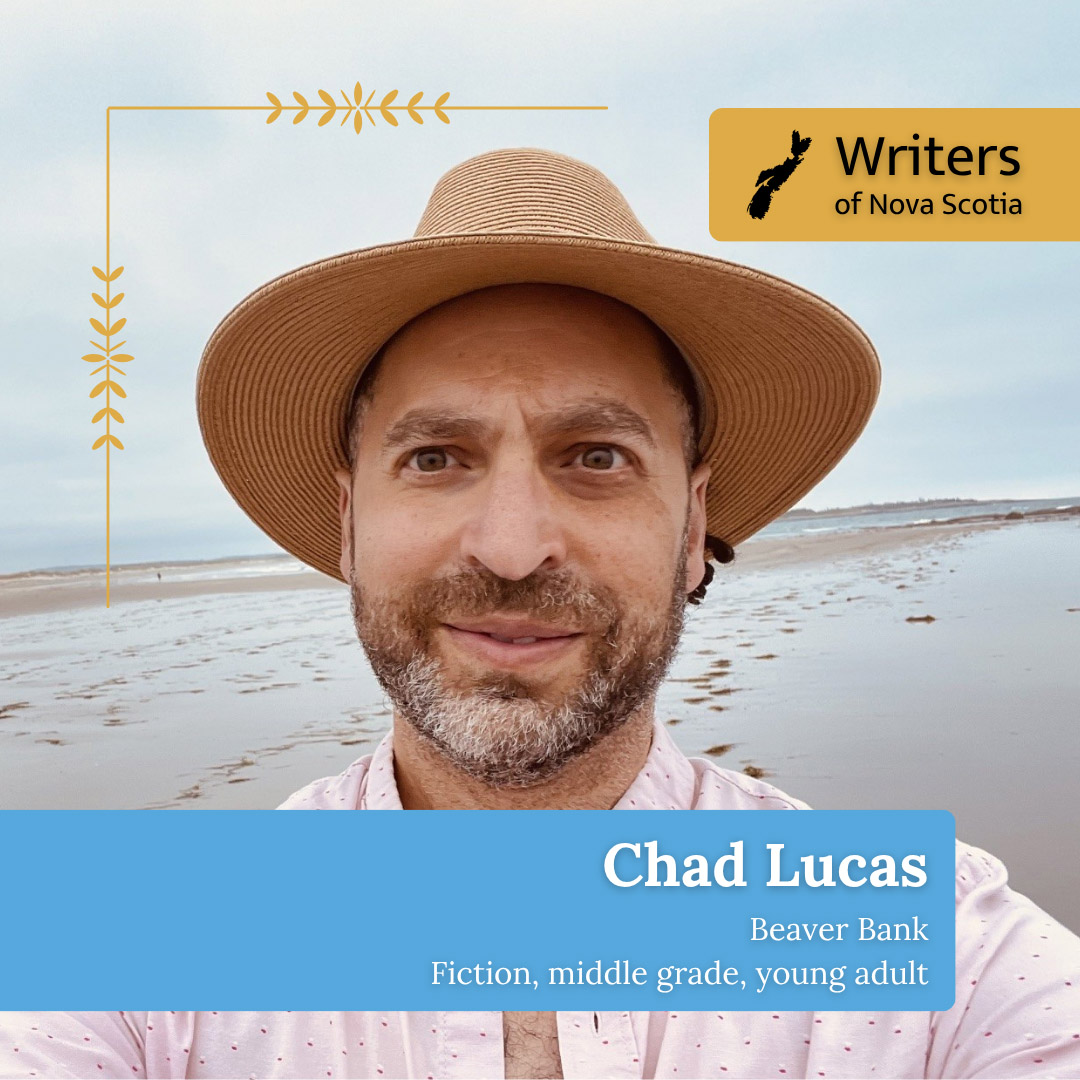
Chad Lucas is the author of four books for middle grade readers, available from Amulet Books. His debut—Thanks A Lot, Universe—won the Ann Connor Brimer Award for Atlantic Canadian Children’s Literature.
What’s your current work-in-progress?
A ghost story with one foot in the present and one in the past. Two sets of teenagers, separated by a century, linked by a grave injustice that ripples for generations.
What’s the best writing advice you’ve ever received?
Write the story only you can write. Lean into your curiosities, your weird little obsessions, the things that delight you or make you angry. That’s where the good stuff lies.
When did you first realize that stories matter?
I fell in love with books early and they never let me go. I still own my battered childhood copy of Judy Blume’s Tales of a Fourth-Grade Nothing, which I re-read so many times that the cover fell off.
Any recommendations for NS writers & readers?
I’m biased as a current board member, but AfterWords Literary Festival is a treasure. Watching smart people having thoughtful, vulnerable, and often hilarious conversations about writing, I never leave an event feeling less than inspired.
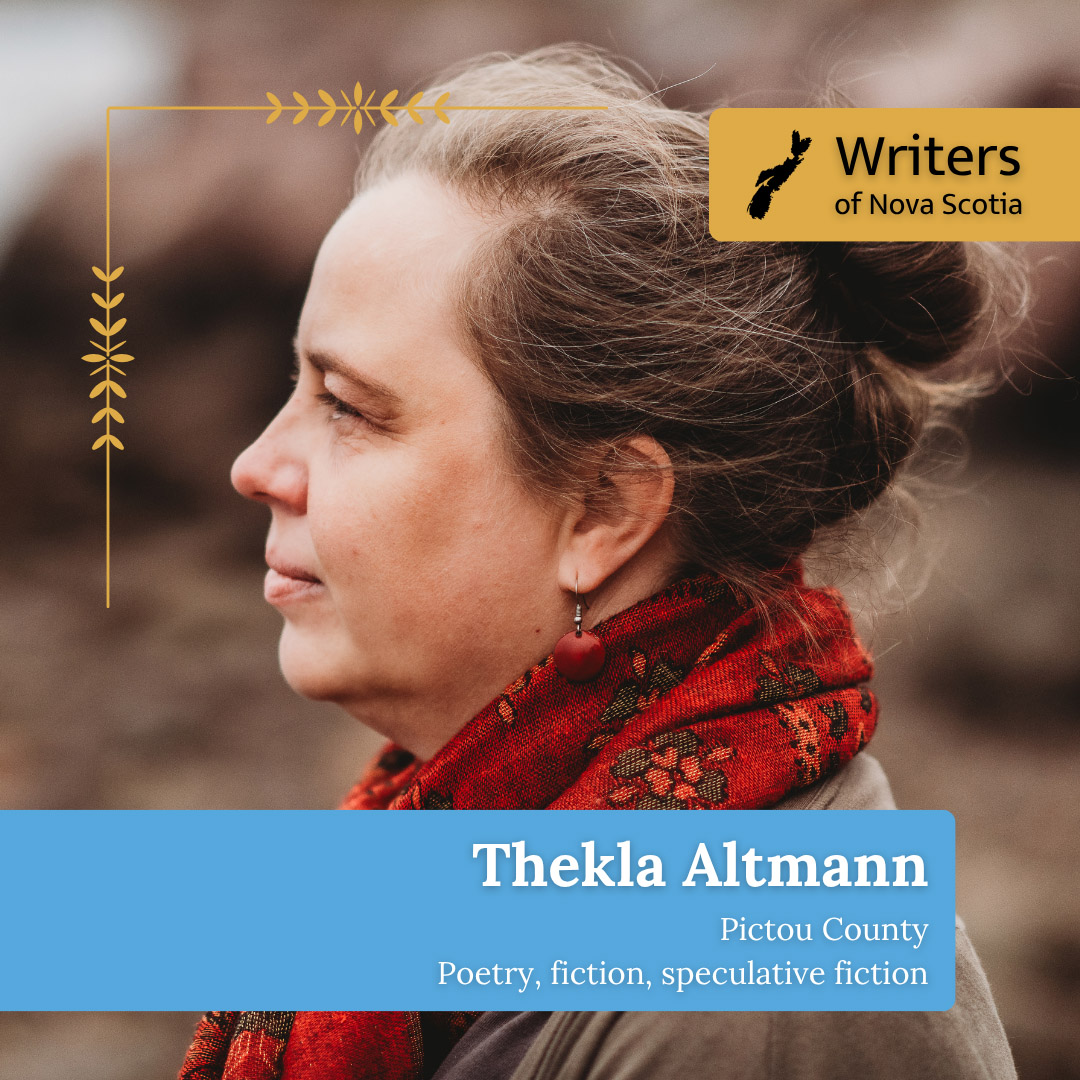
Thekla Altmann (she/they) grew up in Communist East Germany, is a member of and advocate for immigrant and LGBTQ+ communities, and feels that her invisibility in both respects is a tool. Thekla lives in rural Nova Scotia with her wife and kid.
What’s your current work-in-progress?
I’m collaborating with a young graphic novelist on a supernatural adventure series. I generally work alone, and it’s blowing my mind how much we both enjoy the mutual inspiration. I can’t wait to have results to show off!
What’s the best writing advice you’ve ever received?
“What gets published isn’t what’s best but what’s finished and submitted.” (Thank you, Michelle.)
When did you first feel confident calling yourself a writer?
When I was 40, writing poetry saved my life. Sharing what I wrote with others was new as well, but I’m glad my fellow writers convinced me of what I knew deep down—that I’m one of them.
Any recommendations for NS writers & readers?
Trenton Library in Pictou County has a wonderful writing group, warm and open and supportive. There’s also a series of good-quality, varied writing workshops on the last Saturday of each month, and a beta reader exchange program.
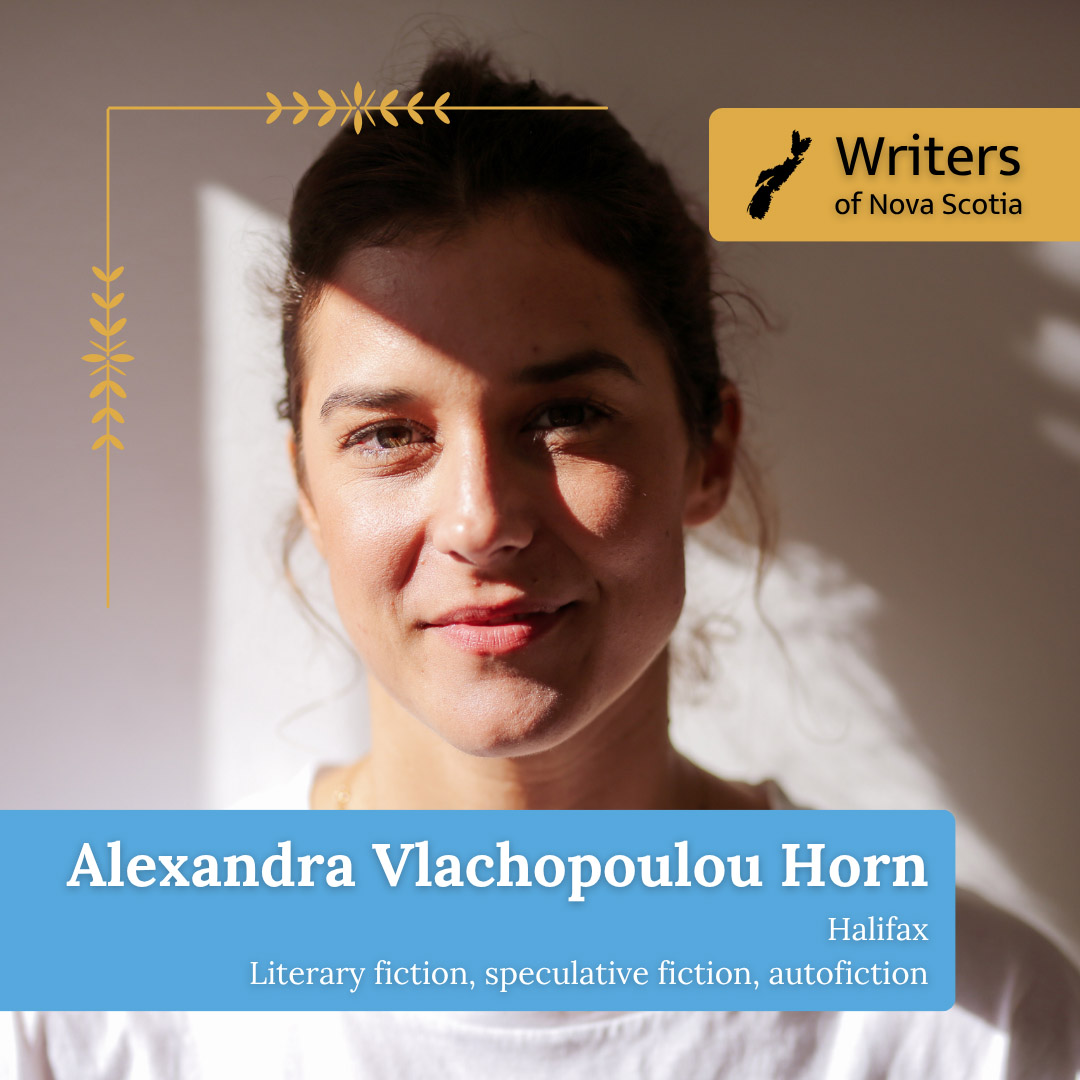
Alexandra Vlachopoulou Horn was born in the Czech Republic, raised in Greece, and shaped by years in Berlin. In 2026, she was awarded an Alistair MacLeod Mentorship through the Writers’ Federation of Nova Scotia for her book-in-progress, Borderlines.
What’s your current work-in-progress?
My work-in-progress, Borderlines, is an autofiction novel that unfolds through memory rather than plot. Set around a return to Greece for a grandfather’s funeral, it explores family, migration, and inherited emotional patterns, tracing identity across generations and fractured belonging.
What’s the best writing advice you’ve ever received?
My friend, artist and musician Nicola Miller, once told me not to worry about having too many ideas. Her music often arrives in fragments that later merge or transform into something new. That, she said, is part of the process.
What’s a surprising source of inspiration for you?
Qigong. As a practice of cultivating life energy, it brings me back to the principles of creation. Through breath, movement, and stillness, it keeps my system balanced and alive—while also opening unexpected pathways into creative insight.
Any recommendations for NS writers & readers?
I love Atlantic News in Halifax. When I first moved to Halifax, I went in for ten minutes and stayed for over an hour. You enter this unassuming place, and it opens into a vast universe of surprise and curiosity.
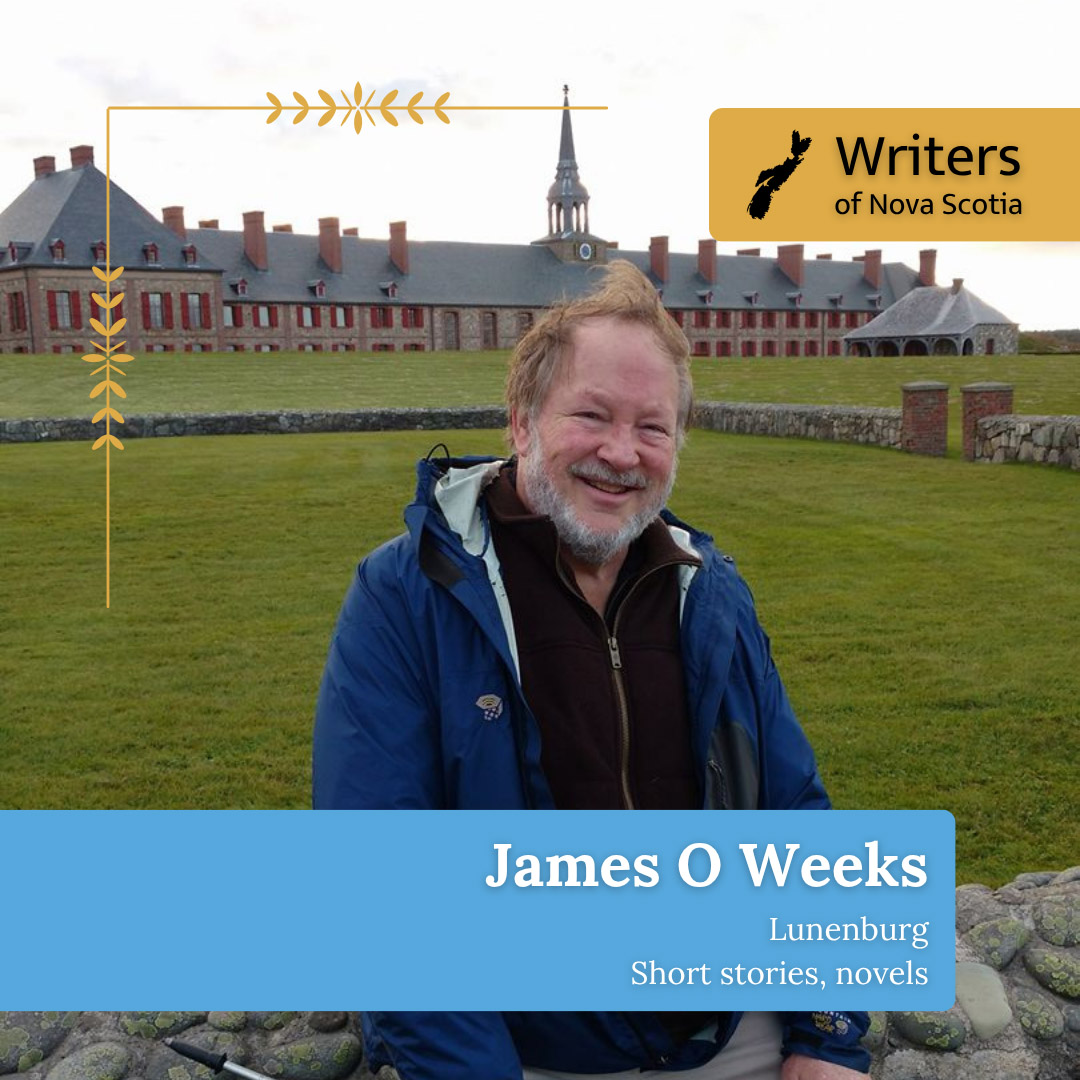
James O Weeks taught for forty years and has published articles, short genre fiction, and two novels. After teaching writing, he decided to put his skills to the test. James lives in Lunenburg with his wife and two Jack Russells.
What’s your current work-in-progress?
I’m currently planning a mystery that will feature a character from my previous novels.
What’s the best writing advice you’ve ever received?
Read, and read some more.
When did you first feel confident calling yourself a writer?
When I first had an educational article published, I realized others were reading my thoughts, which made me a writer.
Any recommendations for NS writers & readers?
Elizabeth’s Books in Lunenburg, as unique as its owner, opens only at night and welcomes book lovers of all ages.
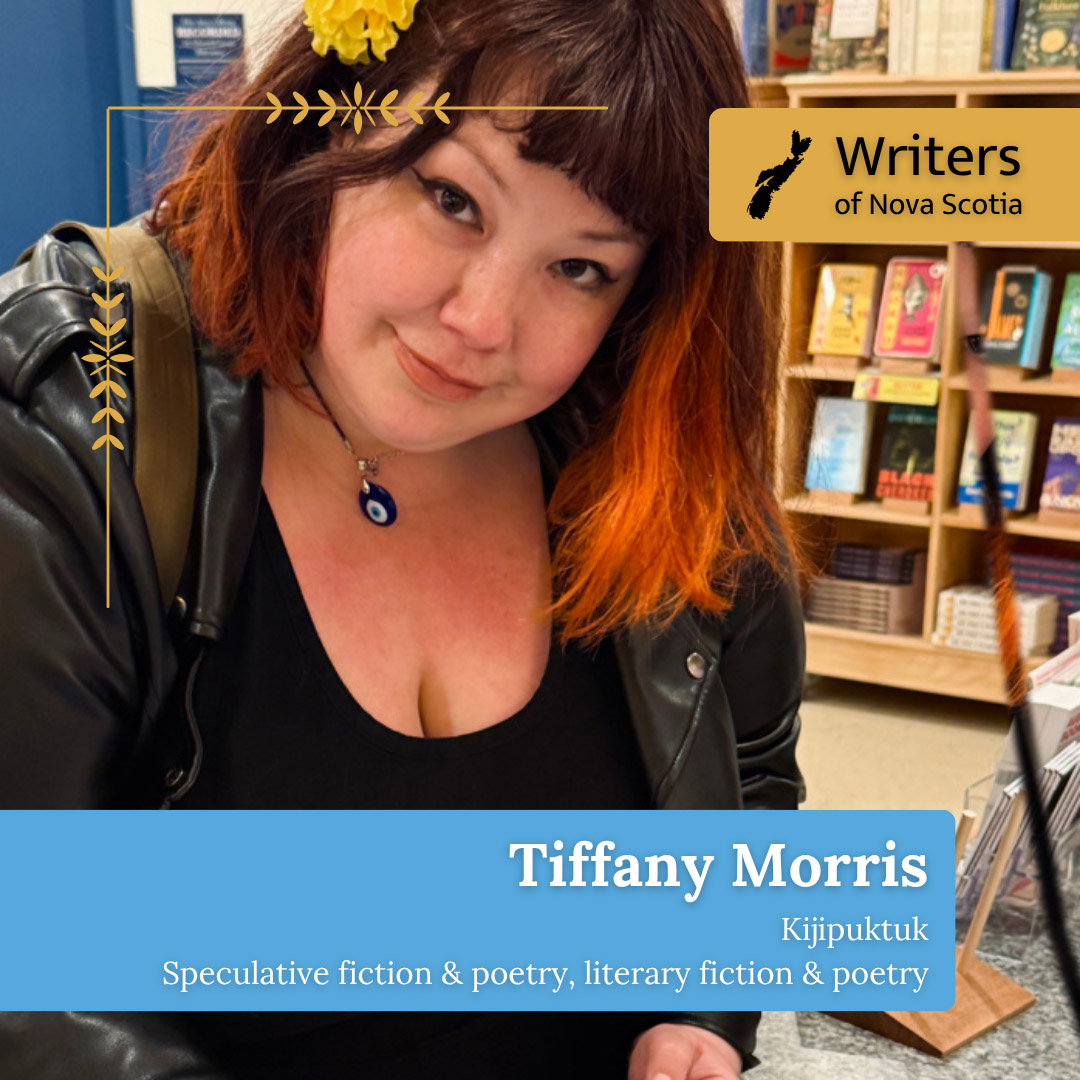
Tiffany Morris is an L’nu’kw (Mi’kmaw) writer from Nova Scotia. She is the author of the horror novella Carnalis, the Indie Ink Award-winning swampcore novella Green Fuse Burning, and the Elgin Award-winning horror poetry collection Elegies of Rotting Stars.
What’s your current work-in-progress?
I have a new speculative poetry collection that will be released next year with Augur Press. I’m so excited to be working with them for this project; it’s divided in two parts, oriented in folk horror and coastal mysticism.
What’s the best writing advice you’ve ever received?
In a workshop that I took from fellow Nova Scotian author Heather Jessup, I learned how to apprentice myself to a book. Reading as a writer is an entirely different experience that really helped me dive into long-form work.
What’s a surprising source of inspiration for you?
Line dancing! As a not-very-athletic person, it’s a wonderful way to immerse myself in the body and get out of my head—clearing it just enough that I can get back into it and get into writing.
Any recommendations for NS writers & readers?
King’s Co-Op Bookstore has been a wonderful support for my writing journey; they really show up for the local community of writers. They are a vital presence at literary events and a great source for books, locally and in Canada.
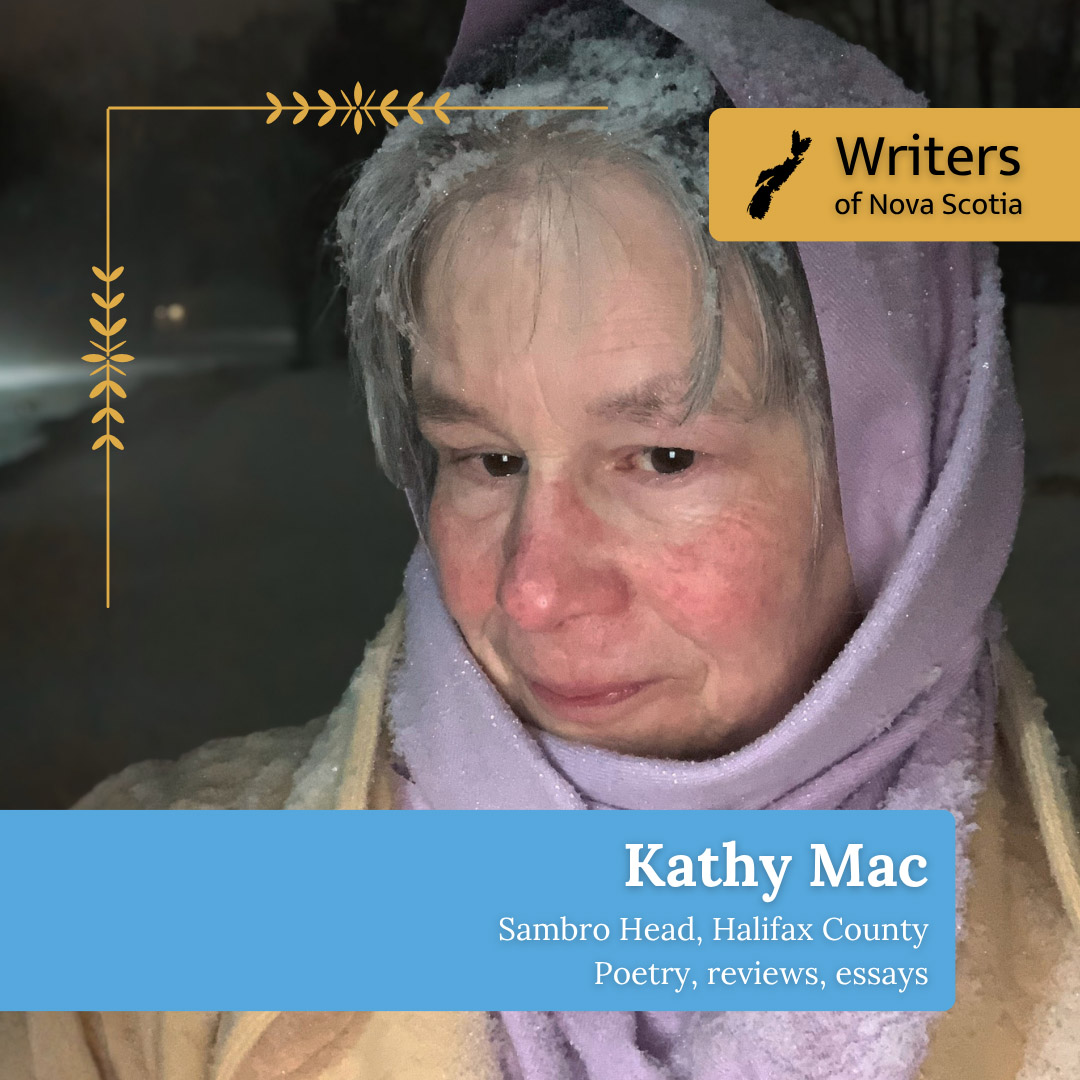
Kathy Mac has published three poetry books (with Roseway Publishing), two on writing (with Wording Around), and one of essays (with Wolsak and Wynn). She retired from teaching Creative Writing at Saint Thomas University in Fredericton, NB, and now lives near Kjipuktuk in the territory of the Mi’kmaq.
What’s your current work-in-progress?
A poetry manuscript called How to Disassemble a Life. Specifically, “The Head On Poems,” which obsessively revise a moment in 2020 when I was nearly T-boned by another car in the otherwise empty road. (It was during lockdown.)
What’s the best writing advice you’ve ever received?
“Find the white heat in your writing, and get rid of anything else,” as Anne Simpson said at a workshop in Fredericton in September, 2014.
What’s a surprising source of inspiration for you?
Industrial pop culture. I’ve written “The Twilight Quartet: Romance, Pain, Porn and Complicity,” “Omar Khadr is Not Harry Potter,” “The Inevitable Feminist Treatise on Catwoman,” “Sunnydale Library Explains” (on Buffy the Vampire Slayer), and others.
Any recommendations for NS writers & readers?
Joe, host of Open Book Coffee in Halifax, where you’ll find a café/bookstore; a backroom for readings, launches, book clubs, write-ins, and even yoga; the offices of Nimbus Publishing / Vagrant Press; and a warehouse that distributes books from over 60 Atlantic publishers.
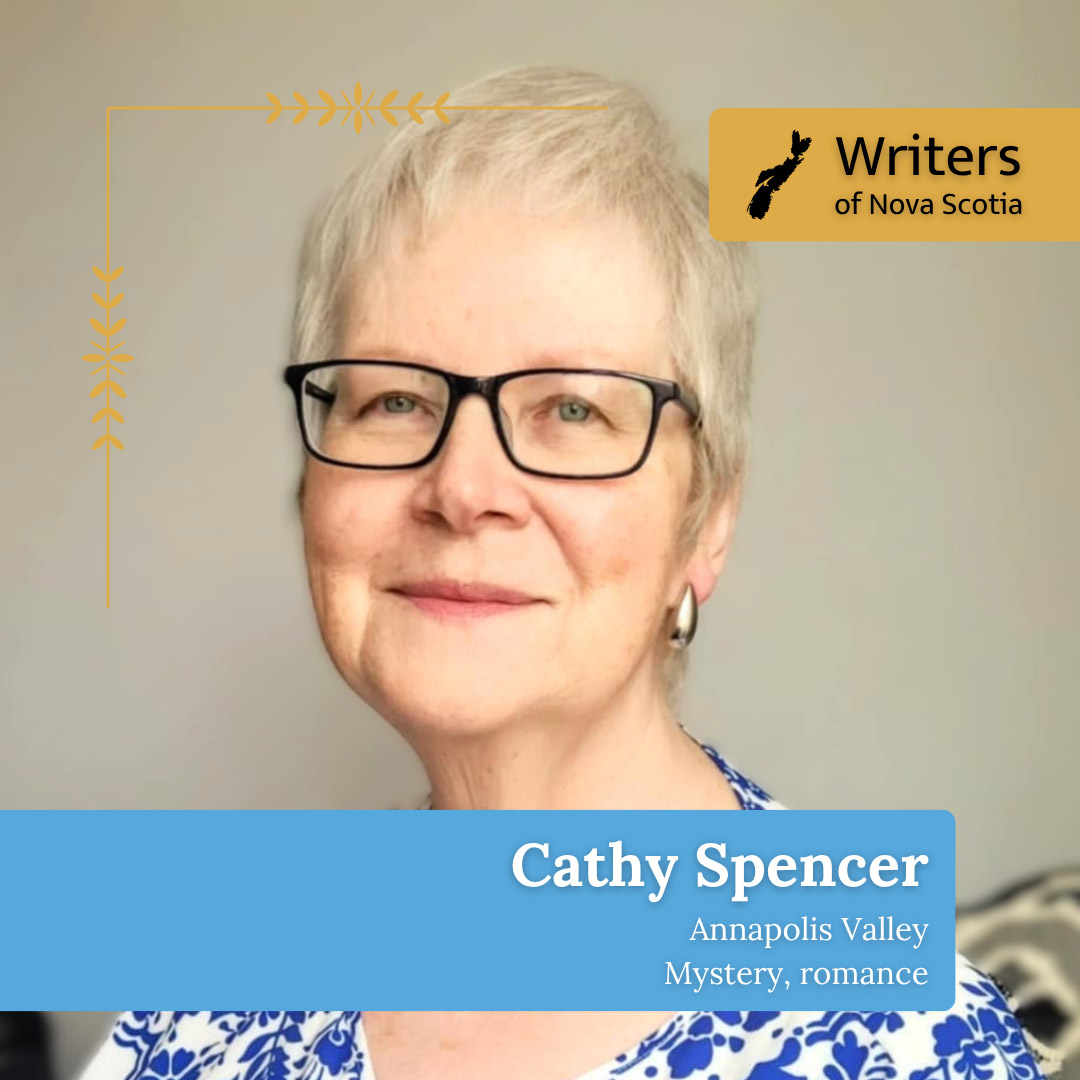
Cathy Spencer is the award-winning author of the Anna Nolan mystery series and two stand-alone romances. Her latest mystery is set in Kentville, NS, in 1927 and involves speakeasies, rumrunners, and a missing woman.
What’s your current work-in-progress?
I’m currently looking for a publisher for my first Eveline Gruen historical mystery, Dancing in the Devil’s Half Acre. I’m also writing a second book in the series, Murder on the Dominion Atlantic. Both are set in Kentville.
What’s the best writing advice you’ve ever received?
You’ve got to catch your reader with the first few paragraphs, but the rest of the book has to be just as polished.
When did you first feel confident calling yourself a writer?
I published my first three novels with a small e-book publisher, who did no editing, and we parted ways. However, my second novel, Framed for Murder, won the 2014 Bloody Words Light Mystery Award, and I felt validated.
Any recommendations for NS writers & readers?
When I first visited the Kentville Library, I asked if they had a writers’ group. They said no but asked if I’d like to start one. I did, and over the past three years, the library has been very supportive and encouraging.
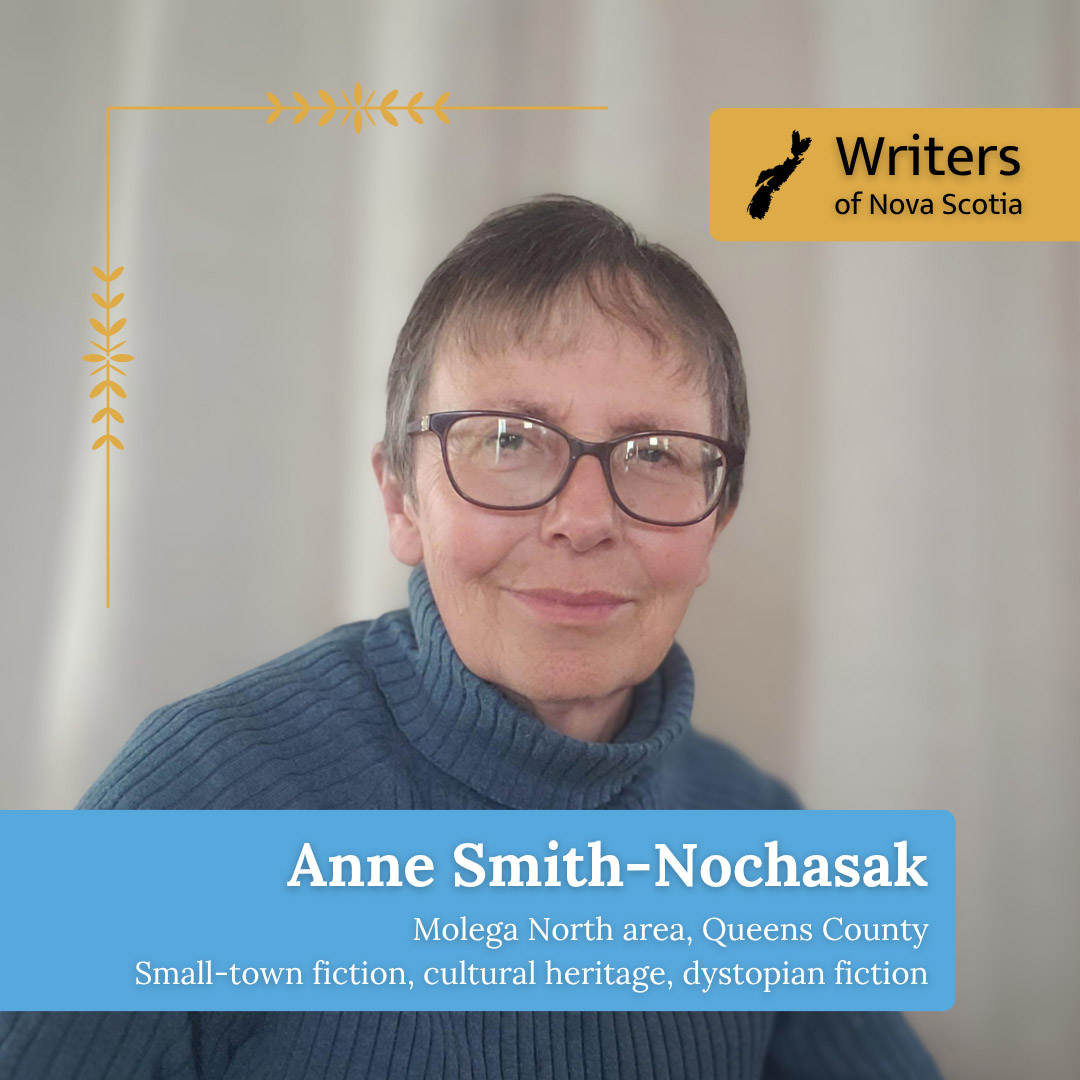
Anne Smith-Nochasak grew up in rural Nova Scotia. After many years teaching in northern Canada, she has resettled in western Nova Scotia, where she teaches part-time while focusing on writing her novels.
What’s your current work-in-progress?
I am working on River Reflects Earth (Taggak Journey series, Book 3). After traversing the apocalyptic wilderness of the Maritimes to raise the revolution, River and her companions turn towards home, to face the final elemental battle for the Earth.
What’s the best writing advice you’ve ever received?
The best writing advice I’ve received is to release the story that is in me. There will be many edits and revisions and rewritings later, but first of all, get the story out in all its rawness and honesty.
What’s a surprising source of inspiration for you?
My summers at my cabin remain my inspiration. Canoeing the lake while a thousand colours swirled on its surface and the loons’ ecstatic cry swept the stillness, I was alive. It remains the source of everything I write.
Any recommendations for NS writers & readers?
Block Shop Books in Lunenburg offers a warm welcome to everyone who enters. Duck through the door under the balcony and be swept into a colourful array of books of all genres, age groups, and interests. Great author support too.
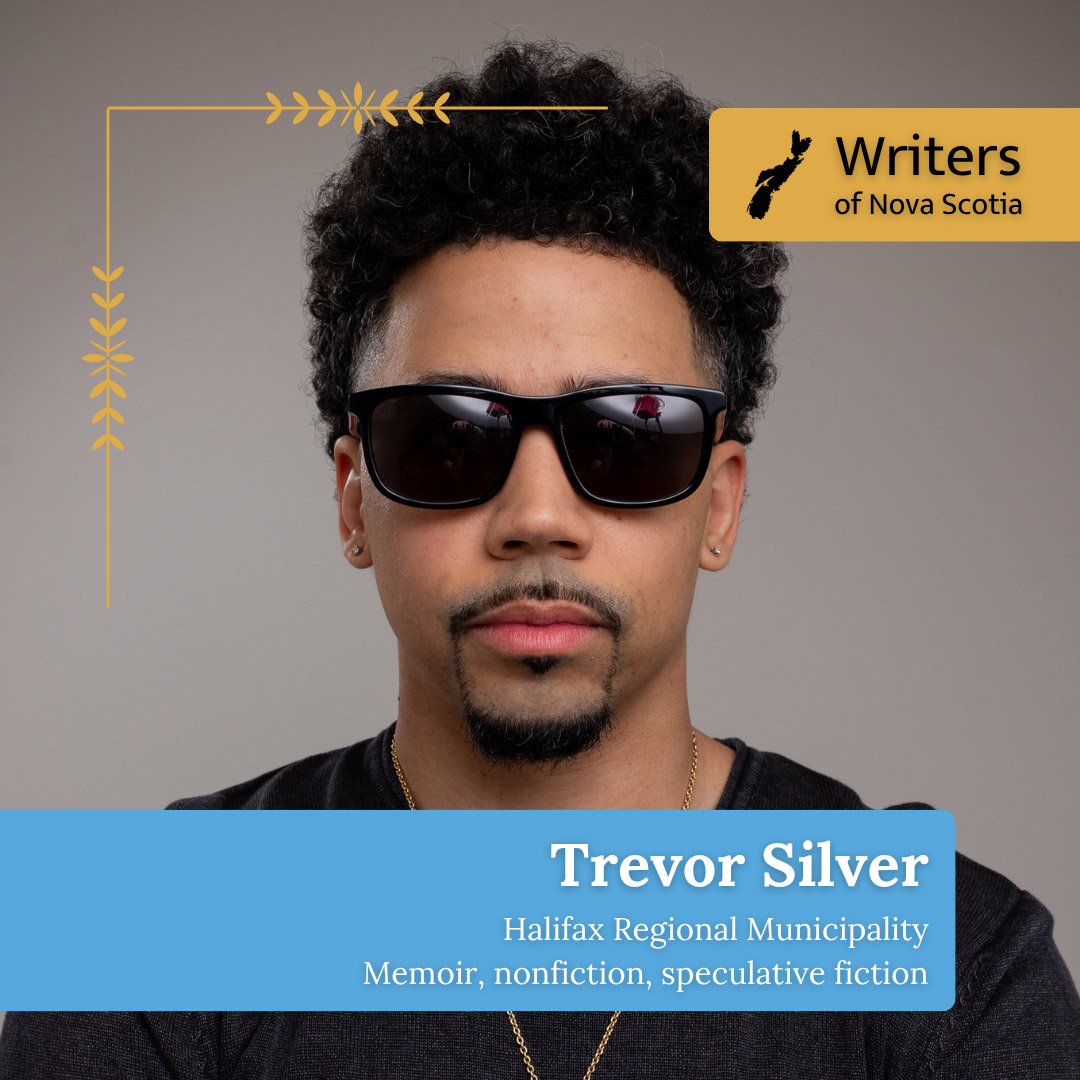
Trevor Silver is a North Preston storyteller, entrepreneur, and founder of tREv. Through fashion, writing, and digital media, his work explores identity, ambition, community, and African Nova Scotian experiences. He is developing two books: Turning Silver Into Gold and The Adventures of Trustamundo.
What’s your current work-in-progress?
I’m developing Turning Silver Into Gold, a reflective collection of life lessons and personal experiences, alongside The Adventures of Trustamundo, a storytelling project exploring identity, culture, ambition, and digital worlds.
What’s the best writing advice you’ve ever received?
I’ve learned that the most powerful writing comes from honesty. People connect most deeply when you stop trying to sound impressive and simply tell the truth as clearly and meaningfully as possible.
When did you first realize that stories matter?
I realized stories matter when I saw how people from my community carried history, lessons, pain, humour, and ambition through conversation. Long before I thought about books, I understood storytelling as something that shapes identity, memory, and possibility.
Any recommendations for NS writers & readers?
I’d recommend the Delmore “Buddy” Daye Learning Institute for its commitment to preserving African Nova Scotian history and storytelling. Guyleigh Johnson showed me writing was possible for folks from my community, and Ross Simmonds’ work continues to inspire me professionally.
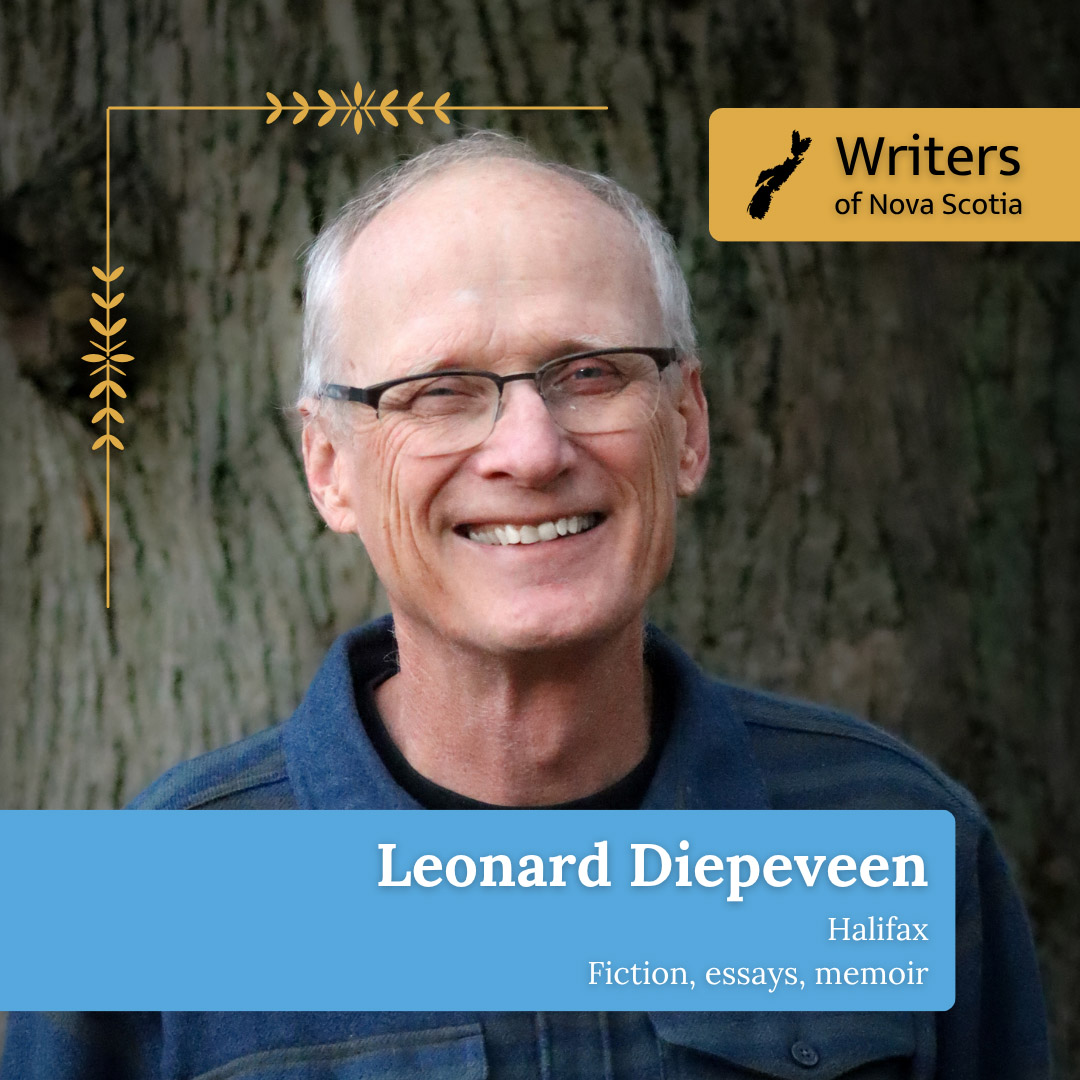
After a career in academia, Leonard Diepeveen has turned to fiction and life writing. The English edition of his memoir—When I Come Back We will Talk: My Father, the War, and Me—will be published in September, 2026.
What’s your current work-in-progress?
I am in the final stages of production of my memoir. When I can focus, I try to finish some shorter pieces, most of which are loosely autobiographical.
What’s the best writing advice you’ve ever received?
Get used to rejection. Lots of rejection.
When did you first feel confident calling yourself a writer?
I first felt I could call myself a writer when my first non-academic work was favourably received by someone who was not a relative.
Any recommendations for NS writers & readers?
The Halifax Central Library! Wonderful staff, welcoming to the whole community. And the Local History room on the 4th floor is a beautifully lit, quiet space to spend a few hours writing.
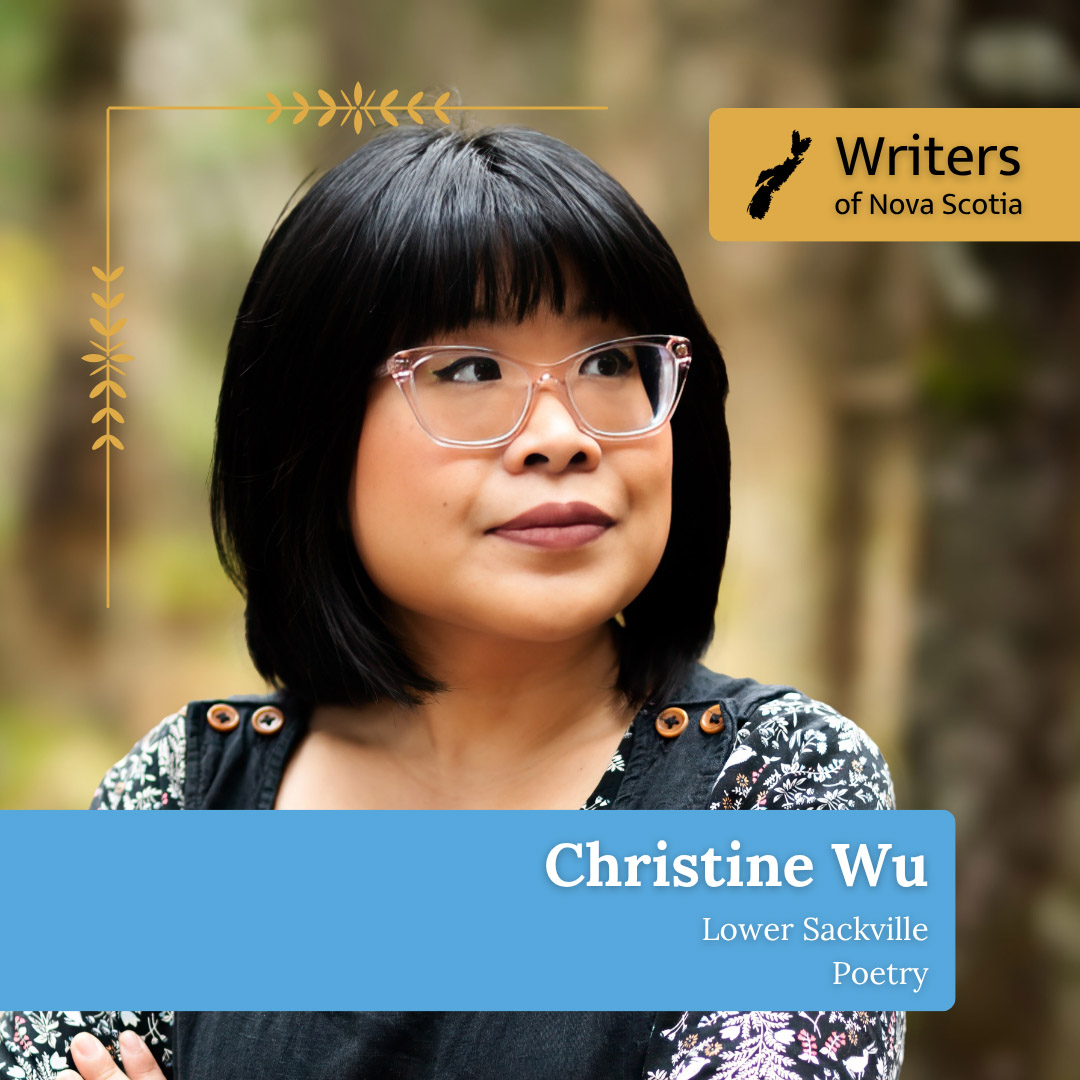
Originally from the West Coast, Christine Wu is a Chinese-Canadian poet living and writing in Mi’kma’ki. Her debut poetry collection, Familial Hungers (Brick Books, 2025), was a finalist for the 2026 J.M. Abraham Atlantic Poetry Award.
What’s your current work-in-progress?
I am working on a second collection of poems, about leaving the Church and losing my late father and the ways those two experiences intersect and complicate one another.
What’s the best writing advice you’ve ever received?
Try things out. Play with words. Read copiously.
What’s a surprising source of inspiration for you?
The funny little fleeting thoughts that flutter through my head often turn into poems, whether it’s eavesdropping on a conversation heard at the dentist’s office or thinking about what constitutes being a ghost.
Any recommendations for NS writers & readers?
I’ve been lucky to be part of multiple events organized by AfterWords Literary Festival. I especially love their Youth Mentorship program: it reminds me of the workshops I took as a teen that solidified my desire to become a writer.
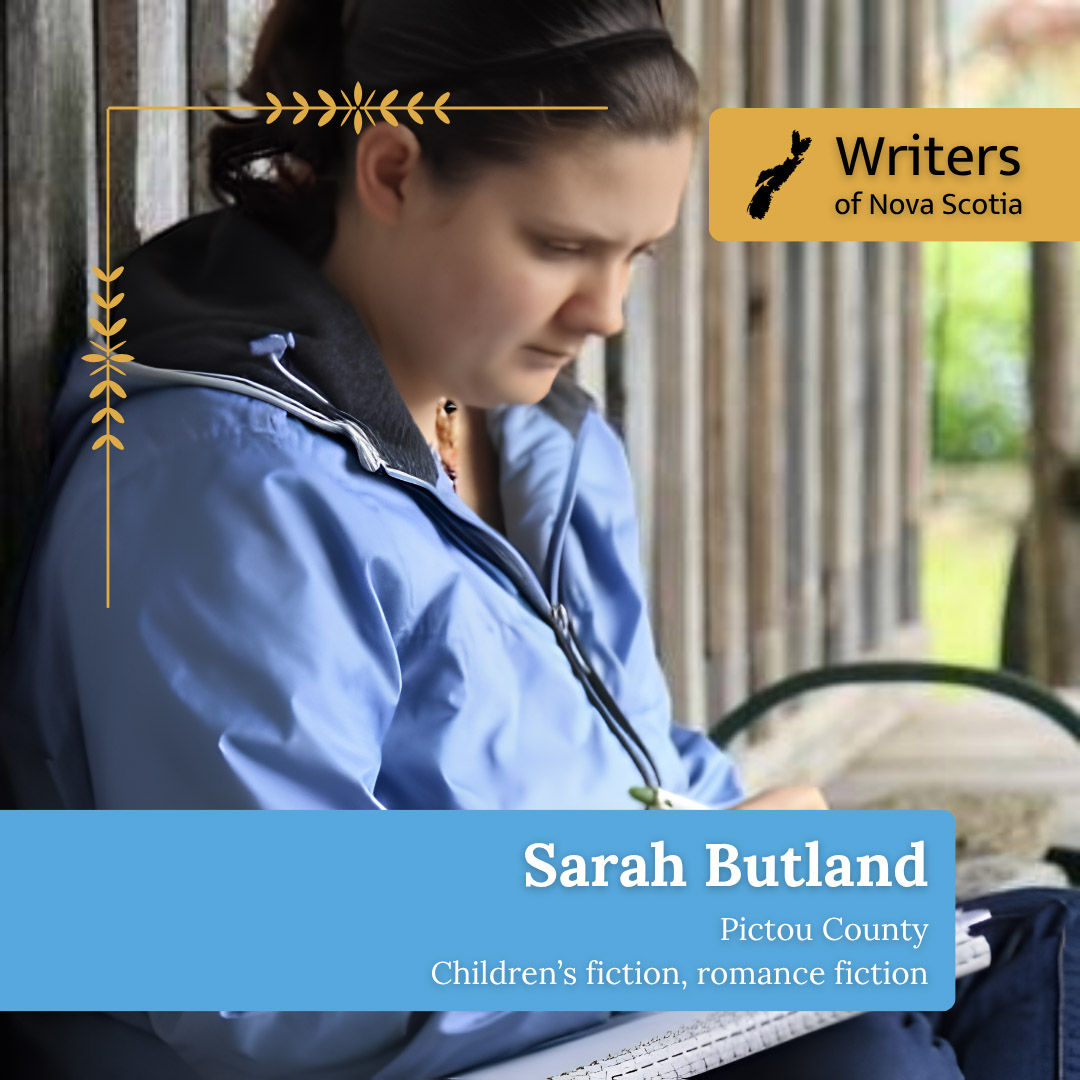
Freelance writer, author, writing coach, and dreamer Sarah Butland lives in Pictou County and thrives through the literary form.
What’s your current work-in-progress?
I am currently writing a book I started years ago with my father-in-law, who has passed away, inspired by Brier Island and our weekend there.
What’s the best writing advice you’ve ever received?
Write for yourself. Find your joy in the process. And don’t fret about the whole project: take it one sentence at a time.
When did you first realize that stories matter?
Stories mattered to me from a very young age. Craving an escape from reality, I devoured books well above my expected grade level and dove into worlds I loved.
Any recommendations for NS writers & readers?
There are so many Nova Scotian authors I adore, including Charlene Carr, Tom Ryan, Vernon Oickle, and TP Wood. All have something special to offer and are people I consider friends.
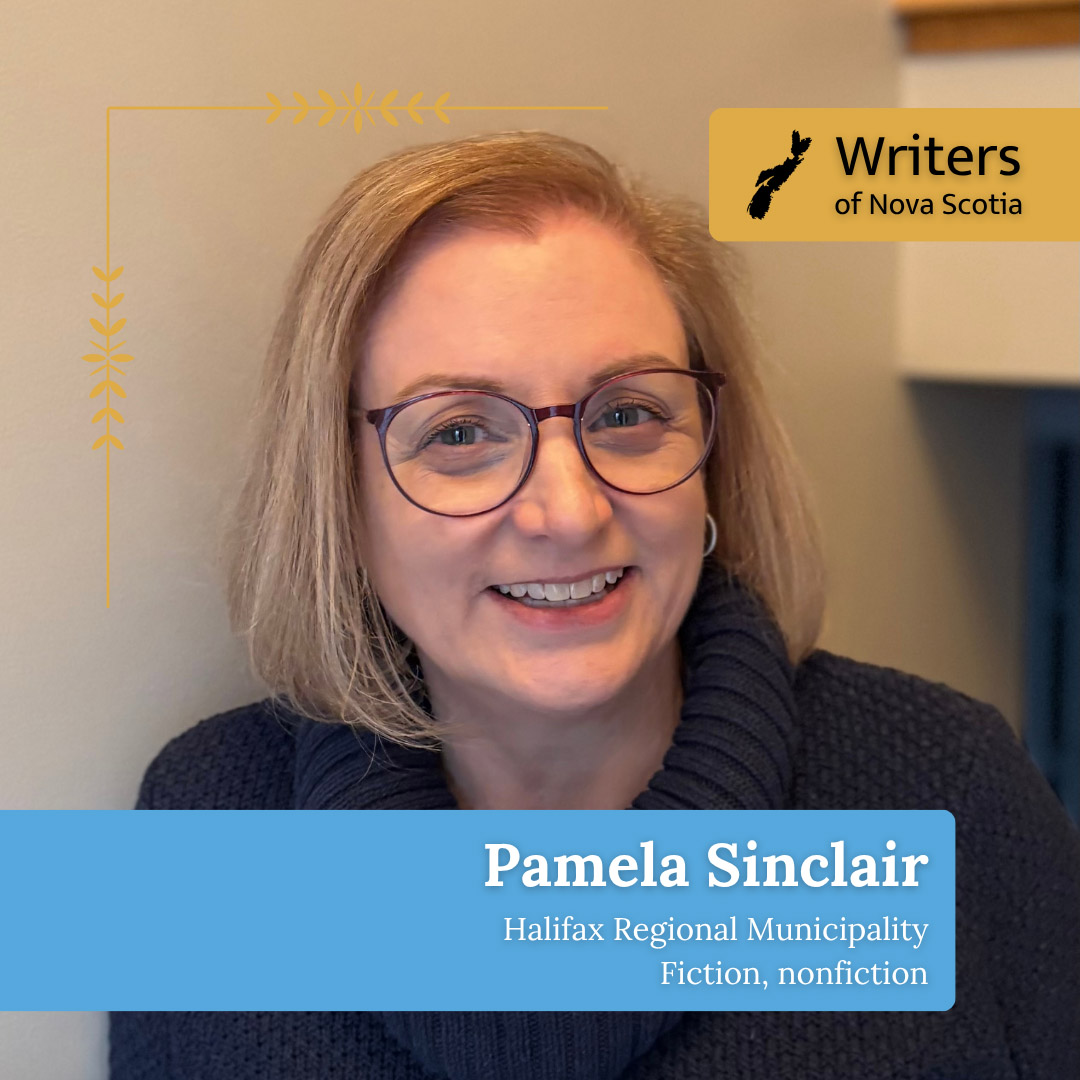
Based in the Halifax Regional Municipality, Pamela Sinclair is an apprentice fiction writer in the 2026 Alistair MacLeod Mentorship Program.
What’s your current work-in-progress?
My current work-in-progress is about a small family navigating their role in a secret society. With a contemporary setting, the story blends multiple genres and includes speculative fiction elements and a mysterious disappearance.
What’s the best writing advice you’ve ever received?
My favourite piece of writing advice is that revision is writing. Messy first drafts are part of the process, but you can only revise what is already on the page.
When did you first realize that stories matter?
When I started reading stories as a young child, I felt the deep connection and immersion into the world of a story’s characters. That drawn-in sensation is what I still seek today when reading.
Any recommendations for NS writers & readers?
A great resource for readers and writers looking for their next great read is The Seaboard Review of Books. They specialize in reviewing titles from small Canadian presses, and their newsletter is not paywalled.
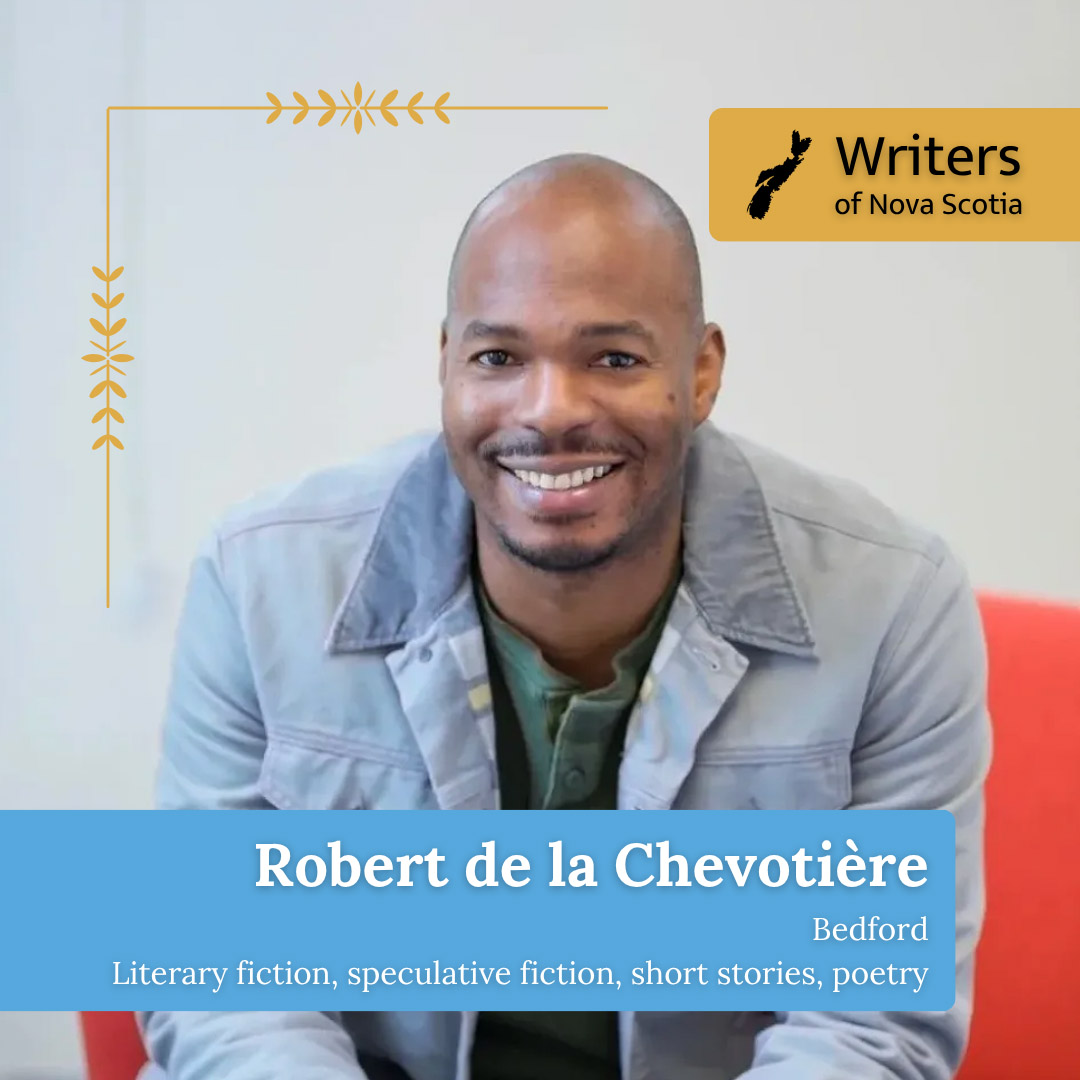
Robert de la Chevotière is the author of two novels, with a third novel—The Twelfth House—forthcoming in August, 2026. His writing centres the Caribbean diaspora’s resistance, both quiet and loud. He moonlights as a junior high teacher most days.
What’s your current work-in-progress?
Take a little bit of Blackness, add a touch of hospice, a cup of regret, a dash of afterlife, sprinkle karaoke and an open mic—and for goodness sake, do not forget the red dress!
What’s the best writing advice you’ve ever received?
I attribute this to my wonderful mentor, Evelyn C. White: I am on nobody’s time but mine. Don’t rush the writing. Take my time.
What’s a surprising source of inspiration for you?
When there is a lot of noise, or if my spirit feels heavy or my mind cloudy, I write until I find the silence on the page, or the clarity, or some levity. And then, I write.
Any recommendations for NS writers & readers?
I am discovering so many wonderful bookstores and bookfolk. I would have to say that Trident Booksellers and Cafe in Halifax is one of my favourite places to write. Just an absolutely perfect atmosphere!
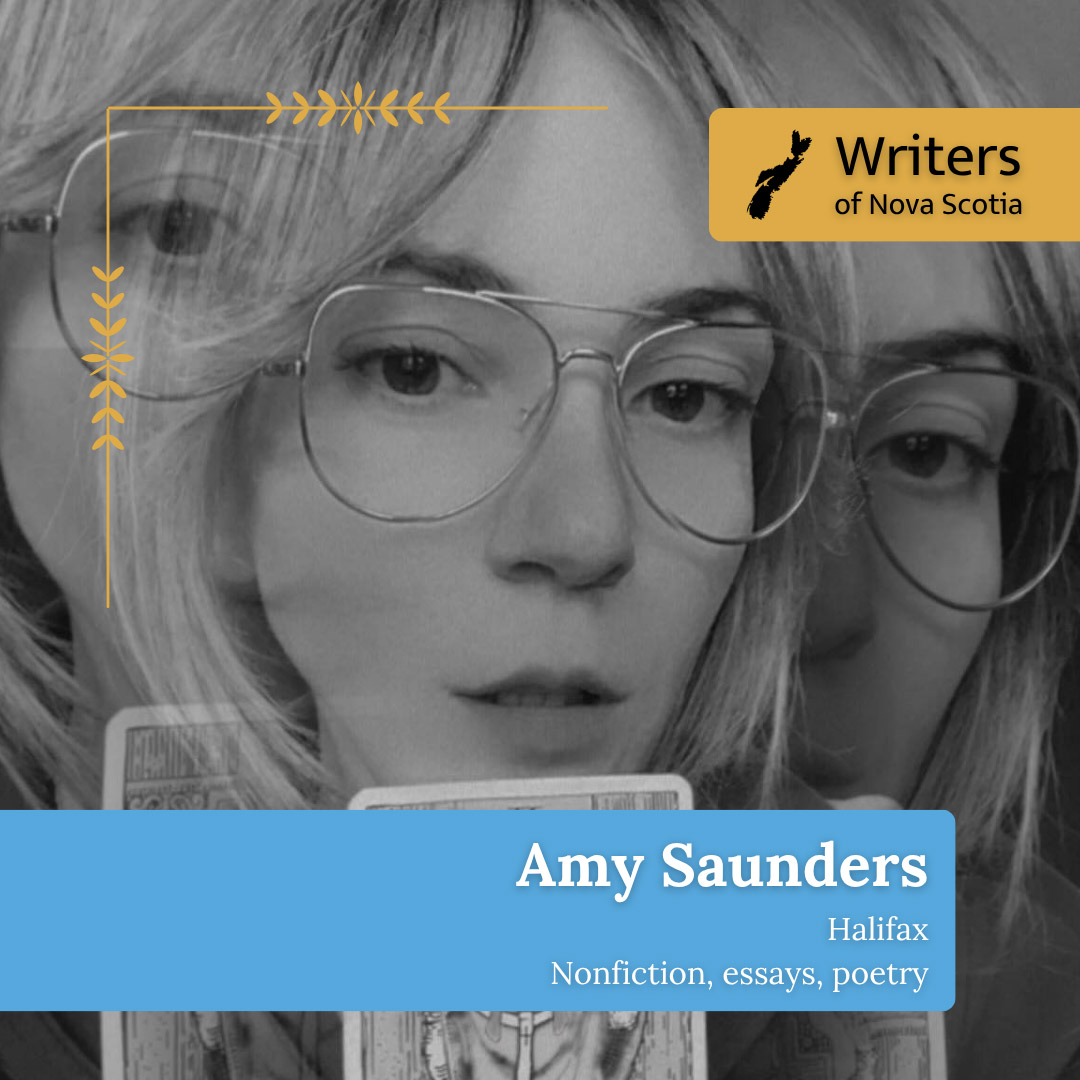
Amy Saunders is a queer, award-winning writer and poet. An alumna of Banff Centre for Arts and Creativity, she is a writer of essays, poetry, memoir, and branded content. Her work has appeared in a variety of Canadian outlets.
What’s your current work-in-progress?
I am working on my first book, a memoir titled To Carry a Corpse, about my relationship with my father following his death.
What’s the best writing advice you’ve ever received?
Fawn Parker told me to “work it out on the page.” It changed the way I saw my writing process, and it is something I remember every time I sit down to write.
When did you first realize that stories matter?
Very young, I began holding family and friends hostage for my ‘poetry readings’ in our family living room. Every word I spoke felt like a spell cast—and I knew then that there was magic in writing.
Any recommendations for NS writers & readers?
I’ve read Mother of God by Sara Peters about three times already this year. I was delighted to learn that she hails from Antigonish. Her work casts spells, and I encourage everyone to allow themselves to be bewitched.
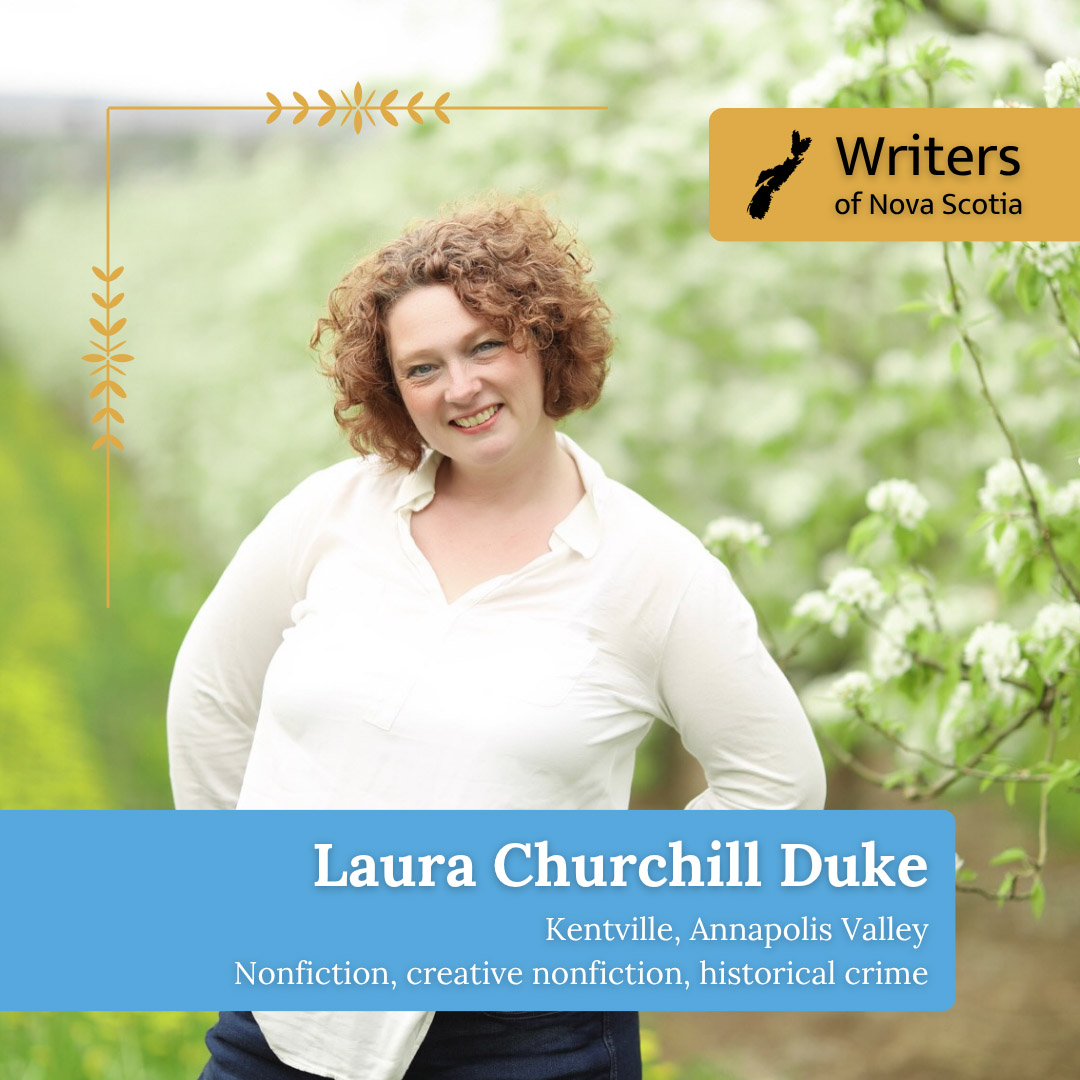
Laura Churchilll Duke is a communication specialist and journalist in the Annapolis Valley. She teaches communication to first-year students at Acadia University, focusing on writing, research, and presentation skills. She is the author of three historical murder books.
What’s your current work-in-progress?
I am currently working on my fourth historical murder novel, which takes place on the Fundy Five Islands in the 1840s. It will be published later this year with Moose House Publications.
What’s the best writing advice you’ve ever received?
Write every day. Set a timer, even if it is just for 20 minutes, and write anything. Don’t go back to edit it, but let the ideas flow. Some days, you will write more, and others, that’ll be enough.
When did you first realize that stories matter?
In Grade 2, I was proud to have one of my poems on display in the mall. In Grade 6, I wrote a detective series and my teacher said, “Keep writing. You might make money some day.” Teachers are inspirational!
Any recommendations for NS writers & readers?
The Annapolis Valley is full of wonderful independent sellers who are supportive of local authors. I love R. D. Chisholm in Kentville, Hennigar’s Farm Market in Greenwich, and Inside Story in Greenwood.
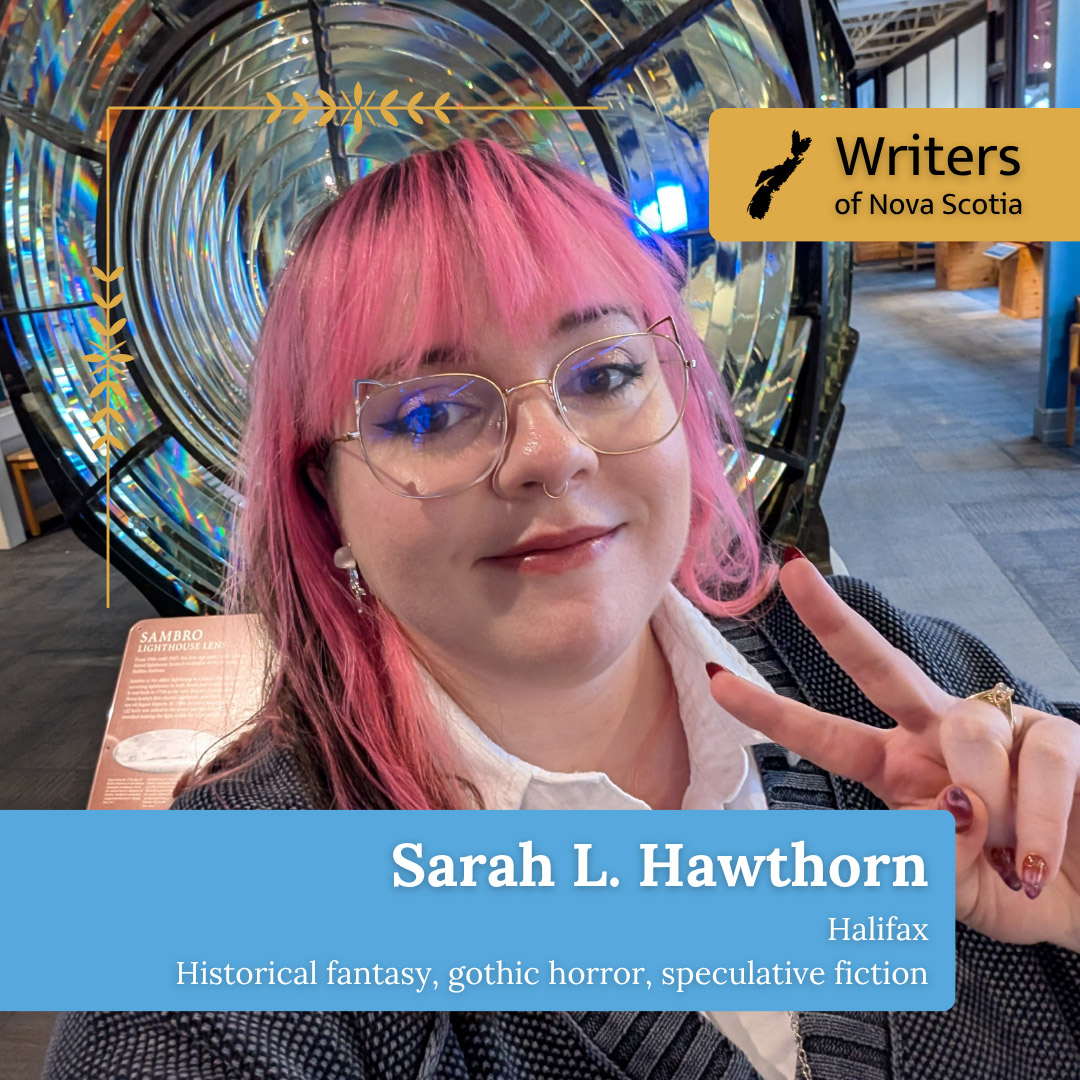
Sarah L. Hawthorn is a Nova Scotian speculative fiction writer. Her debut novel, A Fate Worse than Drowning, will be published by Sourcebooks in July. Their short fiction has been featured in The Arcanist and the Queer Blades anthology.
What’s your current work-in-progress?
My debut novel set on Devils Island, A Fate Worse Than Drowning, comes out July 21. I’m working on another historical fantasy, set in 1890s Nova Scotia and inspired by the Joggins Fossil Cliffs I loved visiting as a kid!
What’s the best writing advice you’ve ever received?
Rejection is proof you’re showing up for yourself. My writing group started ‘collecting’ rejections as a challenge to put ourselves out there more. It made a huge difference in how I process rejection! Also: be nice, publishing is small!
What’s a surprising source of inspiration for you?
I love researching Nova Scotian folklore and historical archives for inspiration. It’s amazing what kinds of questions you can shape into a book with the intriguing gaps that emerge, and how much closer it brings you to your own history.
Any recommendations for NS writers & readers?
Shoutout to some phenomenal Nova Scotian talents: Tiffany Morris, Elliott Gish, Brittni Brinn, Peter Counter, Mere Joyce, Katie Conrad, Jenna Harvie, Jeanna Cotnam (Cammarano), Sal Sawler and Cat Rector!
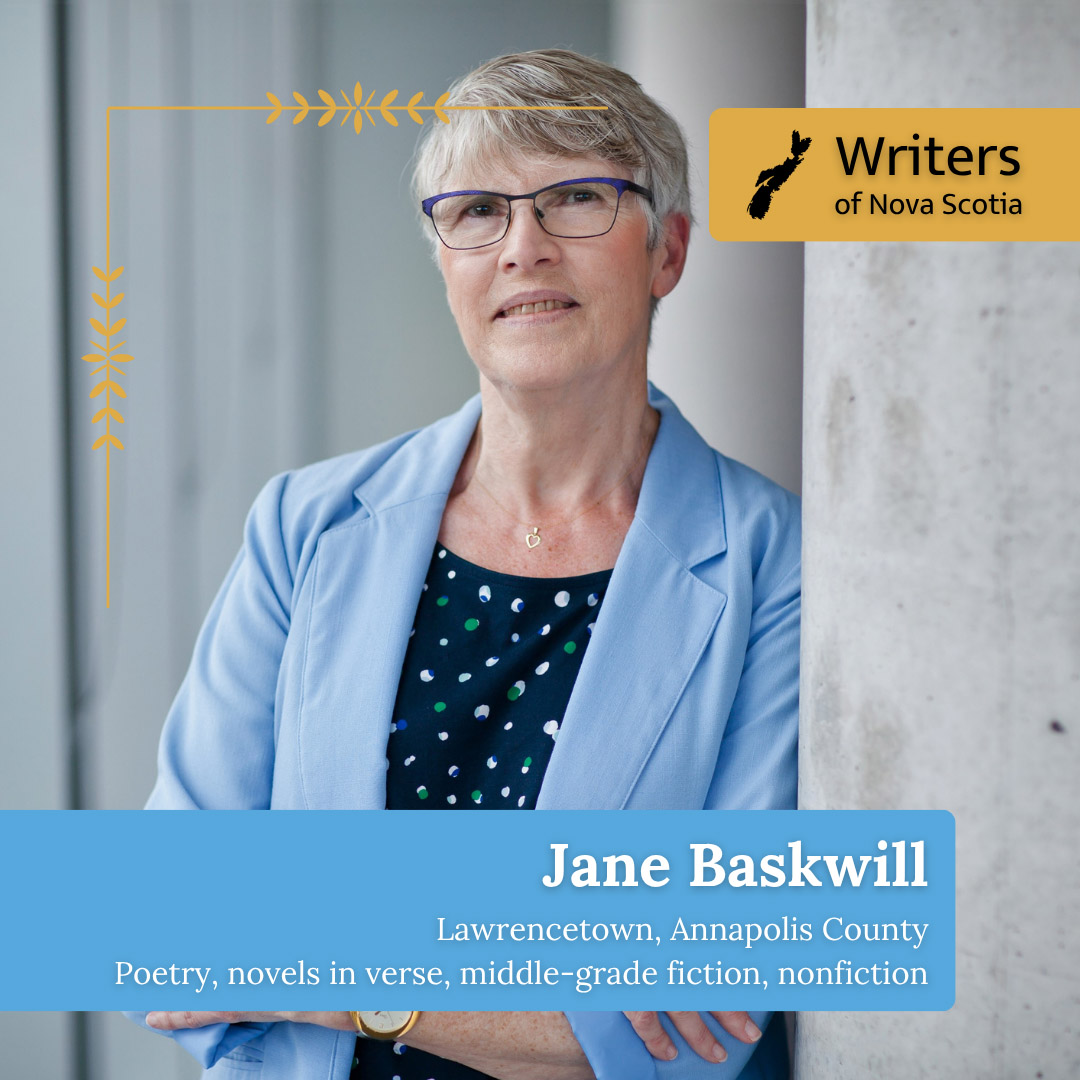
Jane Baskwill is a Nova Scotia poet and novelist in verse whose work explores history, folklore, and belonging. Based in Lawrencetown, Annapolis County, she draws on coastal landscapes and community memory to create stories rooted in place and shared experience.
What’s your current work-in-progress?
I am working on my third Lori Daniels mystery, a middle-grade ghost story in verse inspired by the history and landscapes of the Annapolis Valley. One restless spirit and a long-buried secret refuse to stay hidden.
What’s the best writing advice you’ve ever received?
My mentor Jane Yolen once told me, “Don’t you dare give up. Sit your butt in the chair and keep going.” It remains the truest writing advice I know.
When did you first realize that stories matter?
I learned stories matter when my childhood writing wall was painted over and my stories were lost. My parents gave me a notebook, and I have been keeping stories safe ever since.
Any recommendations for NS writers & readers?
I love Tattletales Books & Toys in Dartmouth for its thoughtful selection and deep commitment to matching children, families, and teachers with the right books. It’s a welcoming place where stories truly find their readers.
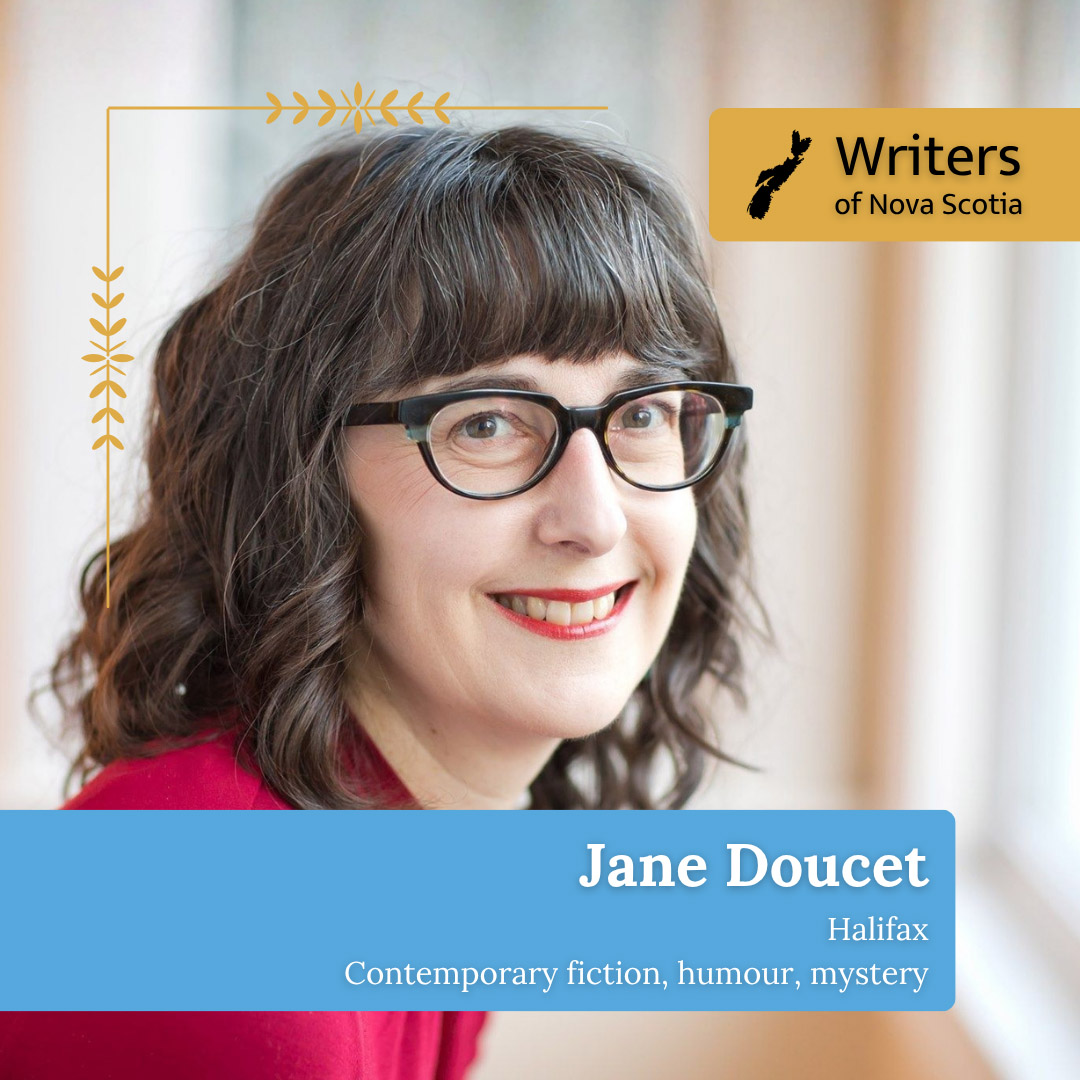
Jane Doucet is a journalist who self-published her debut novel, The Pregnant Pause, in 2017. Vagrant Press, the fiction imprint of Nimbus Publishing, has released her subsequent novels: Fishnets & Fantasies; Lost & Found in Lunenburg; and Blood Typed.
What’s your current work-in-progress?
Death at the Petting Zoo, the second novel in my Val Jenkins Mystery series.
What’s the best writing advice you’ve ever received?
I can’t think of an answer, but the best advice I give is, “Bum on chair; fingers on keyboard; GO.”
When did you first feel confident calling yourself a writer?
When I signed the Vagrant Press contract for Fishnets & Fantasies.
Any recommendations for NS writers & readers?
Fellow Nova Scotian writer Janice Landry is a phenomenal reporter and writer who supports so many others in so many ways, myself included. I feel blessed to call her my friend!
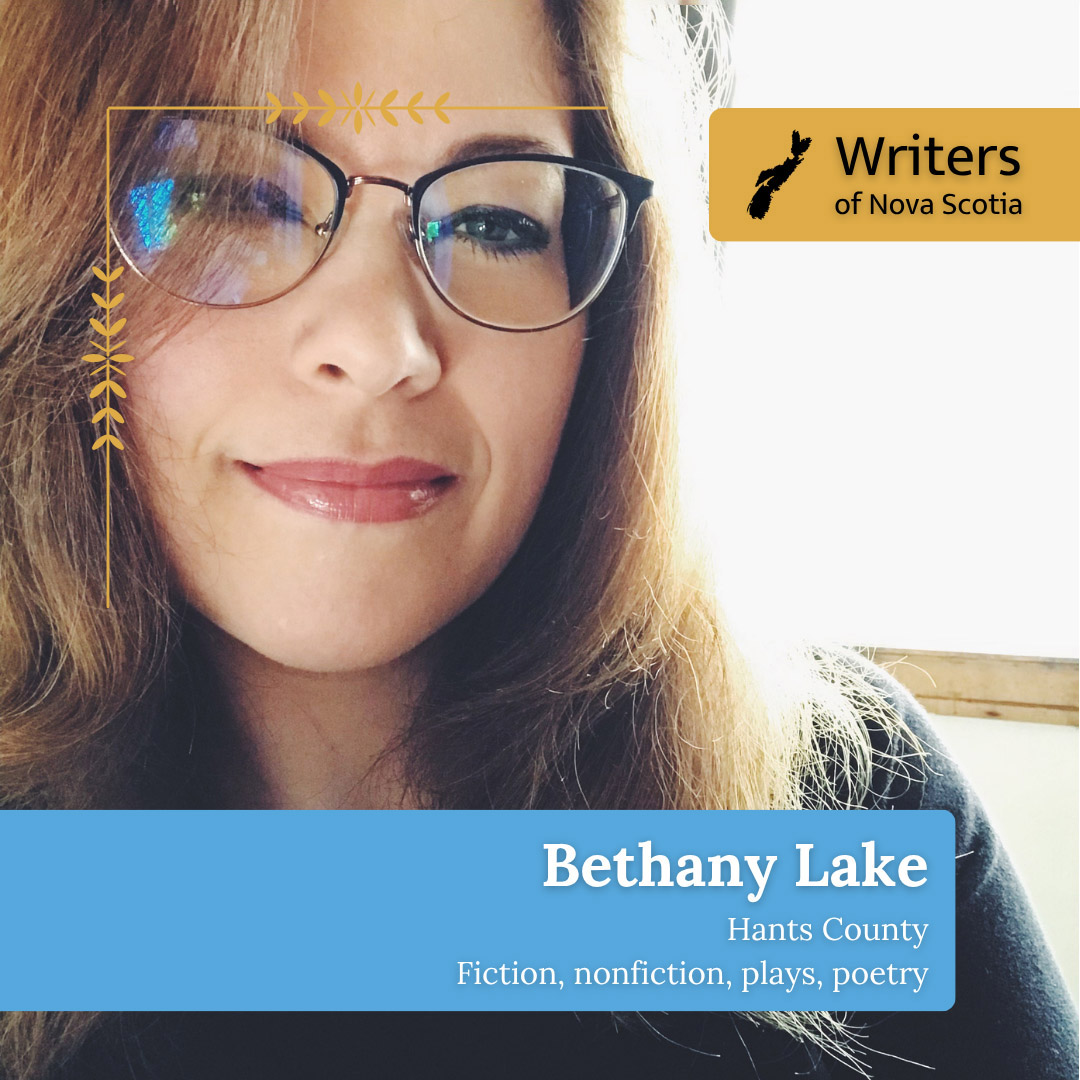
Bethany Lake is a playwright, novelist, and freelancer who has been published in numerous publications across North America. She is writing her second novel while also working as both a manuscript reviewer and a professional juror for several writing awards.
What’s your current work-in-progress?
I am currently working on my second novel while also making detailed notes for my third.
What’s the best writing advice you’ve ever received?
Playwright Anna Chatterton once told me, “Write one line, and then think: How does that make each character feel?”
What’s a surprising source of inspiration for you?
I write all my first drafts on a typewriter. No blue light, no internet and its endless distractions. A computer is great for later drafts, but for me, for a first draft, the typewriter is the best way to go.
Any recommendations for NS writers & readers?
Author Sylvia Gunnery, my mentor through the Alistair MacLeod Mentorship Program, was an endless source of encouragement and inspiration for me. What she taught me about character voice and narrative structure I carry with me to this day.
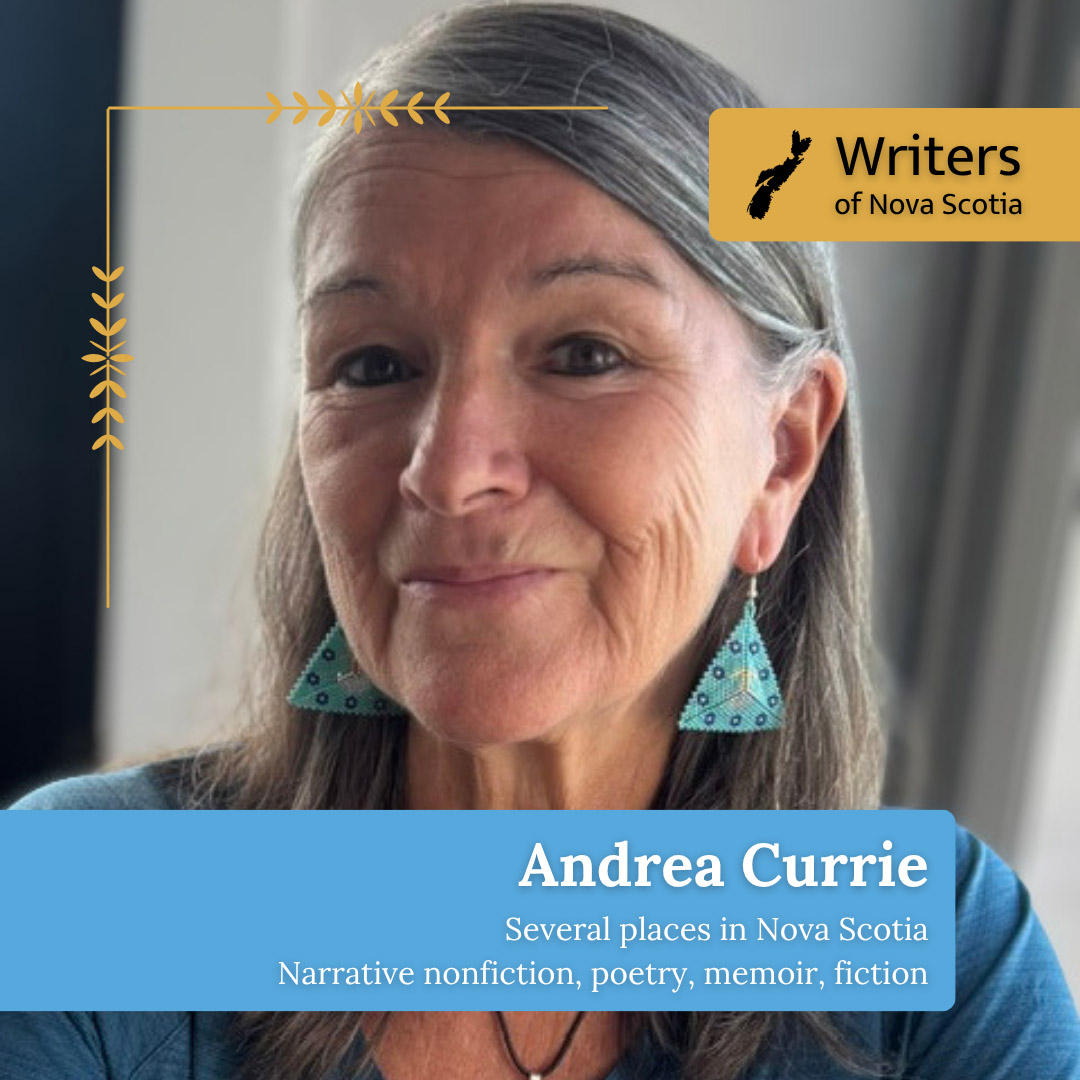
Andrea Currie, Red River Métis, wrote Finding Otipemisiwak: The People Who Own Themselves, a collection of memoir, essay, and poetry about the profound loss and alienation experienced by Sixties Scoop Survivors. Her second book, a novel, is in the works.
What’s your current work-in-progress?
A novel with the working title Ebbie and Tub.
What’s the best writing advice you’ve ever received?
From my Métis and Mi’kmaw Elders: “Stories are medicine.”
What’s a surprising source of inspiration for you?
I heard playwright Daniel MacIvor interviewed, and he described himself as a writer as ‘a professional human.’ This resonated with me because my writing is an expression of who I am and how I want to be in the world.
Any recommendations for NS writers & readers?
I love the Cabot Trail Writers Festival! They have embraced anti-oppression practice and really walk their talk, taking real and meaningful strides to build relationships with equity-deserving communities and individuals, decolonizing and transforming their festival and programs.
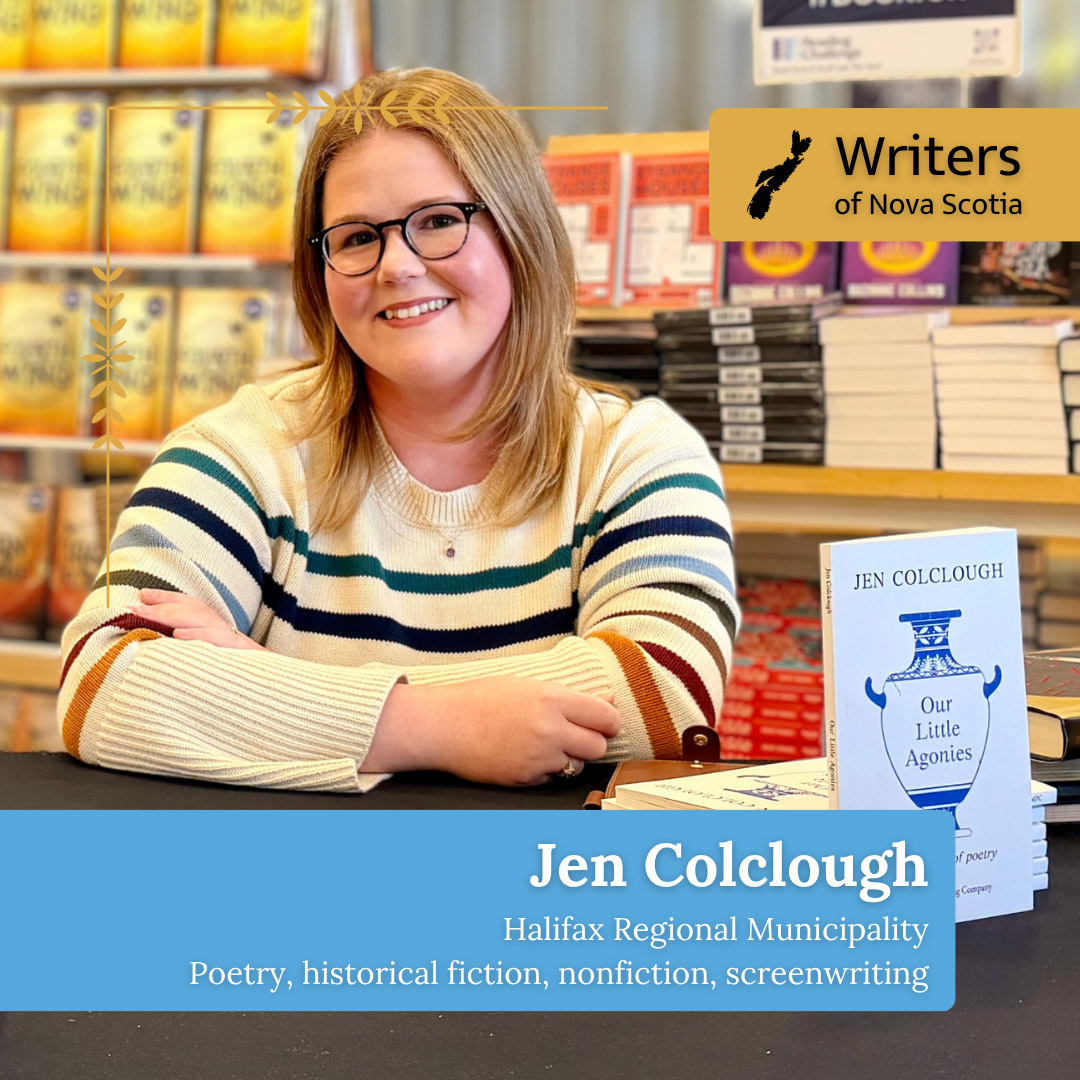
Jen Colclough is a Pushcart-nominated poet, artist, and recovering Classicist from Halifax, Nova Scotia. Her book, Our Little Agonies, was published in 2025 by Montreal Publishing Company.
What’s your current work-in-progress?
I’m currently writing a historical fiction novel and working with my writing partner to develop a serial drama for a major streaming service. Both projects are set during WWI.
What’s the best writing advice you’ve ever received?
To think of writing as similar to the job of a train engineer. The passengers don’t care about switches and levers—they only wish to arrive, preferably on time. You just have to get them there.
When did you first feel confident calling yourself a writer?
When my third grade teacher, Ms. MacDonald, told me I was. Ever since, writing has been my way to connect with the world.
Any recommendations for NS writers & readers?
DartSpeak open mic, held in Dartmouth, is a fun, uplifting community event for writers. It gave me an audience for my work when I was still figuring out my style. They meet the first Thursday of every month and are very welcoming.
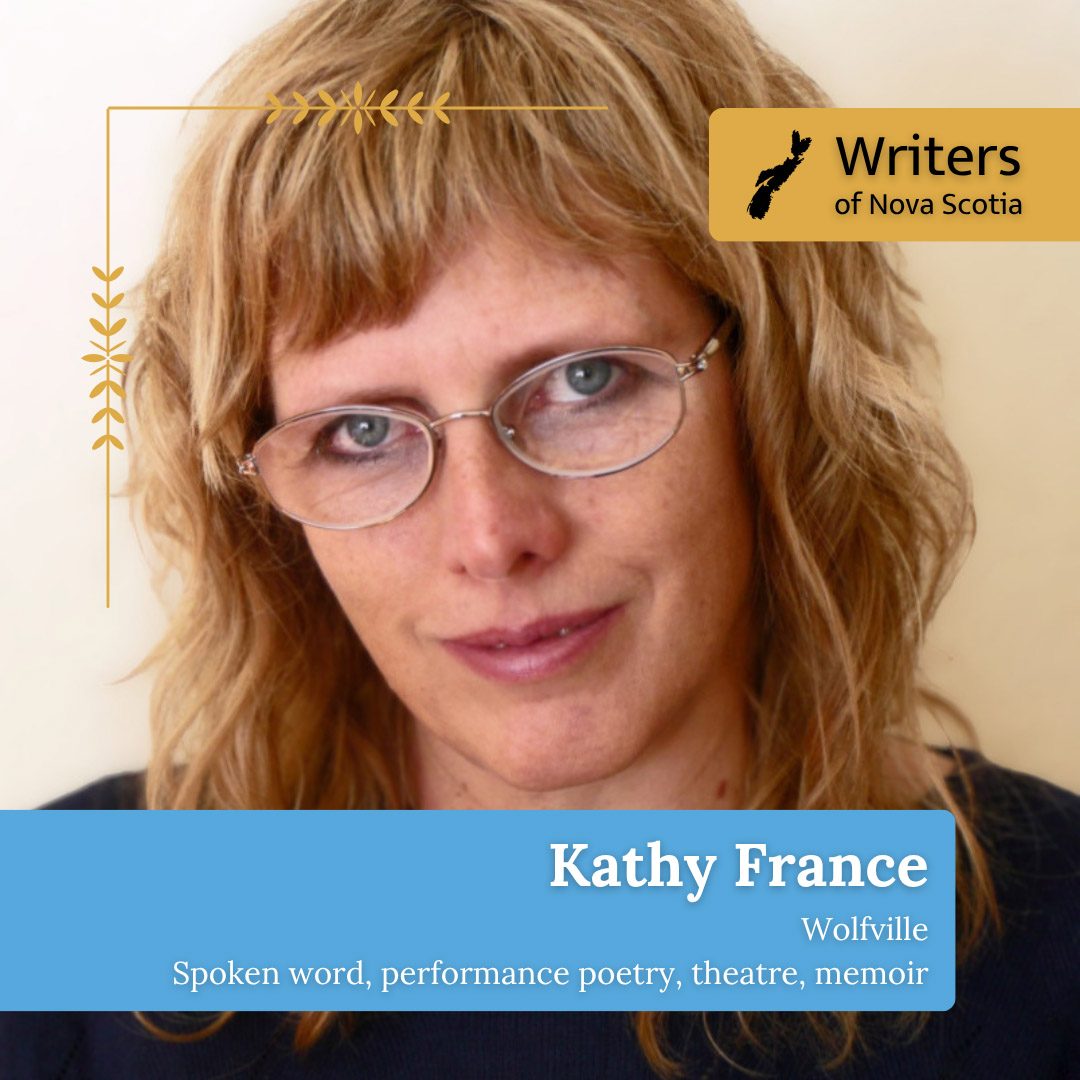
Kathy France enjoys writing plays, poetry and stories. She’s currently working on a travel memoir after having lived many years abroad. Kathy’s plays have been produced by Caravan Theatre, where she serves as Artistic Director.
What’s your current work-in-progress?
I’m writing sketch comedy for a theatre performance and working on a travel memoir. I’m also in early-stage development on a collaborative stage play with Mi’kmaw elder and visual artist Carolyn Landry.
What’s the best writing advice you’ve ever received?
“Write something every day.” Do I do that? Not very successfully, but I try!
When did you first realize that stories matter?
As a teenager, I would endlessly replay every movie I’d seen: quoting dialogue, daydreaming about characters’ motivations, getting lost in an actor’s performance or the film’s visuals. I was obsessed with storytelling expressed through words and physical embodiment.
Any recommendations for NS writers & readers?
Alas, The Box of Delights, an indie bookstore in little Wolfville, went out of business only a few years ago. Author readings, book clubs, writers’ groups, special displays marking local events—that bookstore did it all. Sorely missed!
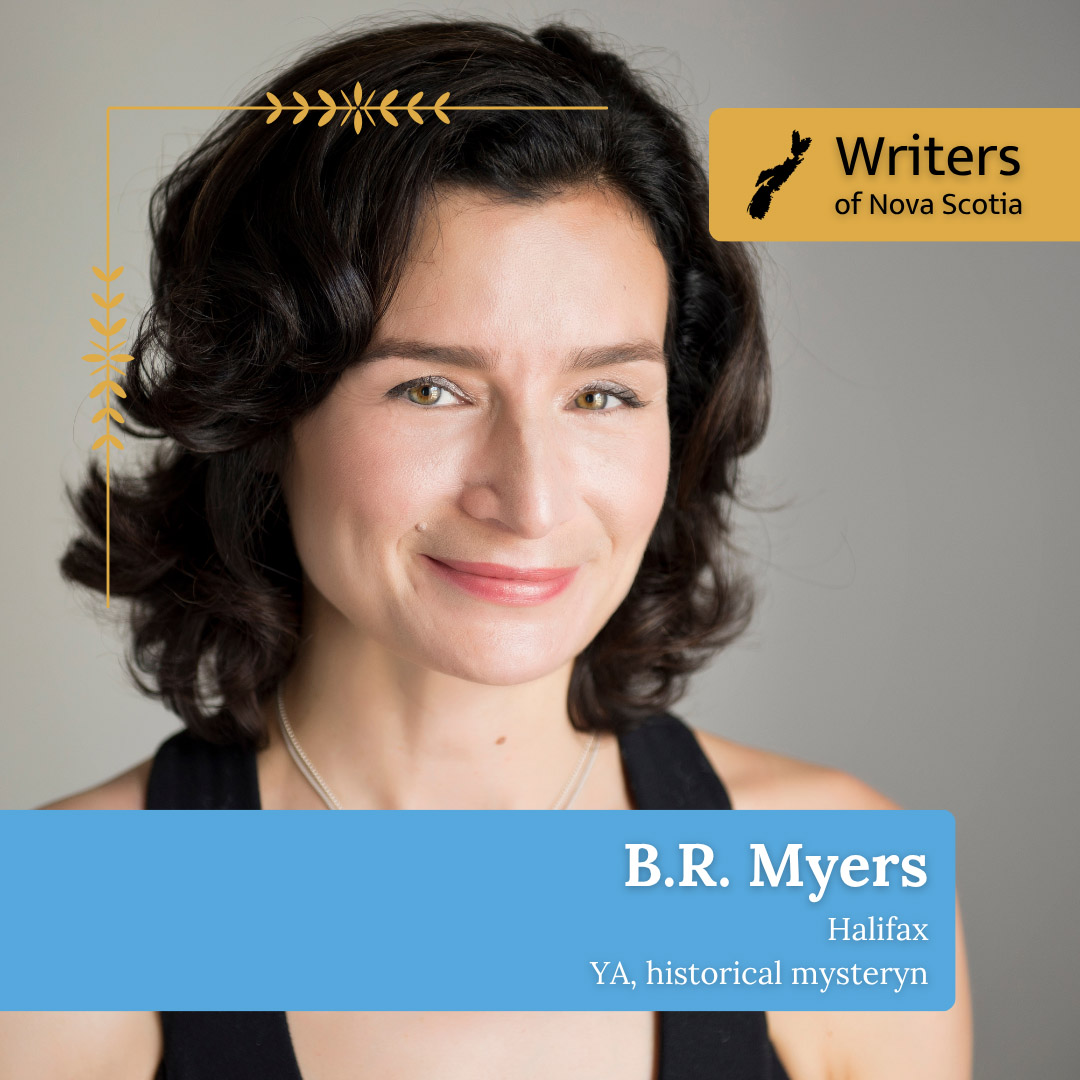
B.R. Myers is an internationally best-selling adult mystery author and Edgar winner. Her YA books have been recognized by School Library Journal, Reader’s Digest, and the Canadian Children’s Book Centre. Before she became a full-time writer, she was a registered nurse for thirty-two years.
What’s your current work-in-progress?
An historical Maritime gothic: a woman washes ashore at a remote fishing village in a blood streaked dory with no memory, unable to explain how she’s the soul survivor of a ship wreck that may have been carrying a cursed treasure.
What’s the best writing advice you’ve ever received?
Write without fear.
What’s a surprising source of inspiration for you?
Simple, everyday stuff. Last summer my dog and I came across a tree that had fallen during the winter, revealing a gaping hole in the ground. I remember thinking, what if there was a skeleton there? Bingo: new story idea!
Any recommendations for NS writers & readers?
Rose Sutherland is a queer historical writer who enchants readers with her lush maritime stories inspired by folktales and how the sea shapes us. Her infectious spirit and enthusiasm about writing are always a boost when we meet up!
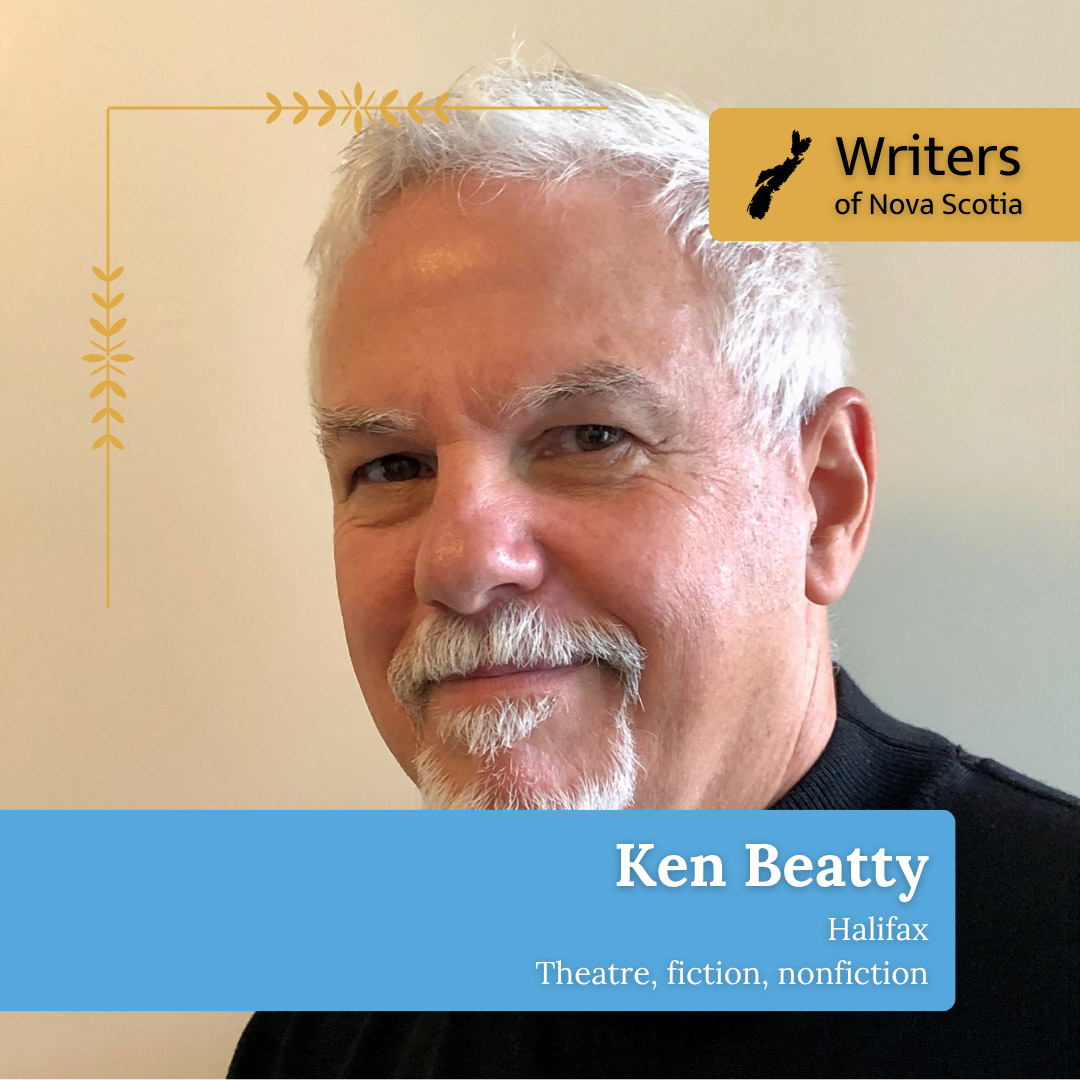
Ken Beatty, winner of the $10,000 2025 Lee Playwriting Prize for New Canadian Plays, completed an MFA in Theatre and a PhD in Applied Linguistics and spent a third of his life wandering abroad while writing 152 readers and textbooks.
What’s your current work-in-progress?
The Book of Judith, a monstrous full-length play set across 3,000 years, exploring deceptions, decapitations, crocodiles, and artificial intelligence. Also searching for theatres to produce my recent adult play, War Artist, and my children’s play, Zoe and the Lost Zeppelin.
What’s the best writing advice you’ve ever received?
Write, finish, submit. Most people have ideas, but don’t write. When they do, they don’t finish. When they finish, they’re too shy to submit, revise, and submit again and again when facing rejection. Also, I’m told all editors are gods.
When did you first realize that stories matter?
At age 7, I played Frosty the Snowman before confused kindergarteners who mistook my costume, drowning out my feeble song with shouts of “Ghost! Ghost!” Audiences matter: our stories are reimagined, expanded, personalized, and sometimes misinterpreted by those who read or hear them.
Any recommendations for NS writers & readers?
Halifax Central Library is my happy place. I go often but seldom use the card catalogue, instead drifting indolently along shelves, discovering remarkable treasures: old books on new topics. How did I not know about this amazing wild thing?
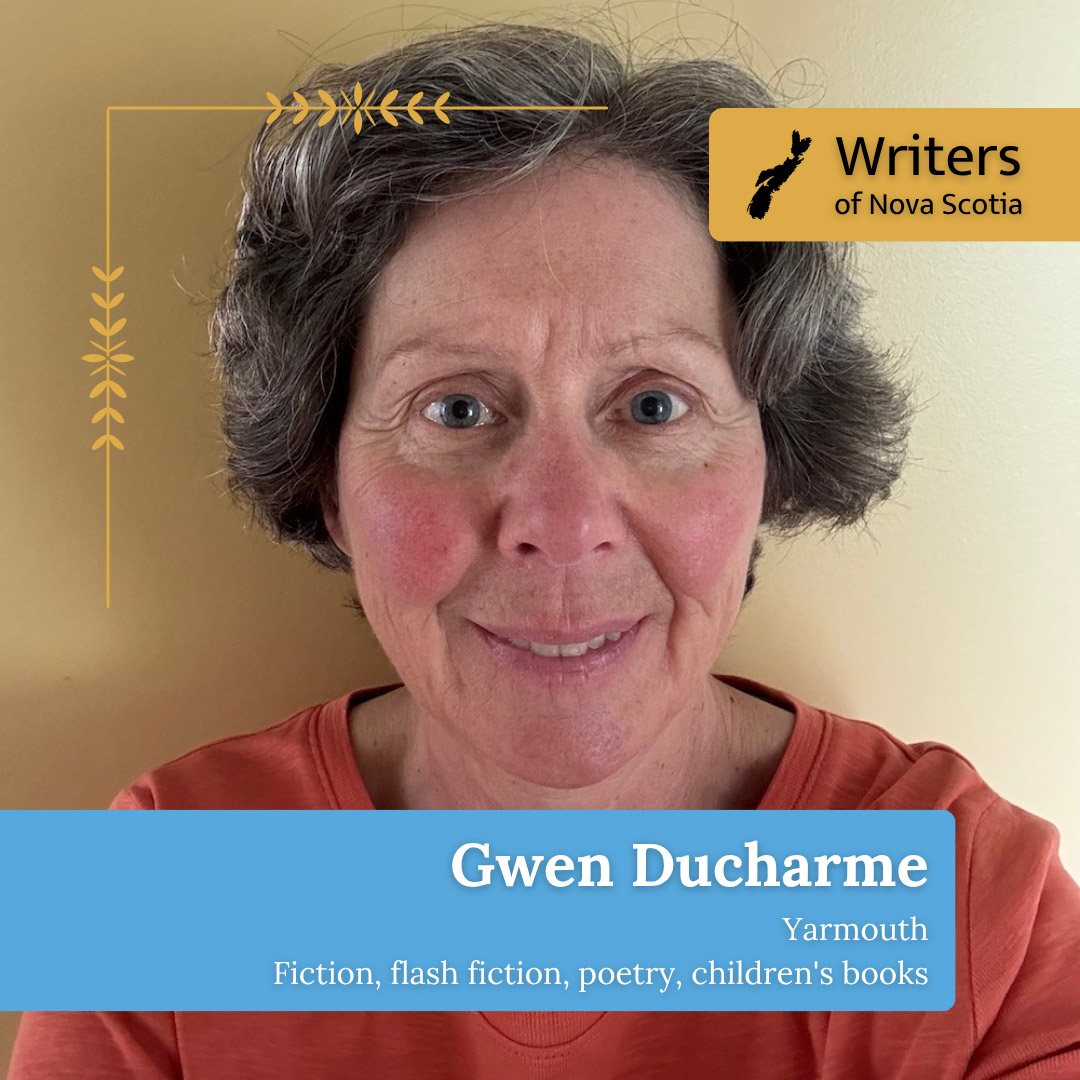
A self-taught emerging writer, Gwen Ducharme loves the craft of writing. Now retired, she hones her storytelling skills. She possesses a strong voice and strives to bring life to her stories and poems.
What’s your current work-in-progress?
Eight years ago, I wrote my first short story. I’ve recently re-written it to incorporate the things I’ve learned. I am very pleased with the result and am now developing it into a novella or perhaps even a novel.
What’s the best writing advice you’ve ever received?
Just write. You have a strong voice.
What’s a surprising source of inspiration for you?
Everything inspires me. I have a million ideas. Even if I live to be one hundred years old, and I hope I do, I will not be able to write all the stories and poems that cross my mind.
Any recommendations for NS writers & readers?
Brenda Levy Tate. Her support and guidance has sparked my confidence. Always receptive to reading through my work, her thoughtful and precise feedback has allowed me to flourish. She has a ton of knowledge that she happily shares. A treasure.
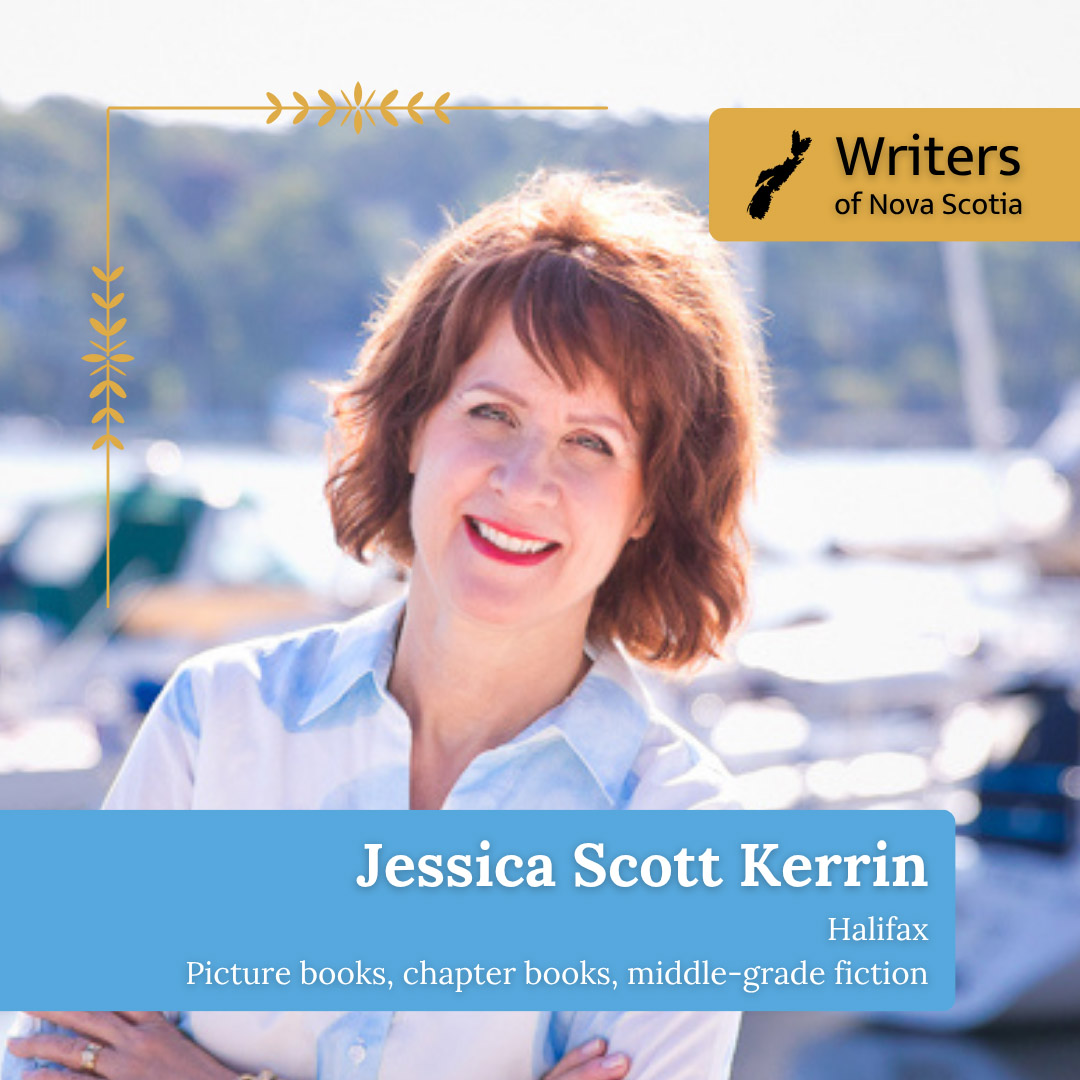
Upon graduating from the Nova Scotia College of Art and Design, Jessica Scott Kerrin pursued a writing career that now includes sixteen traditionally published bestsellers of children’s fiction. She has also served on juries including the Governor General’s Literary Award.
What’s your current work-in-progress?
I’m working on a middle-grade novel about two siblings lost in the woods (unaware that a bear is tracking them); a picture book about an elderly woman adopting a dog; and my new Substack newsletter where I write children’s book reviews.
What’s the best writing advice you’ve ever received?
Keep going. It only takes one “yes.”
When did you first realize that stories matter?
Once I discovered characters with whom I could identify (and, therefore, not feel so alone), I’d happily stand in line, even in Edmonton’s deep winter, waiting for my turn inside our neighbourhood bookmobile.
Any recommendations for NS writers & readers?
The Funny Pages Festival brings talented children’s authors from across Canada to entertain our young readers—for free! Chair of the Board, Vicki Grant, believes that humour can introduce even the most reluctant reader to the joy of books.
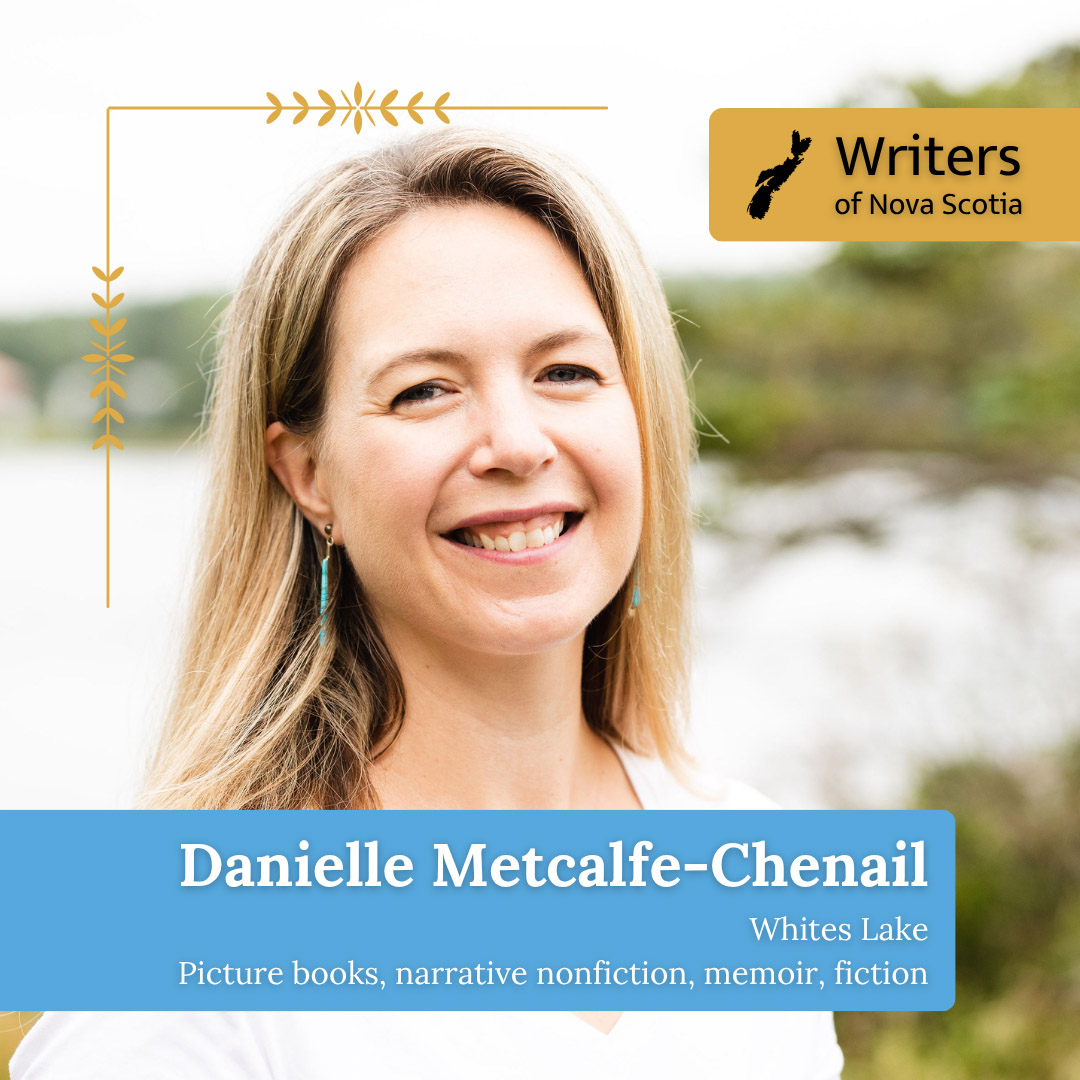
Danielle Metcalfe-Chenail is the award-winning author of eight books for children and grownups. She was Historian Laureate for Edmonton; Writer-in-Residence for Berton House in Dawson City, Yukon; and Maverick of the Year in Chatelaine Magazine.
What’s your current work-in-progress?
I’m working on a picture book about the first female pilot in PEI and the first woman in Canada to buy an airplane, Louise Jenkins. I love telling stories about pioneers who can inspire new generations!
What’s the best writing advice you’ve ever received?
The middle is messy; it’s also where the magic happens. That’s from Brene Brown, one of my all-time favourite researchers, speakers, and writers. I also love my writing mentor Rachael Herron’s idea of emotional regulation being the key to writing.
What’s a surprising source of inspiration for you?
I’m actually pretty woo-woo despite my academic background and practical nature, so I have tapped into many spiritual traditions and rituals on my writing journey. If it doesn’t hurt anyone, I say give it a go!
Any recommendations for NS writers & readers?
I adore AfterWords Literary Festival’s Kidsfest—both attending with my kids to see my favourite local and visiting authors and getting to be part of it when my book Freddie the Flyer came out. The organizers are so kind and supportive!
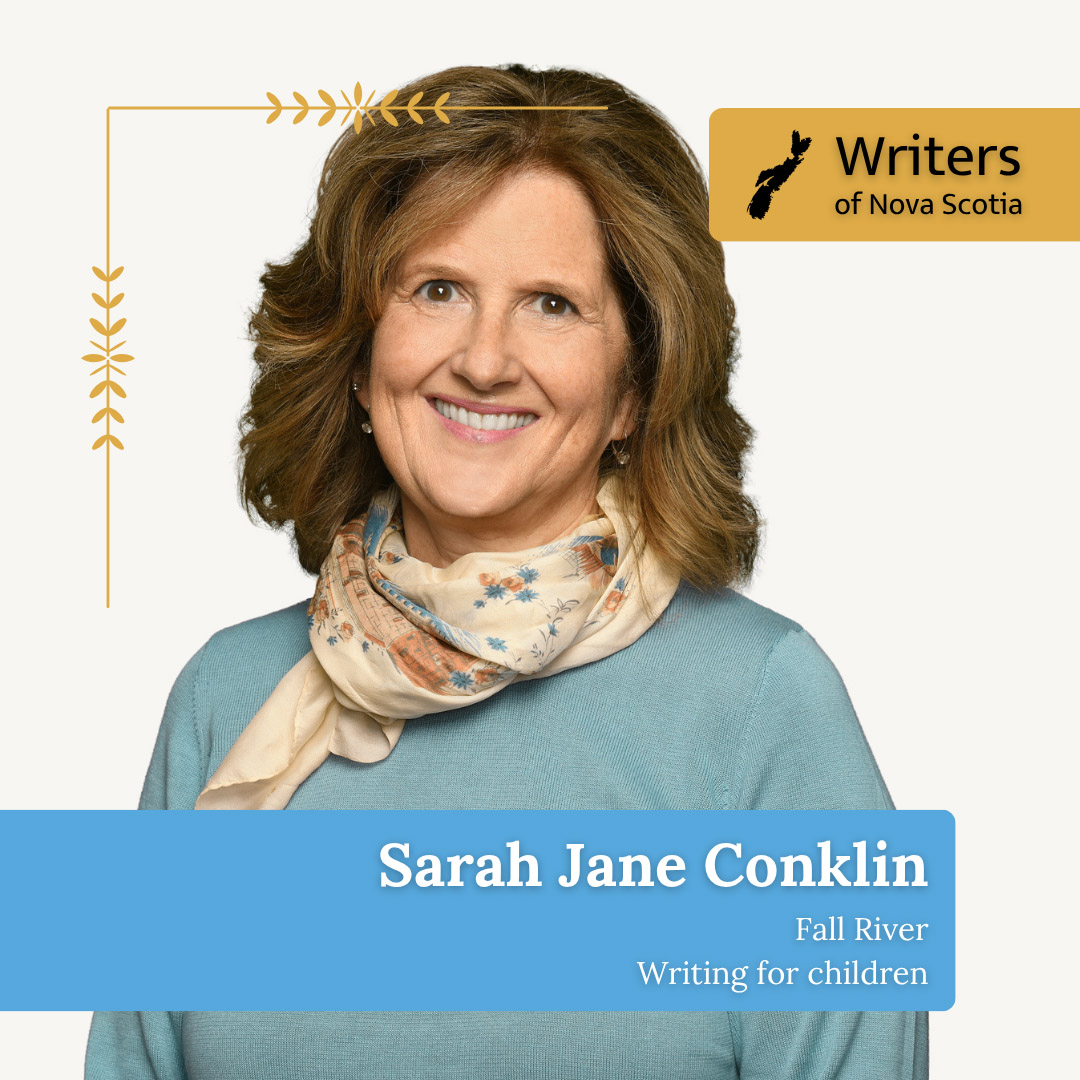
Sarah Jane Conklin is an artist and children’s book author. She writes gentle, lyrical picture books about emotional growth and everyday magic—stories without villains, where kids learn through connection and self-discovery.
What’s your current work-in-progress?
I am looking forward to my book What’s in Cedric’s Treasure Chest? coming out in the fall of 2026. It’s the third book of a series, following What’s in Flora’s Shoebox? and What’s in Alanna’s Secret Sauce?.
What’s the best writing advice you’ve ever received?
The best advice I’ve received is to carry a notebook. I also keep one beside my bed for those middle-of-the-night ideas.
What’s a surprising source of inspiration for you?
I’m a magical thinker inspired by what is in front of me: my grandchildren, nature, and wildlife. Inspiration also comes from my childhood memories, hopes and fears.
Any recommendations for NS writers & readers?
Sheree Fitch is an author that I’ve followed for many years. Her lyrical children’s stories are full of heart and laughter, appealing to children and adults alike.