
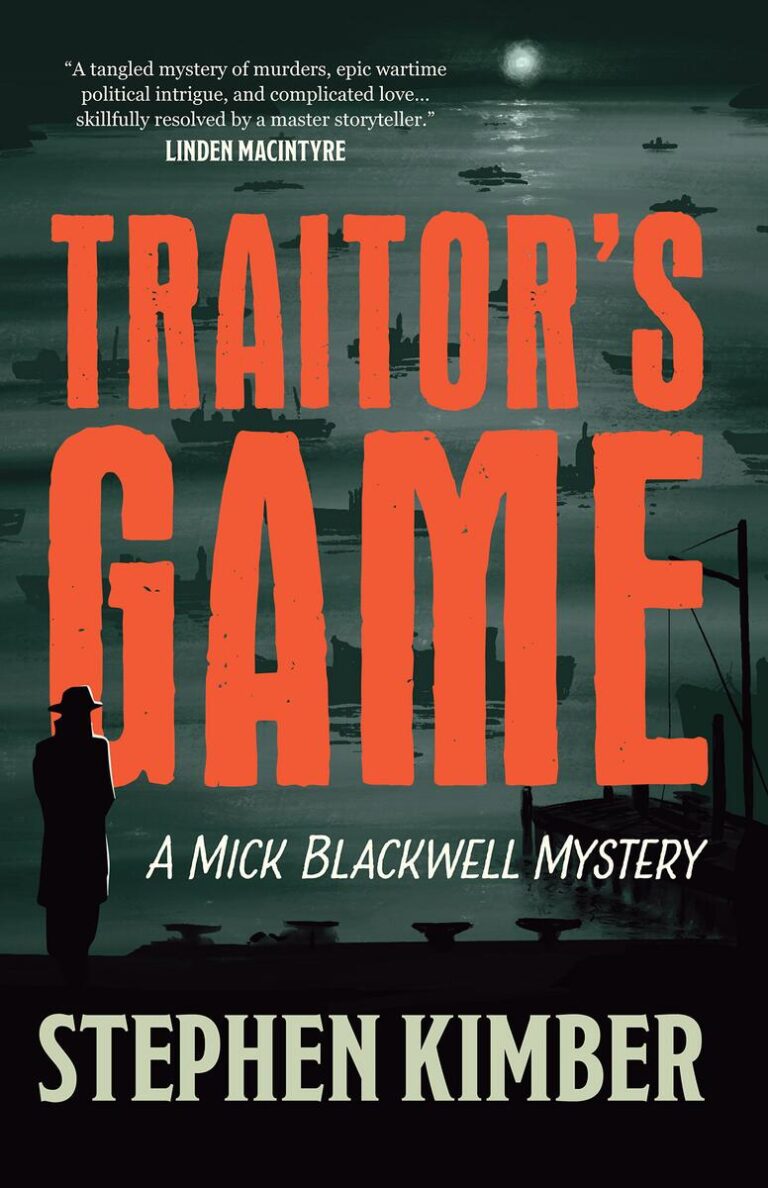
Stephen Kimber launches Traitor’s Game

Date:
Time:
-
Location:
University of King's College - KTS Room, 6350 Coburg Road, Halifax, NS, B3H 2A1

Returning to the world of his non-fiction account Sailors, Slackers and Blind Pigs: Halifax at War, award-winning journalist Stephen Kimber’s Traitor’s Game is a propulsive, clever, and atmospheric work of noir fiction, and the first in an enthralling, character-driven World War II noir detective mysteries set in Halifax, Nova Scotia.

It is the summer of 1940 in Halifax, Nova Scotia, a city that has become a bustling strategic port for the war raging in Europe. In a wealthy South End neighbourhood, the daughter of a local Royal Navy commander has been found murdered. Her father, the number-one suspect, and mother are missing. To complicate matters for Police Detective Mick Blackwell—a “shell shocked” veteran of World War I—the Royal Navy has claimed jurisdiction over his investigation.

On the other side of the Atlantic, British Prime Minister Winston Churchill has green-lit Operation Fish, an audacious gamble to ship Britain’s entire gold reserves across the U-boat-infested North Atlantic to Halifax to prevent them from falling into Hitler’s hands.

Blackwell must somehow connect the dots from his off-the-books investigation back to Operation Fish, solve more than one murder, and foil a Nazi plot.

Stephen Kimber is an award-winning Canadian journalist, writer, editor, broadcaster, and educator. He is the author of fourteen books, including two novels and twelve nonfiction works. Kimber is a former Director of the School of Journalism, Writing & Publishing at the University of King’s College in Halifax and co-founded the King’s Master of Fine Arts in Creative Nonfiction and Fiction programs. In 2023, he was named to the Order of Nova Scotia, the province’s highest civilian honour for his “contributions to the life and people of the province through literature, journalism and academia.”

Scroll to Top

Experience Levels

The Writers’ Federation of Nova Scotia (WFNS) uses the following terms to describe writers’ experience levels:

  • New writers: those with less than two years’ creative writing experience and/or no short-form publications (e.g., short stories, personal essays, or poems in literary magazines, journals, anthologies, or chapbooks).
  • Emerging writers: those with more than two years’ creative writing experience and/or numerous short-form publications.
  • Early-career authors: those with 1 or 2 book-length publications or the equivalent in book-length and short-form publications.
  • Established authors: those with 3 or 4 book-length publications.
  • Professional authors: those with 5 or more book-length publications.

Please keep in mind that each form of creative writing (fiction, nonfiction, poetry, writing for children, writing for young adults, and others) provides you with a unique set of experiences and skills, so you might consider yourself an ‘established author’ in one form but a ‘new writer’ in another.

Occasionally, WFNS uses the phrase “emerging and established writers/authors” to mean ‘writers and authors of all experience levels.’

The “Recommended experience level” section of each workshop description refers to the above definitions. A workshop’s participants should usually have similar levels of creative writing and / or publication experience. This ensures that each participant gets value from the workshop⁠ and is presented with info, strategies, and skills that suit their experience. 

For “intensive” and “masterclass” workshops, which provide more opportunities for peer-to-peer feedback, the recommended experience level should be followed closely.

For all other workshops, the recommended experience level is just that—a recommendation—and we encourage potential participants to follow their own judgment when registering.

If uncertain about your experience level with respect to any particular workshop, please feel free to contact us at communications@writers.ns.ca