
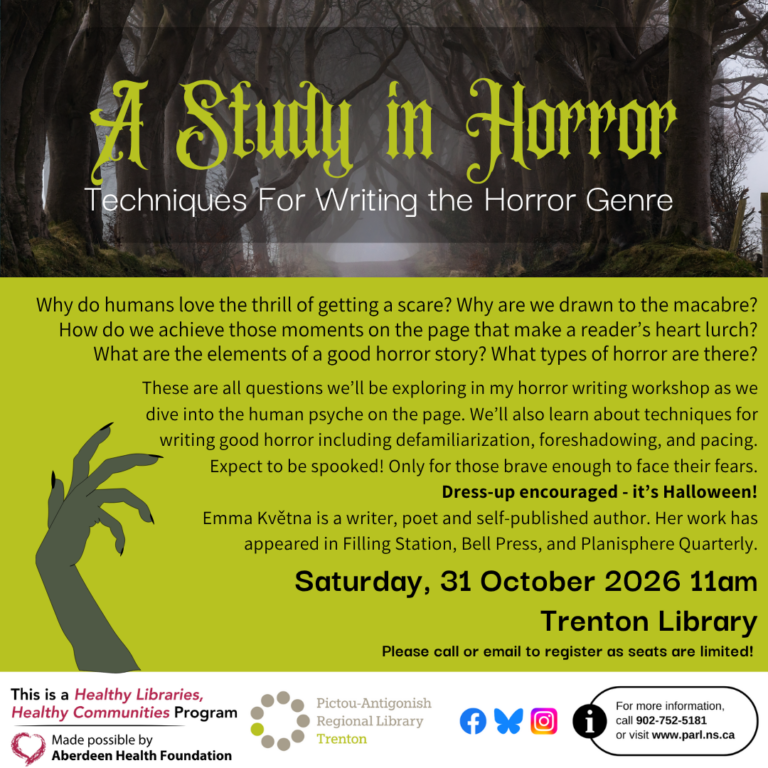
A Study in Horror: Techniques for Writing the Horror Genre

Date:
Time:
-
Location:
1 Forge Street, Trenton. More info
Calendar:

Why do humans love the thrill of getting a scare? Why are we drawn to the macabre? How do we achieve those moments on the page that make a reader’s heart lurch? What are the elements of a good horror story? What types of horror are there? These are all questions we’ll be exploring in my horror writing workshop as we dive into the human psyche on the page. We’ll also learn about techniques for writing good horror including defamiliarization, foreshadowing, and pacing. Expect to be spooked! Only for those brave enough to face their fears. Dress-up encouraged—it’s Halloween!

Emma Května is a writer, poet and self-published author. Her work has appeared in Filling Station, Bell Press, and Planisphere Quarterly.

This is a Healthy Libraries, Healthy Communities Program, made possible by the Aberdeen Health Foundation.

Please call or email to register, as seats are limited!

Scroll to Top

Experience Levels

The Writers’ Federation of Nova Scotia (WFNS) uses the following terms to describe writers’ experience levels:

  • New writers: those with less than two years’ creative writing experience and/or no short-form publications (e.g., short stories, personal essays, or poems in literary magazines, journals, anthologies, or chapbooks).
  • Emerging writers: those with more than two years’ creative writing experience and/or numerous short-form publications.
  • Early-career authors: those with 1 or 2 book-length publications or the equivalent in book-length and short-form publications.
  • Established authors: those with 3 or 4 book-length publications.
  • Professional authors: those with 5 or more book-length publications.

Please keep in mind that each form of creative writing (fiction, nonfiction, poetry, writing for children, writing for young adults, and others) provides you with a unique set of experiences and skills, so you might consider yourself an ‘established author’ in one form but a ‘new writer’ in another.

Occasionally, WFNS uses the phrase “emerging and established writers/authors” to mean ‘writers and authors of all experience levels.’

The “Recommended experience level” section of each workshop description refers to the above definitions. A workshop’s participants should usually have similar levels of creative writing and / or publication experience. This ensures that each participant gets value from the workshop⁠ and is presented with info, strategies, and skills that suit their experience. 

For “intensive” and “masterclass” workshops, which provide more opportunities for peer-to-peer feedback, the recommended experience level should be followed closely.

For all other workshops, the recommended experience level is just that—a recommendation—and we encourage potential participants to follow their own judgment when registering.

If uncertain about your experience level with respect to any particular workshop, please feel free to contact us at communications@writers.ns.ca