

Author Spotlight: Gabriel Milhet, 2026 Ellemeno Prize recipient
Recipient of the 2026 Ellemeno Visual Literature Prize, Gabriel Milhet is an African Nova Scotian writer. He is a winner of the 2025 Varma Prizes in Gothic Literature. His research appears in Intersections and Canada’s History and is forthcoming in The Canadian Encyclopedia and Findings / Trouvailles. His poetry is forthcoming in The White Wall Review and The South Shore Review.
Below is Gabriel’s winning poem, “Researching the Life of Gabriel Hall (to 1824): Farmer, Freedom Fighter, and a Black Refugee of The War of 1812,” which responds to a photographic portrait of Gabriel Hall (1892) taken by George H. Craig.
Following the poem is Gabriel’s artist’s statement and an interview conducted by Sonja Boon, last year’s Ellemeno Prize recipient and a member of this year’s selection committee.
"Researching the Life of Gabriel Hall (to 1824): Farmer, Freedom Fighter, and a Black Refugee of The War of 1812"
Gabriel Milhet
I.
For Gabriel Hall
I look into his eyes and see
the Chesapeake rice-field escape,
the hemlock hull harboring his shadow,
the rusted promises chained to him—
to all of them.
My eyes take shape,
the scar-splintered archive
assembles my body—
as history seeps into my bones
writing me in its hand.
II.
“I’m going to write about Gabriel Hall,”
I say to my mother.
She keeps doing what she is doing.
“From the War of 1812.”
She doesn’t look up.
“Is that one of those old stories?”
I wait.
“You’ll never find much,” she says.
“They didn’t keep records for people like that.”
“And if they did,” she adds,
“don’t believe a word that they say,”
before changing the subject.
“The old people always told us that.”
III.
Archives
Sources to consult:
– MG 15, “Ethnic Groups” (formerly “Negro Papers”)
– MG 100, Volume 44, Miscellaneous Manuscripts concerning
“Negroes sent to Halifax during the War of 1812”
– Miscellaneous, “Blacks”
(III. a.
Ages recorded:
inconsistent
Status:
amended
Handwriting:
illegible
*Margins used
for later correction.)
IV.
A PROCLAMATION by the Honourable Sir Alexander Cochrane, April 1814
This is therefore to give notice,
That all those who may be disposed to emigrate from the
United States, will, with their families, be received on
board His Majesty’s Ships or Vessels of War, or at the
Military Posts that may be established, upon or near the
Coast of the United States, when they will have their
Choice of either entering into His Majesty’s Sea or Land
Force, or of being sent as FREE Settlers, to the British
Possessions in North America or the West Indies, where
they will meet with all due encouragement.
V.
The Acadian Recorder
3 September 1814
“Ship News:
Thursday, Sept. 1—
H.M Brig Jaseur, Capt.
Watt, 10 days from
the Chesapeake; also
a transport with a few
hundred Negroes
(dead and alive).”
(V. b.
Marlborough,
San Domingo,
Ganon,
Mariner,
Fox,
Diomede—
recorded as arrivals.
Harbingers of salvation.
The tickets: tomorrow.)
VI.
Return of [B]lack people at Halifax arrived from the Chesapeake,
Autumn 1815
“[we hereby acknowledge the receipt of one
‘Gabriel Hall’
a Boy
from 1 to 13
years old.
he comes without
family
or
friends
as do forty-four others
such is the oppression
we
have liberated them from.
we sincerely hope
that he can
make something of himself—
(against the afflictions of nature,
opposition,
and abuse at our hands) ¹
unlike those lazy loyalists
and murderous maroons
who quitted to Sierra Leone.]”
VII.
Halifax List:
Return of American Refugee Negroes who have been received into the Province of Nova Scotia
between 27 April 1815 and 24 October 1818
“Hammond, William”
a male
59 years of age
“Hammond, Wife of William”
a female
40 years of age
“Hammond, Child of William”
“Hall, Gabriel”
a male
17 years of age
“Higans, William”
a male
38 years of age
VIII.
Lost Chapter, 1818-1824
deemed
too adolescent
for allocation,
left destitute by the liberators;
alone
he struggled against sterile soil,
downpours,
and merciless mice—
refusing to give.
IX.
Claim of Walter Wells, Case 113
“[my boy
was born around 1801
on my plantation
in Calvert County,
Maryland
he was always treated good
stout fellow
valued accordingly at
600 dollars
he could see the boats
down the Patuxent
and ran off with
James Duke’s,
mine, and Jenny—
no-good wench]”
(IX. b.
Department of State Compensation Commission
“[next…
to Mr. Walter Wells, esq.,
we herewith award the sum of
$840
for the loss of his three slaves—
for loss of property
next…]”
X.
Petition on behalf of the black people at Preston and Hammonds Plains
“[we,
the (white) gentry of Halifax,
humbly sheweth
that the extreme poverty of the
Black immigrants
calls aloud for relief
these poor people lack
food,
shelter,
clothing,
and
will not
have the means of growing seed—
although much has been done
by his Majesty
in distributing bedding among them]”
XI.
Memorial of Gabriel Hall, 1824
“he has no means of making a living
but
by husbandry”
XII.
XIII.
Claim of Walter Wells, Case 113. Case Files, compiled ca. 1827 – ca. 1828, documenting the period ca. 1814 – ca. 1828. *ARC Identifier 1174160 / MLR Number PI 177 190*. National Archives, College Park.
“Halifax List.” African Nova Scotians: in the Age of Slavery and Abolition. Nova Scotia Archives (hereafter NSA).
“Return of black people at Halifax arrived from the Chesapeake,” Commissioner of Public Records NSA RG 1 vol. 305 no. 7 (microfilm no. 15387).
“Memorial of Gabriel Hall of Preston,” Commissioner of Crown Lands NSA RG 20 series A, vol. 90 (1824) (microfilm no: 15737).
Whitfield, Harvey Amani. Blacks on the Border: The Black Refugees in British North America, 1815-1860. Hanover, NH: University Press of New England, 2006.
¹ Reference to Lord Dalhousie to Earl Bathurst, 14 August 1817. Almost a year after his (now) infamous “slaves by habit and education” musing, Dalhousie, upon visiting several refugee settlements, wrote: “almost every man had one or more Acres cleared and ready for seed & working with an industry that astonished (him)—against difficulties of nature almost insurmountable & opposed, abused & cheated by the old Settlers near whom they had been placed.” It is important to note that Lord Dalhousie was very erratic in his treatment of the Black Refugees.
Artist's statement
My poem “Researching the Life of Gabriel Hall (to 1824): Farmer, Freedom Fighter, and a Black Refugee of The War of 1812” responds to a photo of Gabriel Hall taken by photographer George H. Craig in March, 1892. It is the only known image of an African American refugee who came to Nova Scotia after the War of 1812.
In my article “Setting the Record Straight: Colonialism, Biographies & History’s Accountability to the Enslaved” (which appears in Intersections 8.3, a publication of the Canadian Historical Association), I argued that the archive itself is designed to preserve the voices of powerful members of the predominant group (drawing on research done by Stefanie Slaunwhite and Stefanie Hunt-Kennedy). This poem highlights the violence of colonialism by reconstructing Gabriel Hall’s life through primary sources that scholars have used to capture it.
The poem is composed almost entirely from documentary fragments: petitions, claims, newspapers, compensation records. Sections devoted to research processes and archival consultation are demonstrations of what some may deem a systemic failure, but what I would argue is a structural success. What emerges is a system that consistently records ownership, loss of property, and benevolence more clearly than Black survival. I have deliberately avoided imagined interiority — what Saidiya Hartman coined “critical fabulation” in her article “Venus in Two Acts” — for historical silence. Gabriel Hall speaks only where the record permits him to speak; under conditions that require justification for subsistence rather than recognition of humanity. In contrast, enslavers and state institutions speak fluently, are named, and are compensated. This asymmetry is not corrected by the poem; I chose to repeat this logic.
Ultimately, Gabriel Hall is the refugee who we know the most about; the archive — and its logic — has swallowed the others.
Interview with Gabriel Milhet
Sonja Boon (2026 Ellemeno Prize selection committee member): As a committed archives nerd and someone who is interested in lost, hidden, and silenced stories, I was struck by your poem on a number of levels. What resonated particularly strongly is your use of space, which evokes silences and silencing, while also making room for possibly hidden voices to burble up. Can you speak more about the power of silence as a response to erasure, and how you experienced this while writing your poem?
Gabriel Milhet (2026 Ellemeno Prize recipient): This is a very thought-provoking question. I will apologize in advance for my enthusiasm; it manifests through my wordy (and sometimes garrulous) writing.
For me, the silence in the poem—especially the near-complete absence of Gabriel Hall’s voice—represents refusal. It refuses to let the record speak as if it is complete. The spacing, as you probably ascertained when judging, was used intentionally to emphasize the power-imbalance(s) of the archive. Sometimes spacing was used to emphasize the minimal control that the Black Refugees had over their circumstances (not their responses to the circumstances); the dire conditions of their immigration (i.e., “he comes without/family/or/friends/as do forty-four others); white benevolence (i.e., “we/have liberated them from”); hierarchical and gendered violence within slavery (i.e., “James Duke’s/mine/and Jenny—no-good wench”); the commodification of black bodies (i.e., “$840… for loss of property); and sometimes spacing was (not) used to preserve colonial voices.
The blank paragraph in particular was inspired by Shannon Webb Campbell’s poem “Her Eros Restored,” which won the inaugural Ellemeno Visual Literature Prize. It was strategically placed to force readers to imagine what Gabriel Hall’s life might have looked like beyond the documents. And what does this imagining tell us about the archive and how it was constructed?
For me, writing the poem was a counter-archival, counter-hegemonic practice. I take a great deal of inspiration from M. Nourbese Phillip and her magnum opus, Zong!, where silence and fragmentation is used to subvert the ordering of grammar and structure; what Phillip dubs the “impulse of empire.” I too wanted to hold that absence in place to make the limits of the archive apparent.
SB: In your artist’s statement, you write, “Sections devoted to research processes and archival consultation are demonstrations of what some may deem a systemic failure, but what I would argue is a structural success. What emerges is a system that consistently records ownership, loss of property, and benevolence more clearly than Black survival.” Can you speak more about this? Are there risks to repeating the logics of the colonial archive—and if so, how do you see your work pushing back against them?
GM: I think of section III of my poem, Archives. The titles of those bullet points: “Ethnic Groups (formerly Negro Papers),” “Miscellaneous Manuscripts concerning Negroes sent to Halifax during the War of 1812,” and “Miscellaneous, Blacks” are how Black lives appear at the Nova Scotia Archives. Not two hundred years ago: today. There do remain references to Blacks that appear in the “Biography” section, among others, but they are few and far between. For many visitors—or the untrained—these headings are the primary point of entry to African Nova Scotian history.
I argue “structure” frequently because most issues are structural. Archives are reflections of societies that create them. Many collections we consult today were completed when Black lives were deemed disposable, Black servitude ubiquitous, and Black autonomy non-existent. Why record their history? (I cannot speak for other groups). This constitutes structural success. If you were a colonial official who harboured wholly racist notions, wouldn’t you consider this—that Black history, whether it be triumph or defeat, was, and remains, hardly recorded (even hundreds of years later)—a success? What about the “progressives,” who held sympathetic (paternalistic) views? Their efforts, it would appear, in welcoming the “Negroes” who were sent to Halifax haven’t been forgotten by posterity. (Emphasis on the word “sent,” which removes the agency of people who performed many acts of defiance before arriving, including the initial abscond and fighting alongside the British.)
The danger associated with engaging the archive is recreating its violence. The nature of the sources that do exist tend to record eurocentric values (property ownership, tax assessments, etc). The sparse sources that do illuminate the “everyday lives” of socially marginalized peoples are themselves violent, typically court records. Do we—as writers, researchers—want to solely highlight the negative? (To remediate the lack of voice?) Do the positives of this action for the subject of research outweigh its pernicious effects on communities today? In her seminal essay “Venus in Two Acts,” Saidiya Hartman (whose work I draw on extensively) articulates my logic succinctly: “How does one revisit the scene of subjection without replicating the grammar of violence?” It is very tricky as you can imagine.
I see my work as an indictment of the structure itself, rather than as an indictment of those who edified said structure or participated in the violence frequently written about.
SB: I’m interested in form: you chose to write a poem to respond to the photograph of Gabriel Hall. Why poetry? What does poetry make possible that a more traditional narrative form might not? What would have changed if you’d chosen creative nonfiction or short story instead?
GM: Well, this may be too forthright, but poetry is my only art form. The choice was that simple; I was limited by options. It worked out great, I guess! I really wanted to tell Gabriel Hall’s story—rather than a story about Gabriel Hall—and felt that poetry would be the best medium. Poetry offers much more flexibility in its structure compared to a more traditional narrative form (given the contemporary insistence on free verse). Other forms—I imagine—with their rigidity would force stricter creative choices. I don’t think I would be able to oscillate between voices and perspectives as fluidly, from observer to son to researcher to narrator to Hall to Wells to the archive itself, and that was something that I had set out to do from the poem’s conception.
SB: In your artist’s statement, you reference Saidiya Hartman’s “critical fabulation.” Can you talk more about this, what you find appealing about this approach, and what it means for your work?
GM: The concept of “critical fabulation” is a critical methodological approach which blends historical research and imagination. (Think typical experience and its interactions with the environment.) It was first coined by Saidiya Hartman in her article “Venus in Two Acts” to describe the brutal murder of two enslaved girls aboard the Recovery. She sought—admirably—to move them beyond inert subjects of violence. “Picture them,” Hartman writes:
The relics of two girls, one cradling the other, plundered innocents; a sailor caught sight of them and later said they were friends. Two world-less girls found a country in each other’s arms. Beside the defeat and the terror, there would be this too: the glimpse of beauty, the instant of possibility.
Critical fabulation is derived from both “fabula,” the basic elements of a story, and the word “[to] fabulate,” which is defined as “[relating] (an event or events) as fable or story.” It allows scholars to tell “impossible stories” that the archive alone cannot convey.
I find critical fabulation appealing because it provides a framework for restoring people’s lives beyond fragments that the archive leaves behind. I think of the story of Mary Postell. For readers who don’t know, Mary Postell was an enslaved Black Loyalist whose life has received sustained scholarly attention because it illustrates the ways in which Black people attempted to negotiate their way out of bondage. In 1791, Mary Postell went to the court and “Complained against Jesse Gray, of Argyle, for taking away her children.” The most damning line from her affidavit—which highlights Gray’s grotesque (mis)treatment —was: “when asked ‘if she made any objection to… Jesse Gray selling her to Mr. [Mangrum],’ she says that she did not, because she was glad to get out of his Service, [for] he used her so ill.”
The line has always stuck with me.
Mary’s life—like so many others—appears in the archive primarily through violence. It is studied because of violence. It is remembered because of violence. Critical fabulation invites us to consider the life that existed beyond those moments: the ordinary experiences that never entered the record.
SB: Here’s the archives nerd question: Can you talk a bit more about what it might mean to be “captured” in the archives? How does your poem respond to this?
GM: Being “captured” in the archive, I think, is really a form of valuation. It means that some aspect of your life intersected with what the prevailing power structure considered worthy of recording. It typically manifests through the “great man” or “exceptional” orientation of history. I mean, who doesn’t love the story of two friends from different backgrounds who form an enduring friendship in the face of hardship; of wartime love and shotgun weddings; of a mentor who recognizes the potential in their struggling protege; of an ordinary person who harbours a vagrant; of the vagrant himself; or of the story of an immigrant who overcame all odds to become successful.
I am a sucker for it personally! I write a lot—like, my mom gets tired from hearing my daily “guess what” spiel a lot—about B.A. Husbands, who prolific historian Bridglal Pachai dubbed the “father of incipient Black politics in Nova Scotia.” He arrived in Nova Scotia as a destitute teenager from Barbados; by the end of his life, Husbands was made an Officer of the Order of the British Empire (O.B.E.) for distinguished patriotic service in the Second World War. The Canadian (American) dream!
Archives preserve what institutions valued. When marginalized people appear, it is often because they entered those structures in some way. (Husbands was heavily involved in promoting youth sports, for example.) My poem responds by foregrounding that logic rather than trying to escape it. The fragments, headings, and austere archival language show how recognition itself is structured—who becomes legible to the archive, and under what conditions.
SB: At the end of your artist’s statement, you write, “Ultimately, Gabriel Hall is the refugee who we know the most about; the archive—and its logic—has swallowed the others.” How might you, as a poet, respond to archival swallowing—a form of capture that is also cannibalistic? How would you write (or have you written) complete archival silence? Is it possible? Is it desirable? Why or why not?
GM: I think writing complete archival silence is impossible. Silences are all about perception. They only exist because we recognize them as such. We know there should be something there because records allow us to perceive the absence. Which documents have survived? Whose voices are preserved? The archive allows us the privilege of actively interrogating it in pursuit of the truth. The “true” silences are those completely unimaginable to us.
It is my view that attempting to write archival silence could become problematic. Humans are inherently egocentric. There exist many developmental theories built on the idea that we interpret the world through our own position and experience. Because of that, any attempt to represent silence is already an act of interpretation. Further, active engagement in any form of critical study is political and unquestionably teleological—it moves towards particular ends. Can we ever—objectively—imagine what someone lived through? Can we be honest in our imagining? I think not (or at least I can’t).
SB: Do you see this poem as a standalone work, or are you working on a series of poems that address similar themes?
GM: I see my poem as a standalone work. My eventual foray into academic history was what compelled me to start writing seriously and remains my principal focus. I am sure I will continue to write poems about similar themes along the way. That’s what all writers do when they encounter new material.
Congratulations to the four artists and writers named as finalists for the 2026 Ellemeno Visual Literature Prize: Shelagh Howard, Basma Kavanagh, Gabriel Milhet, and Rebecca Wilson.
The annual Ellemeno Prize celebrates creative cross-pollination between the literary arts and the visual arts. The selected writer or artist receives a cash prize ($250) along with digital publication of their work and a featured interview on the Writers’ Federation of Nova Scotia website.
The 2026 Ellemeno Prize recipient will be announced on March 12.
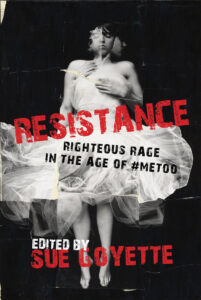
Finalist Shelagh Howard’s long-exposure photo series, The Secret Keepers, responds to the poetry anthology Resistance: Righteous Rage in the Age of #Metoo (University of Regina Press, 2021), edited by Sue Goyette.
Shelagh Howard (b. 1971) is an award-winning photo-based visual artist whose work delves into the layered terrain of selfhood, interrogating themes of gender, trauma, vulnerability, intimacy, and isolation. With an unflinching gaze, she peels back the surfaces of constructed identity to reveal the tenderness beneath. Her images thread motion and stillness, capturing the ephemeral shadows of the self and offering a fleeting glimpse of what lingers behind our carefully assembled facades. She studied psychology at The University of Toronto and photography at Ryerson University. She lives, works and befriends crows in Halifax, Mi’kam’ki, Nova Scotia.
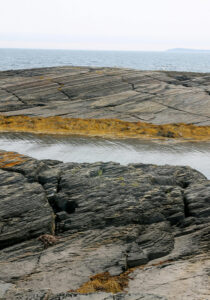
Finalist Basma Kavanagh’s textile work, Untitled (Tidelines embroidery), responds to an unpublished short poem by fellow Nova Scotian poet Sean Howard.
Basma Kavanagh is a Lebanese Canadian artist whose multidisciplinary practice includes writing, drawing, printmaking, artist’s books, textiles, land-based explorations, performance, and scholarly work. She has published three volumes of poetry, Ruba’iyat for the Time of Apricots (Frontenac House, 2018), Niche (Frontenac House, 2015) and Distillō (Gaspereau Press, 2012). She has an MFA in Creative Nonfiction from University of King’s College, Halifax, and her nonfiction work has been recently anthologized in Best Canadian Essays 2026. She currently lives in Nova Scotia, in the Kespukwitk region of Mi’kma’ki.
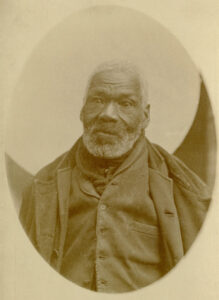
Finalist Gabriel Milhet’s poem, “Researching the Life of Gabriel Hall (to 1824): Farmer, Freedom Fighter, and a Black Refugee of The War of 1812,” responds to a photographic portrait of Gabriel Hall (1892) taken by photographer George H. Craig.
Gabriel Milhet is an African Nova Scotian writer. He is a winner of the 2025 Varma Prizes in Gothic Literature. His research appears in Intersections and Canada’s History and is forthcoming in The Canadian Encyclopedia and Findings / Trouvailles. His poetry is forthcoming in The White Wall Review and The South Shore Review.
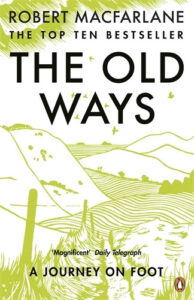
Finalist Rebecca Wilson’s watercolour painting, Desire Paths, responds to Robert McFarlane’s The Old Ways: A Journey on Foot (Penguin Books, 2012).
Rebecca Wilson is an artist from Bedford, Nova Scotia, who works primarily with watercolour paint. Working in an illustrative and folk-art inspired style, she engages with themes of memory, community, and nostalgia in her art. Her background in academic research comes through in the theses of her paintings, which often engage in conversation about history, literature, and personal identity as it ties into time and place.